Second Dark Age
Last and First MenThe Second Dark Age is the ten-million-year eclipse of human mental development that followed the brief civilization rebuilt after the First World State fell. Its scale makes it more than an aftermath: after humanity’s first recovery from savagery, a final planetary catastrophe again plunged mind into dormancy, extending the darkness for ten million years.
Definition and Historical Scale
The book distinguishes two long periods of human decline. The First Dark Age lasted about one hundred thousand years, ending only when humanity struggled from savagery through barbarism back into civilization. The Second Dark Age came after that civilization’s short-lived renaissance. Its duration—ten million years—was a hundred times that of the earlier eclipse.
This chronology is set against a much larger frame: the narrative moves from the history of the First World State into a period almost five thousand years after Newton, then surveys roughly 115,000 years before turning to the next ten million. The Second Dark Age is thus both a named historical age and a decisive change in the book’s scale, carrying human history beyond a span that can be measured by ordinary political or civilizational cycles.
The Collapse Behind the First Eclipse
The First World State fell when its coal supplies failed. Its original fields had been exhausted centuries earlier; for thousands of years, the main supply had come from Antarctica, whose richness fostered the belief that it could not run out. When reports finally disclosed that even the deepest borings had found no further vegetable deposits, the public initially refused to believe them.
The crisis had roots in earlier choices about energy and power. The League of Nations had imposed cosmopolitan control over oil and coal after a severe oil famine, and restricted oil to uses for which no other power source would serve. Later, newly accessible Antarctic fuel lay beyond the World Fuel Control Board’s jurisdiction: the United States sought to use it for national advancement, while China feared Americanization and pressed for international control. The fuel policy had helped postpone the exhaustion of coal, but that postponement became dangerous when the intelligence of the race had deteriorated and it could no longer manage the resulting crisis.
From the First Dark Age to the Second
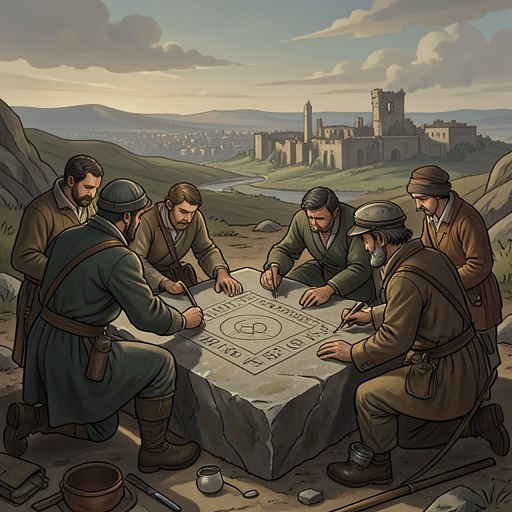
The coal failure was followed not by a quick recovery but by a hundred thousand years of near-total degradation. At the end of that First Dark Age, humanity rose again and achieved civilization, but the renaissance lasted only about fifteen thousand years. In its final agony, the planet was seriously damaged; mind then fell into deep slumber for another ten million years. That planetary injury and ensuing mental dormancy define the Second Dark Age in the account, though the narrative does not specify the particular conditions of life throughout its immense duration.
The contrast between the two ages matters: the first is the long descent and partial re-emergence after the World State’s collapse, while the second follows a renewed civilization and a later catastrophe. The sequence rules out a simple story of continuous progress. Recovery proves possible, but it does not secure humanity against another, far longer interruption.
Knowledge, Power, and the Long View
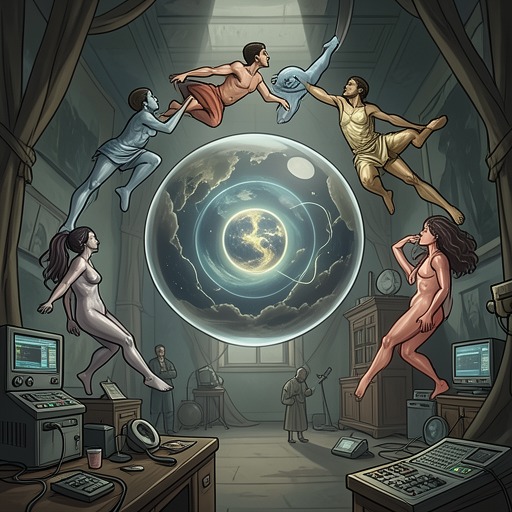
The brief renaissance preceding the Second Dark Age included a renewed pursuit of material power. After about five hundred years of intermittent research, Patagonian scientists found a way—requiring a vast initial expenditure of energy—to annihilate the positive and negative electric charges in one relatively uncommon kind of atom. The discovery offered an apparently inexhaustible, controllable energy source, but it was not foolproof: its users could still act foolishly or let it escape their control. Its arrival shortly before the later planetary devastation sharpens the historical contrast between technical achievement and the fragility of civilization.
Far beyond the dark ages, the Fifth Men’s society draws unlimited power partly from artificial atomic disintegration and partly from the annihilation of matter into radiation. Their machinery performs transport, mining, manufacture, and agriculture, freeing people from routine labor. This distant technological world shows that the Second Dark Age is not the end of human history; it is an immense interval in a history that eventually recovers powers and forms of life beyond the comprehension of earlier humanity.