Second Men
Last and First MenThe Second Men are a successor human species whose history rises from biological renewal to long periods of cultural achievement, then to repeated catastrophe and a near-inconceivably prolonged failure to advance. They surpass the First human species in physical organization, cognition, and spontaneous altruism; yet their story is not a simple ascent. Their sympathy can unify a world, but religious division can turn that unity into civil war, and the same refinement that makes them capable of extraordinary social life leaves them vulnerable to disasters that repeatedly destroy it.
Emergence and physical nature
The Second Men appeared roughly ten million years after the Patagonian disaster. A wave of biological variations had first supplied promising new traits; over the following hundred thousand years, the new environment acted on this material until the species emerged. They were taller than their predecessors, with larger crania, massive necks, broad hands, and legs and feet strengthened for locomotion. Many retained the thick, blondish hair acquired during the First human species’ Siberian exile. Their appearance combined great physical scale with mobile, expressive features.
Their bodies were also more effectively integrated and maintained. They lacked several vestigial structures, had teeth unusually resistant to decay, and possessed tissues that repaired themselves more reliably than those of the earlier species. Development was slow: puberty began around twenty, maturity came at about fifty, and physical powers usually began to fail only around one hundred and ninety. Their mothers carried pregnancies for three years, nursed children for five, and remained sterile through those periods and for seven additional years. This long life and slow development gave the species a different temporal rhythm from its predecessors, though even the Second Men would eventually regard individual life as too brief.
Temperament, intelligence, and social ideals
The species’ defining changes were inward. Sexual interest extended beyond attraction between individuals into an intense appreciation of living forms more generally, while parental feeling broadened into an instinctive concern for any being understood to need help. Altruism, unusual among the First human species, became a normal passion. At the same time, possessive attachment and the drive to assert oneself against others were diminished. Private ambition alone rarely summoned a Second Man’s strongest effort; social purpose or personal love could do so.
Their intellectual abilities reinforced these dispositions. Their vision distinguished additional colors and finer differences within the visual field, while mental imagery and insight helped them grasp unfamiliar situations with a speed that the First human species could not match. Intelligence continued to develop into adulthood, and their more flexible wills could abandon habits once those habits no longer seemed justified. The species could therefore achieve, without the prolonged discipline required by its predecessors, both dispassionate judgment and a largely unreserved love of others. Its early religion of love appeared in different forms throughout its history. Yet rigorous reflection brought a recurring difficulty: the Second Men’s devotion to love coexisted uneasily with their admiration of fate.
This social nature was a strength and a constraint. The Second Men were comparatively free of the lust for personal power and ostentation that had helped drive earlier industrialism and militarism. They enjoyed long eras of peace and, at times, high culture. But they were less likely to undertake exhausting projects for private advancement. Their exceptional public sympathy could mobilize them for shared ends, while their preference for companionship, art, sport, and intellectual life could slow the wider effort to master their world.
Expansion and repeated cultural setbacks
Within a few thousand years, the Second Men spread from Afghanistan to the China Sea, across India, and into the new Australasian continent. Their expansion was primarily cultural rather than military. The remaining tribes of the First human species could not ordinarily interbreed with them and gradually disappeared as the newer culture surrounded them. The Second Men then moved from a largely pastoral existence toward agriculture and exploration. An expedition crossing the Hindu Kush into Africa encountered descendants of the ancient Siberian ship’s crew, who had spread through the Americas and across the Atlantic isthmus.
The encounter ended in a devastating epidemic. The descendants scattered infected nuts across Asia, carrying microbes to a population with no prior resistance. Pioneering settlements and much of the wider population were lost; civilization broke apart, leaving scattered, diseased survivors. The infection did not permanently extinguish the species. Within centuries, the Second Men had begun rebuilding, and a later expedition again crossed into Africa. By then the simian intelligence of the opposing population had disappeared: the animals formerly kept by the ape-descended peoples had rebelled against and consumed their masters.
For nearly a quarter of a million years, prosperity and decline alternated. A glacial epoch pushed Arctic conditions as far south as India, crowding the Second Men into the peninsula and reducing their culture to a rudimentary level. After recovery, bacterial epidemics repeatedly erased promising barbarian cultures and medieval civilizations. These setbacks interrupted development despite the species’ intelligence and capacity for renewal.
Civilizations, religious division, and the zenith
After long isolation, several great peoples encountered one another. Their differences demanded difficult cultural changes, sometimes accompanied by bloodshed, before a shared world order could be restored. That unity endured only for a few centuries. A monotheist nation attempted to impose its faith on a broadly pantheist world, and the Second Men entered their only world-wide civil war. Religious commitment made this conflict more brutal than their previous wars: citizen armies used crude artillery, laid waste to fields, burned cities, and poisoned rivers and winds. The war continued even after its destructiveness had become apparent. Its eventual collapse left the species burdened by a profound sense of betrayal and disillusionment, and a world-community did not return for thousands of years.
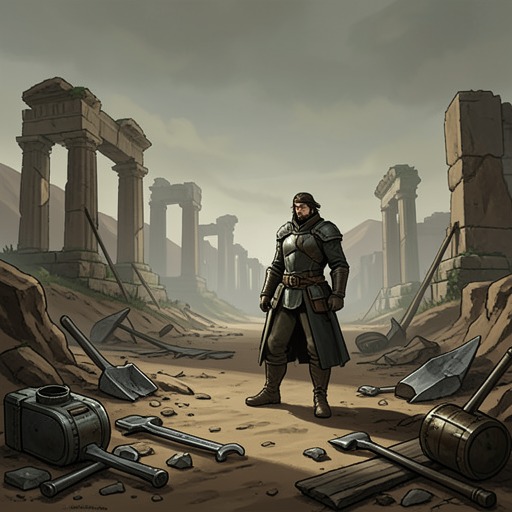
The third and most enduring civilization revived an earlier, idealized medieval culture and then developed a brilliant natural science. Chemical fertilizers increased crops and population; wind and water supplied electricity; and, after repeated failures, volcanic and subterranean heat could drive dynamos. Industrial development transformed daily life, but the Second Men avoided many of the economic errors associated with earlier civilizations. Their sympathy made other people’s lives vividly present to them, while their relative indifference to wealth reduced the impulse to accumulate private economic power. Mining and manufacture remained arduous, but the collective will to avoid industrial abuses was sincere.
At its height, this civilization respected individual personality while treating each generation as a stage toward more capable people in the future. The Second Men were disturbed by the shortness of individual life and by the limits that kept one mind from fully apprehending another. They wanted greater natural longevity and more complete understanding between persons. Their culture thus joined profound attention to the individual with an ambition that reached beyond the individual’s lifetime.
The Martian invasions and their aftermath
The Martians invaded as the Second Men prepared a major venture in artificial evolution. They sought water and plant matter, and also came in a religious campaign to free terrestrial diamonds. Conditions on Earth made the invasion difficult: its dense atmosphere restricted the Martians’ movement and vital processes, while the oxygen caused them distress. The conflict exposed a deeper obstacle than physical environment: each species struggled to understand the other’s mentality.
The first invasion ended with the Martians’ defeat, but their dispersed subvital remains became an ultra-microscopic infection. The infection disrupted human tissues, leaving the population weakened and the planet’s vegetation damaged across the war zones. Research eventually cleared the infection, but the generations already affected did not recover. Their reduced fertility left a small, healthy younger population alongside many ageing invalids. As the older generation lost the ability to work, its members agreed that those judged no longer competent should end their lives. The young initially resisted, both from affection and from fear of having to continue without their elders, but the decision was carried out one person at a time so that a smaller, vigorous population could rebuild.
Four centuries later the Martians returned. The cycle repeated: devastation, human victory, pulmonary plague, recovery, and voluntary deaths among the impaired. Over the following fifty thousand years, invasions recurred at irregular intervals. Each time the Martians adapted to humanity’s latest weapons, while attempts at negotiation failed because the Martians regarded human envoys as mere cattle of the terrestrial intelligence. They removed substantial quantities of water to Mars but repeatedly stayed to pursue their crusade until humanity found a way to defeat them. Human recovery became slower and less complete even as Mars was replenished.
The eventual catastrophe was more decisive. A lethal bacterium spread through the Martian colony and reached Mars; humanity, too, faced disease and the pulmonary plague left by the dead Martians. Expecting extinction, people ceased trying to save themselves. Public life disintegrated into apathy, households were left without help, and even the young were overshadowed by the expectation of death. A small, scattered stock survived in tropical regions, where the bacterium was less vigorous. This remnant preserved human life, but not the civilization or the confidence needed to rebuild it.
The long decline and historical significance
The surviving Second Men did not quickly recover. For roughly thirty million repetitions of the seasons, they remained nearly fixed in bodily and mental character. Their communities settled into indolent tropical lives; elders failed to pass on the knowledge of the past and instead impressed the young with a sense of defeat. The young, in turn, were innately incapable of enthusiasm. The species’ earlier spiritual disasters had become, in the account’s explanation, a condition transmitted into its inherited constitution.
This final stagnation completes the contradiction at the center of the Second Men’s history. Their intelligence, sympathy, and flexibility enabled expansive cultures and a sincere resistance to economic domination; none could guarantee recovery from epidemic, war, or accumulated despair. Their ability to see beyond private interest could inspire extraordinary loyalty, as in the decision of the stricken generations to relinquish their place to the young. Yet admiration of fate, religious certainty, and the lasting effects of defeat could also narrow the future. The Second Men remain a genuine advance over the First human species, but their long history shows that biological and moral improvement does not make a civilization invulnerable.