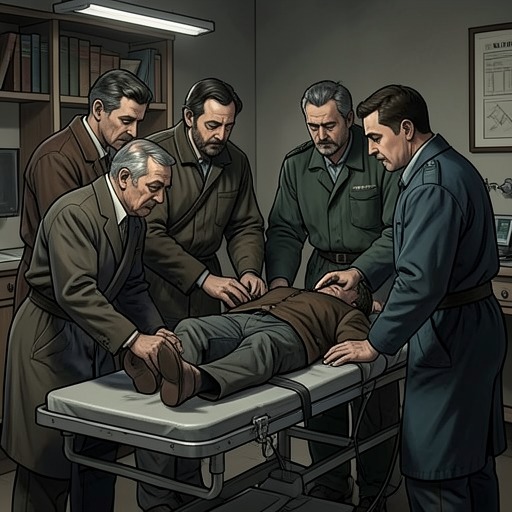
Second Men's Voluntary Euthanasia Policy for the Incapacitated
Last and First MenThe Second Men's Voluntary Euthanasia Policy for the Incapacitated was a collective response to the lasting bodily damage left by the Martian invasion. It asked people judged by their generation to have outlived their competence to choose death, even as younger Second Men resisted losing the elders they loved and relied on. The policy joined an ethic of loyalty to a stark demand: a damaged society had to decide who could still sustain it.
Origins in the Aftermath
The invaders' defeat did not end the danger. Their dispersed Martian Subvital Units became a predatory virus: carried into human lungs, they adapted to the new environment and disrupted the tissues of the people they infected. Research eventually found a way to check the infection, and after years of rigorous purging the atmosphere and human bodies were clean. But that recovery could not reverse the harm already done. The stricken generations' tissues had been too badly corroded, and their fertility had fallen.
The resulting population was sharply divided: a small number of healthy people below middle age lived alongside a very large number of ageing invalids. For years, the older generation continued to carry on the work of the world despite its frailty. Gradually, however, its members lost endurance and competence, while young people, compelled to take on responsibilities before they were ready, made errors and blunders their elders would have avoided. The policy arose within this widening crisis of care, capacity, and survival.
Eligibility and Opposition
The decision was that an individual should die when their own generation declared that they had outlived their competence. The judgment was thus described as a generational one, rather than as a decision made solely by the younger people who would inherit the work. The stricken generations adopted the policy almost unanimously, presenting it as a response to the needs of the body politic rather than as a demand imposed on them by their successors.
The young initially opposed it. They still loved and considered wise the elders whose physical vigour had declined, and they feared that they could not continue without them. Their resistance gave the policy its most painful conflict: the people expected to benefit from the elders' deaths did not wish to lose them. The elders nevertheless maintained their decision. Many of the rising generation were no longer children, they argued, and the economic crisis left society unable to carry all of its damaged capacities forward unchanged.
Implementation and Consequences
The policy was carried out individually, as circumstances demanded. One by one, the stricken chose what the narrative calls the peace of annihilation. Their deaths left a population that was scanty and inexperienced, but vigorous enough to begin rebuilding the civilization damaged by the war. The choice therefore addressed an immediate generational emergency, without restoring what the infection and the invasion had destroyed.
The episode presents the policy through two sharply opposed images: society must ruthlessly cut out its damaged tissues, yet the young remain attached to the elders they are asked to lose. Its account of the decision emphasizes both the willingness of the stricken to accept it and the severe practical pressure behind it. The result is not a simple triumph over disease: survival becomes possible through a sacrifice that leaves the rebuilding generation bereft of much of its accumulated experience.