Siberia
Last and First MenSiberia is the remote refuge where a small band of survivors attempts to preserve human culture after a planetary catastrophe. First a precarious shore at the edge of an uninhabitable world, it becomes the site of a deliberate archive for the distant future. Yet preservation cannot secure recovery: across vast spans of time, the people who remain in Asia lose much of the capacity to use the inheritance their ancestors struggled to save.
A refuge after planetary disaster
The survivors reach the Siberian coast after a voyage through a world transformed by catastrophe. A year after the explosion, their ship is still laboring through stormy, iceberg-filled waters near the Pole. They have tried to make southward progress, but extreme heat and weather repeatedly force them back. When conditions ease, they approach their original objective in Norway, only to find the lowlands scorched and lifeless, the settlement flattened by a hurricane, and its dead still in the streets. They continue south, encounter France in volcanic chaos, and flee north again as falling debris turns the surrounding sea dangerous.
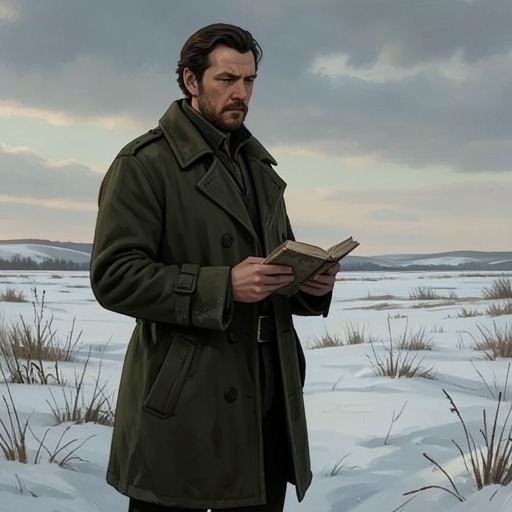
After creeping along the Siberian coast, the voyagers find a tolerable resting place at the mouth of a great river and bring the ship to anchor. The land is not untouched: vegetation has been scorched and dead animals are frequent. But the first fury of the disaster appears to be abating. The company has been reduced by the journey; six men and two women have died. In this battered setting, the survivors recognize that a worldwide calamity has overwhelmed their fellow humans, while their remoteness and the Arctic ice have helped them escape immediate destruction.
The settlement and its archive
The Siberian settlement is founded on a grim calculation. The survivors' scientists estimate that volcanic energy will continue escaping from the planet's interior for millions of years, making most of the world uninhabitable. Their hope is therefore not a quick return to civilization, but the survival of a small remnant capable of waiting for a more favorable age. The settlement must sustain a population and, above all, preserve as much as possible of the culture that preceded the catastrophe.
During the long winters, the adults turn that purpose into collective work. Each person is assigned a sphere of knowledge; notes written on slate are discussed and criticized by the group, then engraved on hard stone. Over the years they produce thousands of tablets, recording an outline of human history and the fields of physics, chemistry, biology, psychology, and geometry. Contributors also preserve accounts of their own specialties and personal views of existence. To help distant readers interpret the collection, the group devises an extensive pictorial dictionary and grammar. The tablets are stored in a prepared cave, making Siberia not merely a place of survival but the setting for a painstaking attempt to transmit knowledge across an immense break in history.
That mission strains the small community. The founders' children are precious both as the future of the population and as possible bearers of its culture. The adults disagree over how to raise them: some cherish them for their youth, while the visionary leader sees them chiefly as vessels to be shaped for a future beyond their own. The children, pampered and burdened by instruction, grow distant from the elders and resist an obligation imposed on them without their consent. Siberia's preservation project is thus never only a technical or archival undertaking; it depends on fragile human relationships and on whether the next generation will accept its purpose.
The long decline of the Siberian remnant
The descendants of the Asian settlement remain a tiny population through the Second Dark Age, while the other human settlement, in Labrador, deteriorates under a hotter climate and eventually spreads across the West. In Asia, encroaching water isolates the Siberian communities on an island formed from the old Taimyr Peninsula. As conditions become less oppressive, families spread toward its southern coast, but the sea limits their expansion. A period of more temperate weather allows some recovery of culture, though the people have already been weakened by earlier ages of tropical conditions.
Near the end of the ten-million-year dark age, Arctic conditions spread south over the island. Crops fail; rodents, the people's principal livestock, dwindle; and their small deer herds disappear for lack of food. The population sinks into a remnant of Arctic savagery and remains in that condition for a million years. Its loss is not simply material. The people nearly lose the ability to invent: when ice covers their sacred quarries, they cannot think to obtain stone from the valleys and resort instead to bone tools. Their language contracts to a few grunts for important acts and a more elaborate repertoire of emotional expression. Even in decline, they retain strong social bonds, respect for individual life, parental devotion, and earnest religious feeling.
Place in the history of civilization
Siberia's narrative significance lies in the contrast between what its survivors plan and what their descendants can sustain. The stone archive embodies an effort to keep the accumulated knowledge of civilization available beyond the disaster; the later history of the isolated population shows that an inheritance cannot by itself restore the powers needed to interpret and extend it. Climate, geography, and resource scarcity are not incidental surroundings: the sea confines the settlement, Arctic change undermines its food supply, and ice makes even accessible materials unusable to people who have lost the habit of innovation.
The region therefore marks both a beginning and a limit. It is where human continuity is deliberately kept alive when almost the entire world has become hostile, and where knowledge is given a durable physical form. But its endurance is biological and cultural only in a reduced sense. Siberia preserves a remnant through catastrophe and deep time, while revealing how survival can continue after the capacity for civilization has largely ebbed.