Siberian Stone Library
Last and First MenThe Siberian Stone Library was a deliberately created archive of human learning, engraved on stone by a small community trying to carry civilization through an age in which humanity could scarcely survive. Its makers planned for readers far beyond their own lives: they recorded knowledge, devised tools for interpreting it, and placed the tablets in a prepared cave. The library endured, but its meaning changed—from an urgent project of preservation, to a sacred inheritance its custodians could no longer understand, and finally to a historical document recovered by the Second Men.
Purpose and circumstances
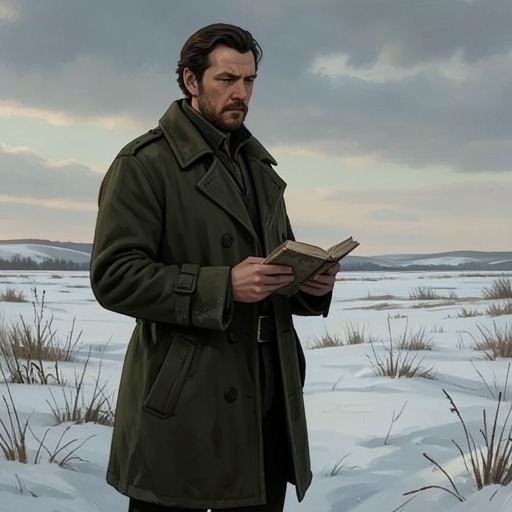
The library arose from the survivors’ assessment that the planet would remain largely uninhabitable for millions of years, with civilized life confined to a narrow Siberian coastal fringe. Their leader concluded that the remnant had to propagate and preserve as much as possible of Patagonian culture for its descendants. The task was not simply to keep people alive: the survivors hoped that their offspring might eventually recover a cultured life, and that a permanent record could help them do so. The purpose demanded long labor under harsh conditions. The adults worked at preserving knowledge during the long winters, even though some grew weary of the undertaking. The founders’ future-minded aim did not pass easily to the young. Overwhelmed by the elders’ teaching and expectations, the next generation resisted an obligation to an improbable future and disliked the hardship of engraving extensive writing on stone. The library thus embodied a hope that its intended inheritors did not willingly share.
Construction and contents
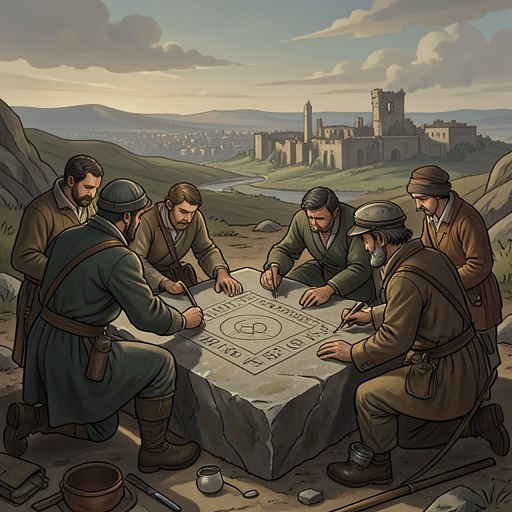
The archive was made up of many thousands of tablets, engraved deeply on hard stone and stored in a cave that the survivors carefully prepared. The work was organized rather than improvised: each person received a sphere of culture, developed an account, first wrote it on slate, and submitted it to the company for criticism before the final version was engraved. The process made preservation a collective undertaking, subject to discussion as well as individual effort. The tablets recorded outlines of the history of Earth and humanity, along with physics, chemistry, biology, psychology, and geometry. Each contributor also summarized a personal field of study and added a manifesto setting out views about existence. To make the archive accessible after the community’s own language had disappeared, its makers devised a large pictorial dictionary and grammar. These interpretive aids were intended to let people in the remote future make sense of the whole library, not merely recognize that the tablets contained writing.
Survival and changing meaning
The settlement preserved the library across generations even as its people’s intellectual abilities weakened. The tropical Siberian coast, its volcanic boundary, and the community’s circumstances contributed to a gradual decline in mental vigor and subtlety. Knowledge and conceptions of the universe sank toward crude myth, while the tablets became increasingly unintelligible to their keepers. Yet loss of understanding did not mean loss of attachment. Curiosity and group feeling persisted, as did a strong, if no longer rationally grounded, loyalty to the future and to the stone archive. The library consequently acquired a sacred status distinct from its original practical purpose. For thousands and even millions of years, later descendants retained a confused tradition of a noble past and an admiration for mental power, though they could no longer recover the learning recorded on the tablets. The object outlasted the intellectual world that had produced it: revered as an inheritance, it was preserved without being fully read. Its survival was therefore both a success and a limitation. The physical record remained, but continuity of knowledge had broken.
Rediscovery by the Second Men
Much later, engineers of the Second Men encountered the remains of the library while preparing a shaft for subterranean energy. The tablets were broken, scattered out of order, and weathered. They were gradually reconstructed and interpreted with help from the pictorial dictionary, making the original effort to prepare an interpretive key consequential long after its creators had vanished. The Second Men valued the recovered material chiefly as history, not as a source of authoritative science or philosophy. The worldview recorded in the tablets seemed to them naïve and artificial, but the archive offered an unusually vivid account of how the earlier species had thought. So little had survived the volcanic epoch that the Second Men had previously lacked a clear picture of their predecessors. The library’s greatest contribution was thus not simply the transmission of propositions: it made an earlier human mentality available for historical understanding. Among its contents was a record of the sacred text Life of the Divine Boy, preserved by the biologist who had led the Siberian party. The record included the prophet’s final words, which had previously baffled Patagonia. The Second Men recognized in them an intuition familiar to their own experience and found a possible, if imperfect, expression for it. In this instance, an item preserved within the archive mattered not just as evidence of the past but as an idea with renewed significance for a later people.
Historical significance
The library’s history joins three different conditions of memory: deliberate recording, reverent but increasingly uninformed preservation, and later reconstruction. Its creators tried to anticipate the loss of language by making a dictionary and grammar, yet no device could ensure that descendants would retain the intellectual capacity to use them. The archive saved a material trace of a culture without keeping that culture continuously alive. Its recovery nevertheless altered the Second Men’s understanding of human history. Broken and weathered, it became a witness to minds separated from its readers by immense time, and its value lay partly in the very distance that had made it obscure. The Siberian Stone Library stands as a record of the survivors’ loyalty to a future they could neither guarantee nor see, and of the later readers who turned their stone-bound effort back into knowledge of the human past.