Siberian Survivors' Knowledge-Preservation Project
Last and First MenThe Siberian Survivors' Knowledge-Preservation Project was an attempt to carry human learning across a planetary catastrophe and millions of years of uninhabitable conditions. Led by a gifted scientist, a precarious settlement on the Siberian coast set itself two linked tasks: preserve a remnant of civilized humanity, and leave a durable record of what that humanity knew. Its stone archive survived long enough to become a historical witness for the Second Men, though the project’s own children resisted the inheritance it was meant to secure.
A plan for survival
The settlement’s calculations suggested that the planet would remain uninhabitable for millions of years. The first fury of the disaster had passed, but energy trapped within the planet would continue escaping through volcanic vents for ages. Only a fringe of Siberian coast could support human life. The survivors therefore imagined the future not as a prompt recovery, but as a long interval in which a tiny, culturally capable population might endure until conditions improved.
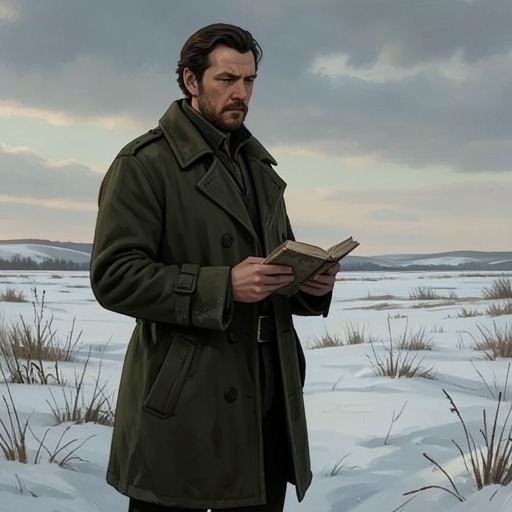
The party had to propagate itself and create some possibility of cultivated life for its descendants. Its leader made preservation the governing purpose of their survival: “We are the germ,” he said. “We must play for safety, mark time, preserve man's inheritance. The chances against us are almost overwhelming, but just possibly we shall win through.” The image of a germ defined the project’s scale and ambition alike: the survivors could not restore civilization in their own age, but they might keep its possibility alive.
Making the archive
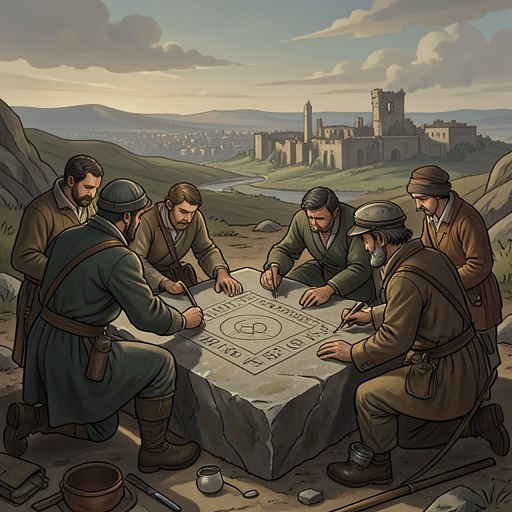
During the long winters, the adults devoted much of their leisure to recording an outline of human knowledge. Each person received a field of culture to work on, thought through a section, and first wrote it on slate. The others then criticized the draft; only after this shared review was it deeply engraved on hard stone. Over the years, they made many thousands of tablets and stored them in a cave prepared for their protection.
The archive ranged across the history of Earth and humanity, physics, chemistry, biology, psychology, and geometry. Each contributor also summarized their own special study and added a personal manifesto about existence. The record was thus not merely a technical handbook: it preserved traces of individual perspectives alongside an organized account of knowledge. The survivors also devised a large pictorial dictionary and grammar, hoping that readers in the remote future could use it to interpret the tablets even after the language itself had been lost.
The inheritance resisted
The work was dear to the leader, but the other adults often grew weary of it. The strain became more acute as the founders weakened and the next generation grew up under their intense attention. The children had been pampered and oppressed, overwhelmed with instruction and expectation. They came to hold the elders at arm’s length and rejected the obligation to live for an uncertain future. Hunting and daily survival offered immediate tests of courage, loyalty, and interest in one another; the archive’s purpose, by contrast, reached toward a culture they knew only through the elders’ accounts.
The young people particularly loathed engraving what seemed to them endless verbiage on hard stone. Their refusal exposed the project’s central vulnerability: a record could be made durable, but the people expected to sustain its purpose might not consent to become its custodians. The effort nevertheless left an archive that outlasted the original settlement and its immediate conflict over how the young should live.
Discovery and later meaning
Long after the settlement, Second Men engineers encountered the remains of the stone library while preparing to sink a shaft for subterranean energy. The tablets were broken, disordered, and weathered. With the aid of the pictorial dictionary, they gradually reconstructed and interpreted them. The archive mattered to its finders chiefly as a vivid historical document, not as an authoritative store of scientific or philosophical truth: its account of the universe seemed both naïve and artificial, while its evidence about the earlier species’ mind was invaluable.
One text preserved in the archive was the sacred account of the Life of the Divine Boy, including the prophet’s final words. Those words, which had baffled the Patagonians, carried a different force for the Second Men, who recognized in them an intuition familiar from their own experience. The library therefore preserved more than general knowledge. It carried particular voices and ideas across the break between civilizations, allowing later readers to encounter an earlier mind without simply accepting its explanations as true.
The project’s significance lies in the distinction between preservation and control over the past. Its makers tried to guard knowledge against physical ruin and linguistic loss, but could not make their descendants share the same sense of duty. Much later, the Second Men could recover the tablets while revising their claims in light of their own understanding. The archive endured not as an unchanged civilization in miniature, but as evidence to be interpreted: an inheritance that survived its creators’ world and became newly meaningful to readers they could never meet.