Solar System of the Last Humans
Last and First MenSolar System of the Last Humans is the setting within which human civilization repeatedly rises, reorganizes, and confronts limits imposed by energy and astronomy. It is not a static backdrop: coal and oil determine the reach of societies, later technologies make planetary motion a matter of human engineering, and the developing minds of its inhabitants exert effects that the system itself must be managed to withstand.
Resources and the organization of civilization
For much of the recorded history, civilization depended on fossil fuel. Oil became politically decisive as it proved more convenient than coal, while its comparatively limited supply and uncontrolled use made access to the remaining fields a source of rivalry. Competition over Russian oil helped drive conflict between Russia and Germany, with United States finance and commercial influence entangled in the dispute. Fuel thus connected distant regions through economic dependence and political suspicion; control of a resource was also leverage over the organization of human life.
A later oil famine prompted the League of Nations to place existing oil and coal fields under cosmopolitan control. Its World Fuel Control Board restricted the use of oil to purposes for which other power sources would not suffice and regulated coal as well. The arrangement endured even after the League had been superseded, and was regarded as an exceptional achievement in international cooperation. Yet it could not prevent new disputes. When techniques made the vast fuel deposits of Antarctica profitable, the supply lay outside the Board’s jurisdiction. The United States sought to exploit it, while China demanded that it be brought under common control. A policy intended to restrain competition therefore became part of the setting for another struggle over resources.
After the establishment of the First World State, Antarctic fuel was husbanded carefully, but the new oil supply was exhausted in less than three centuries. Aircraft then relied on electricity generated from coal. Even the unexpectedly rich Antarctic coalfields were finite, and the eventual failure of their deepest workings brought the first world-civilization down. The catastrophe was not simply a shortage: a society whose ordinary mobility and religious ritual consumed enormous power could not relinquish those uses when its material basis disappeared. The system’s resources set limits that political institutions and belief could obscure, but not abolish.
Interplanetary infrastructure and engineered worlds
In a later, highly developed civilization, daily life and production extended across several planets. Food factories on Jupiter supplied the community, while agricultural regions on Uranus and automatic mining stations on the outer planets were linked to it by Ether ships. The smallest vessels were about a mile long, and their journeys took only a small fraction of a Neptunian year. They descended onto oceans under the pressure of their radiation and then entered harbour. This traffic made the inhabited world part of a wider network of production, rather than a self-sufficient settlement.
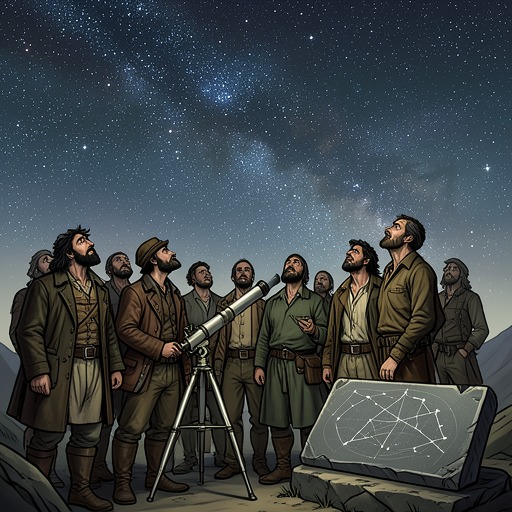
The ships also exposed the limits of that integration. Their navigators spent long periods beyond the reach of telepathic communication and sometimes even mechanical radio, making them a distinctive and unusually self-reliant group. One exploration vessel returned from the longest voyage yet attempted with half its crew dead and the survivors gravely affected. They had encountered only two comets and occasional meteors; nearby constellations appeared altered, a few stars brightened, and the Sun dwindled to the brightest star in view. The desolation of interplanetary space, rather than a battle or a known hostile world, had overwhelmed the expedition. The episode shows how immense the community’s technical reach had become, while also marking the gulf between its organized home and the surrounding void.
The Sixteenth Men altered their planet’s orbit with the energy at their command. Early in their history they moved it farther from the Sun, making its average climate more temperate and bringing occasional snow to the polar regions. As the Sun’s heat later weakened, they gradually reversed the adjustment and brought the planet nearer. Planetary climate and orbital position had become objects of deliberate policy, though that mastery remained responsive to changes in the larger astronomical environment.
Minds as astronomical forces
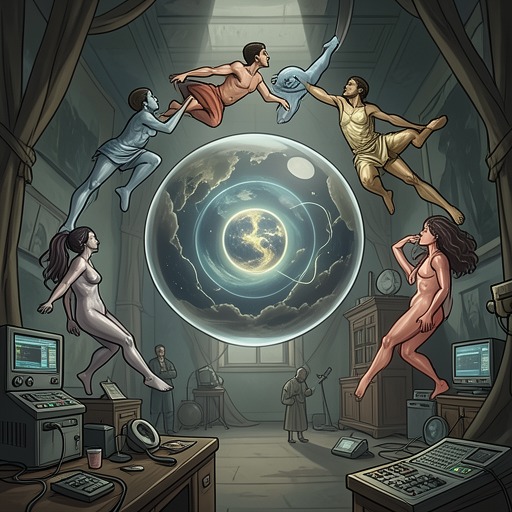
The inhabitants’ mental development also had physical consequences. The Fifth Men’s spiritual development had, in the narrator’s account, dragged the Moon from its orbit. In the Last Men’s own era, the size and mental activity of their society produced astronomical effects detectable at great distances. Their collective presence was so substantial that they had to expend physical energy continuously to keep the Solar System of the Last Humans from confusion.
Their instruments detected remote mentality through minute astronomical effects, which increased somewhat with the quantity of living matter but much more with mental and spiritual development. The Last Men could also enter past minds wherever those minds remained intelligible to them. That capacity offered a possible way to discover distant forms of consciousness, but usually failed: the experience of other minds was too different for them even to recognize its existence. Their knowledge of life elsewhere therefore depended chiefly on physical traces. In this account, intelligence is not merely an observer of the cosmos; at sufficient scale, it becomes one of the forces that can disturb and reshape it.
The approaching solar crisis
The Last Men had long prepared for the Sun’s eventual decline, which they expected to begin at an astronomically near date, though the immediate period of contraction might arrive roughly one hundred million years in the future or much sooner under certain conditions. They had planned to move their planet steadily nearer during the Sun’s comparatively brief shrinkage, eventually placing it in the narrowest orbit possible. For a long time afterward, that position would provide a habitable environment.
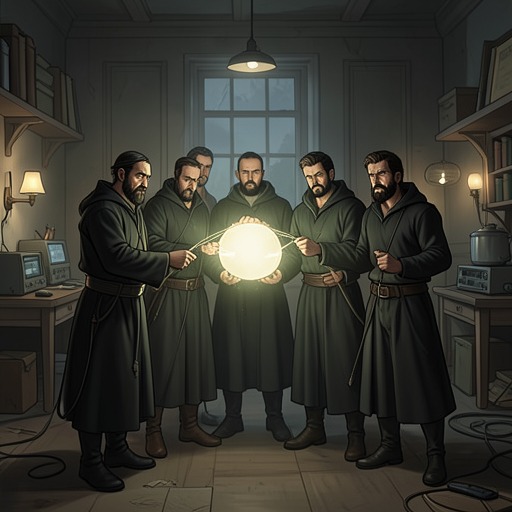
A more distant crisis would follow as the Sun continued to cool and solar radiation could no longer sustain human life. The Last Men considered annihilating matter to provide energy, drawing on other planets or perhaps the Sun itself. Another possibility was to propel their planet toward a younger star, then explore and settle suitable worlds throughout the galaxy and organize a community of inhabited worlds. They even imagined eventual communication with other galaxies. These were projections rather than accomplished undertakings, and the sudden discovery that humanity’s end was approaching transformed what had seemed a remote problem into an urgent one. The system’s history therefore culminates not in a settled triumph over nature, but in a race to preserve life against the changing star on which its long future depends.