Stagnation of Patagonian growth
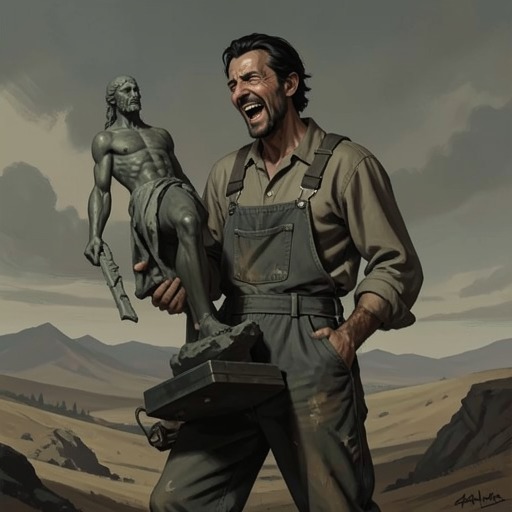
Last and First MenPatagonian arrested growth names the defining failure of Patagonia’s people: they yearned to be young again, yet their fixed immaturity kept them from understanding what genuine growth would require. Their ideal of youth, shaped by an increasingly distorted image of The Divine Boy, turned vitality into a social model that actual young people could not inhabit without denying their own nature. The people’s tragedy was not simply decline, but the failure to move beyond it.
The Ideal of Youth and Its Distortion
The original vision of The Divine Boy embodied youthful qualities: fanatical loyalty, gaiety, comradeship, physical energy, and mischief. As the descendants of the prophet overreached themselves in violent living and weakened, and as their lineage mixed with the larger population, the people returned to a middle-aged cast of mind. Their understanding of the prophet changed with them. The once-violent young hero was softened into a sentimental image of naïve, docile childhood, then credited with the sobriety and caution favored by mature society.
That altered image became an oppressive standard for Patagonia’s young men and women. It was presented as the highest social virtue, although it no longer expressed youth as they actually experienced it. Conforming meant doing violence to their best nature. The account compares this idealization to an earlier pattern in which women were idealized while also being constrained: admiration did not give its objects room to develop on their own terms.
Arrested Growth, Not Mere Senescence
The account distinguishes Patagonia’s arrested growth from physical senescence. In an earlier human era, a subtle physiological change had made the chemical equilibrium of individuals less stable and accelerated the loss of prolonged youth. Living for thousands of years under unnatural biological pressure, without adequate compensation for that strain, had hastened the decline of tissues and minds. That account of bodily aging provides a contrast to Patagonia’s deeper failure: its people felt old and longed to be young, but could not recognize how to advance beyond the yearning itself.
A few Patagonians across their history saw The Divine Boy more clearly. Fewer still entered into the spirit of his final message. His enduring youthfulness, as the narrative presents it, had raised him to a maturity foreign to Patagonia. The people mistook youth’s fulfillment for the achievement of youth’s immediate desires; the fuller fulfillment lay in advancing into a more awake and far-seeing vitality. Their fixation on recovering an earlier state thus prevented the very development they sought.
A Wider History of Biological Change
The long history after Patagonia’s disaster places this condition within a world where species change, but not along a simple path of improvement. About ten million years after the catastrophe, biological variations appeared, and a changed environment acted on them for roughly a hundred thousand years before the Second Men emerged. Their later history included repeated setbacks: glacial conditions pushed populations toward the end of the Indian peninsula, while bacterial epidemics destroyed promising cultures. Their brains also increasingly outgrew the capacity of their bodies and circulatory systems, bringing congenital and acquired mental disorders. A roomier-skulled, stronger-hearted variety eventually spread through interbreeding and saved the species.
Much later, after the Second Men had spent about thirty million years in a racial trance, geological change isolated some of them on an island continent. Cooling climates altered the germ-plasm and produced another epidemic of variation; one more vigorous, better-adapted type eventually displaced its competitors as the Third Men. Still later, the makers of a new human type deliberately altered germ cells to strengthen bone and muscle and specialize nerve tissue. These episodes differ from Patagonia’s cultural and psychological arrest: they show biological variation shaped by circumstance, selection, and design, while Patagonia’s people remained unable to convert their longing for youth into mature vitality.