Sub-men
Last and First MenThe Sub-men are a human-descended species whose history moves through successive reversals of fortune: a remnant stranded in Labrador degenerates into a radically altered population, some groups are subordinated by the Apes, and their resistance to disease helps them survive a catastrophe that devastates the Second Men. The narrative describes them chiefly through the observations of the Second Men, setting their changing status against the assumptions that make physical form, intelligence, and power seem like fixed measures of human worth.
Origins and environmental transformation
The Sub-men descend from survivors of a shipwreck on the coast of Labrador. The party had been driven west and southwest from Siberia, past Iceland, through severe storms and oceanic upheaval. By the time the vessel was wrecked, only a carpenter’s mate, two women, and a pair of Apes managed to reach shore. The survivors found a climate much sultrier than the one they had left, but Labrador also offered uplands with abundant vegetation. The man and women initially struggled to find food, then adapted to eating berries and roots.
The change in their descendants unfolded over generations. The account attributes their mental decline to the climate and describes the later population as having fallen into extreme savagery, retaining humanity principally through ancestry. This is not presented as a sudden transformation or as the result of a single encounter: isolation and a prolonged environmental pressure separate the Labrador descendants from the civilization remembered by their forebears. The origin story therefore makes the Sub-men both a distinct people in the later history and a living trace of an earlier human migration.
Form and social organization
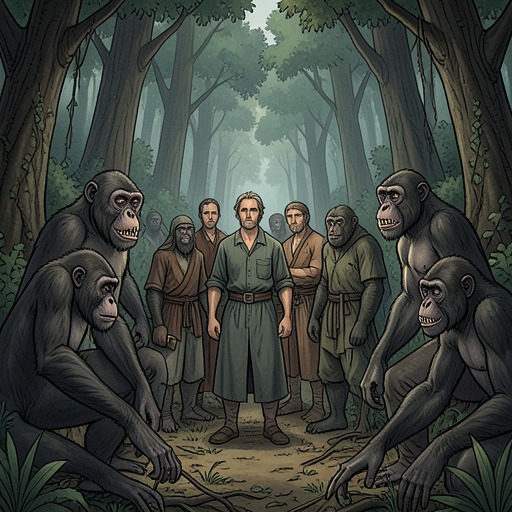
When the Second Men later encountered them in Africa, the Sub-men had become markedly smaller than the visiting species, reaching only to about the Second Men’s knees. Many walked bent over and used their arms to help them move. Their flat heads and elongated snouts gave them a baboon-like appearance. These physical descriptions establish the sharp contrast through which the Second Men first perceive them, but the account also emphasizes that the Sub-men possessed an elaborate social order of their own.
Among wild groups, social rank was organized around smell. Certain odors were associated with particular diseases, and people affected by those conditions received deference from others. The status system itself had gradations: the more repellent the odor associated with a person’s illness, the higher that person’s standing. The account links the diseases both to this hierarchy and to increased reproductive activity, which it identifies as one reason for the population’s high fertility. Although the diseases could eventually prove fatal, their course was slow; people whose illness had advanced and left them dependent on care received support from healthy members of their group, who did not necessarily avoid infection.
This arrangement turns illness into more than a biological hazard. In the narrator’s description it is also a source of authority, a basis for social ranking, and one influence on population growth. The Sub-men’s order is therefore neither a simple absence of society nor a diminished copy of the Second Men’s institutions. It is presented as a system adapted to the particular conditions of their own communities, though the account describes it from outside rather than through a Sub-man’s perspective.
Subordination by the Apes
The Second Men’s expedition into Africa brought it to a forest region where the African Tree-Dwelling Apes resisted its arrival. These Apes used simple bows and poisoned arrows, coordinated their defense, and demonstrated practical ingenuity that made them formidable opponents. The Second Men also discovered that the Apes controlled nearby groups of Sub-men. The latter were free of the diseases prevalent among their wild relatives, a difference that led those relatives to look down on them even as it made the domesticated groups useful to their captors.
The Apes employed the Sub-men as laborers and valued them as food. In one settlement, an arboreal city made of woven branches was under construction, with Sub-men hauling timber into the trees while the Apes directed their work. The Apes maintained their authority not only through weapons but through intimidation: they applied the juice of a rare aromatic plant, which frightened the Sub-men into docility. The detail makes their rule depend on a combination of organized force, control of labor, and a means of exploiting the Sub-men’s fear.
The Second Men reacted with outrage to the treatment of the Sub-men and tried to protest, but the Apes could not understand the objection. From their perspective, using subordinate beings in the service of a superior species was self-evident. The disagreement thus exposes a collision between different ideas of hierarchy and use. The Second Men had entered the region in search of metals, not to wage war on the Apes, and initially responded to their ingenuity with amusement rather than hostility. After an Apes’ attack killed most of the first expedition, a larger party returned; it established itself nearby and eventually negotiated access to the forest rather than seeking revenge.
Epidemic and aftermath
The relationship between the Second Men and the Apes deteriorated for several reasons, including the Second Men’s protest against the use of Sub-men. The Apes also knew that the Second Men were vulnerable to the diseases carried by wild Sub-men. When trade in a locally gathered nut expanded, the Apes used the opportunity to spread infection: they contaminated a large quantity with diseases prevalent among wild groups, and caravans carried the nuts across Asia.
The epidemic devastated the Second Men. It destroyed the pioneering settlements and killed much of the species; within a few generations, Asia held only scattered, diseased survivors, and civilization had broken down. The Sub-men, by contrast, had become adapted to the microbes, and their reproduction increased in their presence. That difference in susceptibility reverses the apparent hierarchy between the two species: the Second Men’s more delicately organized bodies made them vulnerable to a danger the Sub-men had endured as part of their established environment.
The Second Men eventually recovered from the infection and, about a thousand years later, crossed into Africa again. They met no resistance from the Apes. The account attributes the end of the Apes’ power to their growing fixation on metal, which burdened their bodies and preoccupied their minds; the herds of Sub-men were then able to rebel and destroy their former masters. The Sub-men’s history thus does not end with their subordination. Their earlier adaptation to disease allows them to persist through the epidemic, and their later revolt closes the account of the Apes’ rule.
Narrative significance
The Sub-men occupy a shifting place in the long account of human descent. Their Labrador origin ties them to an earlier migration, while their African communities show how environmental change can produce bodies, capacities, and social systems unlike those of the Second Men. Their relative resistance to disease is decisive in the epidemic: a trait associated with their survival becomes, indirectly, a source of the Second Men’s ruin. The episode cautions against reading evolutionary difference as a stable ranking of fitness, since advantage depends on the conditions a species encounters.
At the same time, the Sub-men’s characterization is constrained by the narrative’s external viewpoint. Their communities are described through the Second Men’s expedition and through the conflict between the Second Men and the Apes; their own speech, beliefs, and account of their history are not presented. Even so, the record grants their social organization and persistence a consequential place in the larger chronology. They are not merely the defeated remnant of an earlier humanity: in Africa, their survival outlasts both the Second Men’s civilization and the Apes’ authority.