Sun
Last and First MenThe Sun is the center of two successive existential crises in humanity’s distant history: first, its anticipated collapse prompts the Eighth Men to prepare for life beyond Venus; later, a dark body collides with it, radically transforming the Solar System. The difference between a catastrophe forecast and one newly discovered gives the Sun’s changing condition its decisive narrative force.
The predicted stellar collapse
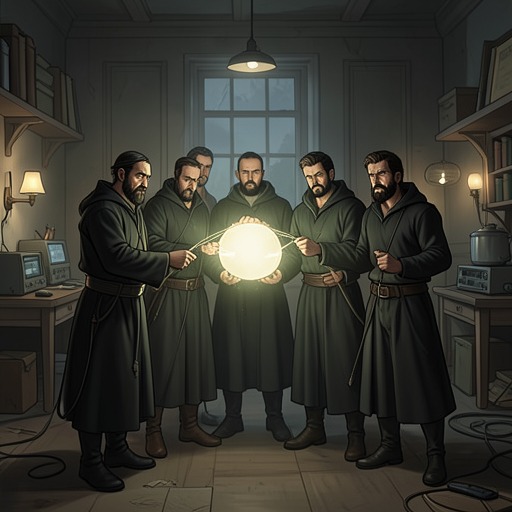
After a long period of peace and scientific advancement, the Eighth Men identify signs that the Sun is approaching the critical stage in a star’s life when it collapses into a small, dense body with feeble radiation. They predict that the change will begin in twenty thousand years and estimate that Venus will probably be frozen and uninhabitable within another fifty thousand. The threat is not immediate, but its projected timetable is short enough to make migration a practical necessity.
The proposed refuge is Mercury, which is already becoming less intolerably hot. To make it habitable, the Eighth Men begin planning to provide it with an atmosphere and to breed a new species capable of adapting eventually to extreme cold. The Sun’s expected transformation thus directs both planetary engineering and the design of a successor humanity.
A second astronomical threat
Before this migration plan can resolve the danger, astronomers discover a volume of non-luminous gas approaching the Sun from beyond the Solar System. Their calculations indicate that the two will meet at a tangent. The predicted outcome overturns the earlier plan: the Sun will flare and expand so greatly that life will be impossible on nearly every planet. Uranus might remain viable, and Neptune appears the more likely refuge, but neither offers an easy destination. The outer planets are glacial, while the Eighth Men’s imperfect ether ships cannot reach the two most distant worlds; Neptune is also cold and inhospitable to human bodies before the collision.
The new discovery changes the crisis from one of adapting to the Sun’s gradual decline into one of surviving a violent encounter. The Eighth Men cannot inhabit Neptune themselves, so humanity’s continuation depends on preparing a different species for that world. The Sun’s fate therefore governs not only where people might go, but which form of humanity can carry life onward.
Collision and transformation
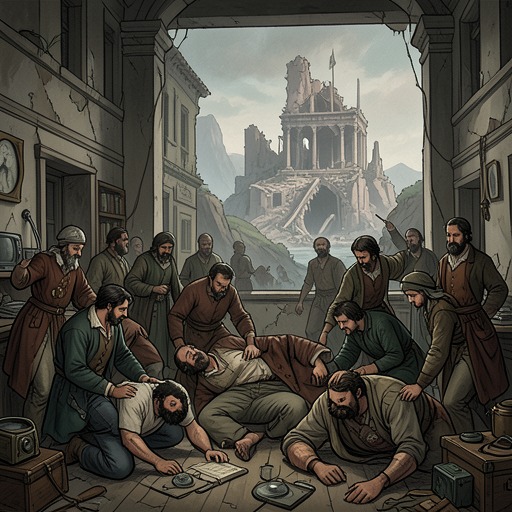
The dark body’s passage through the planetary system unfolds in stages. It narrowly misses Neptune, but engulfs Saturn along with its rings and satellites, producing a sudden incandescence described as a prelude to the larger disaster. It then tangles the planetary orbits, passes through the asteroids, misses Mars, and catches Earth and Venus in its blazing path before reaching the Sun.
After the collision, the center of the Solar System is no longer the Sun as it had been known: it is a star nearly as wide as Mercury’s former orbit. The account presents this encounter as a transformation of the system itself, following the loss or disruption of worlds that had shaped earlier human history.
Narrative significance
The Sun first appears as a distant clock whose predicted change gives the Eighth Men time to plan. The discovery of the approaching gas body makes that timetable inadequate: the danger is no longer simply the Sun’s eventual collapse, but the collision that will make the Sun flare and reorder the planets. These successive revelations turn astronomical observation into a test of whether humanity can anticipate change, revise its plans, and preserve life beyond its existing home.