The Aesthetic Ideal of Flight
Last and First MenFor the Seventh Men, flight was more than a means of movement or a source of exhilaration: it was the central medium through which individual life became an aesthetic experience and the community took its form. The Aesthetic Ideal of Flight joined physical danger, heightened perception, and collective art, while placing beauty above longevity and material progress. It made life in the air vivid and meaningful, but also left the civilization with a severe measure of its own worth: a future confined to the ground could seem worse than extinction.
Meaning and Scope
The Seventh Men’s defining preoccupation cannot be reduced to aviation, or even to the desire for intense sensation. They sought the spiritual aspect of flight: an experience in which the variety of peril and skill offered by the atmosphere became a means of self-expression. The air was not simply where they travelled. It was where their lives acquired their fullest intensity and where experience could be apprehended as form and beauty.
This ideal also helps explain an apparent tension in their culture. The Seventh Men studied ancient philosophical problems partly to persuade themselves that thought could not probe beyond the limits of their orthodox system. They preserved practical knowledge, but abstract inquiry was not their highest pursuit. Their intellectual restraint belonged to a civilization whose central ambition lay elsewhere: in creating and appreciating vivid lives, rather than in extending knowledge for its own sake.
Two Modes of Life
The ideal divided existence into aerial and terrestrial phases. On the ground, the Seventh Men worked in agriculture and industry, soberly and industriously, though often with mild boredom and impatience toward routine. Their hearts remained oriented toward the air; anticipation of their next flight helped sustain them through pedestrian tasks. A biological invention increased their time aloft: a minute foodplant spent winter rooted in the ground and summer drifting in the sunlit upper air, where it photosynthesized and could be browsed upon. As reliance on terrestrial labor diminished, material civilization simplified and manufactured goods became rarer.
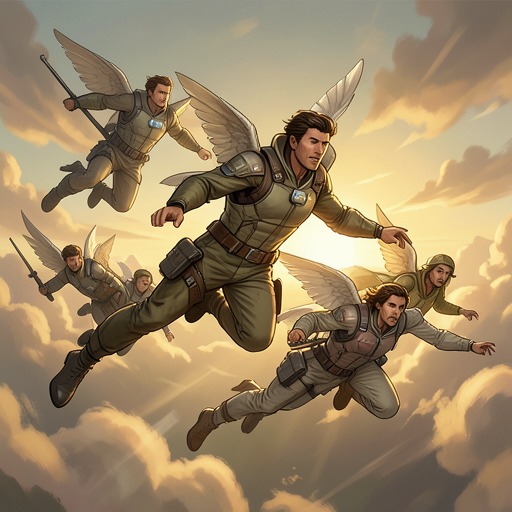
Flight altered the Seventh Men more profoundly than a change of setting would suggest. In the air, their hearts beat more powerfully, their temperature rose, and their sensations and intelligence sharpened. They experienced pleasure and pain more intensely, yet the result was not simply greater emotional absorption. They could regard their own fortunate or tragic circumstances with detached aesthetic appreciation, whether alone in a storm, among vast aerial gatherings, or in solitary meditation above the world.
The contrast became most severe when flight was lost. Their makers had arranged for the heart to stop when pain or misery became extreme, intending to spare them serious distress; this safeguard worked only on the ground. Prolonged confinement there could bring acute melancholia and death. In the air, by contrast, even a companion’s loss could be met with exhilaration and an attempt at rescue. After landing, grief could return with force, as the flyer struggled to recover the vision of the air. Survivors of a vast atmospheric disaster on Venus likewise maintained their exaltation while aloft, only to lose it after landing and remember the event as horror.
Aesthetic Society and Shared Experience
The social order of the Seventh Men was organized neither primarily around utility, humanism, nor religion, but around aesthetic form. Institutions and actions were judged by whether they contributed to a beautiful community: one in which vivid individual lives were harmoniously related. Prosperity mattered as a medium for realizing that form, rather than as an ultimate end. The ideal was therefore social as well as personal; flight’s beauty was experienced within a population whose members made their lives part of a shared pattern.
For nearly a hundred million terrestrial years, this society endured with little change. Ancient towers remained as sleeping nests, while work continued on the ground and most of the population spent its time in the air. Flyers skimmed the ocean for fish, hunted wildfowl, and gathered food among drifting vegetable particles. Others soared at great heights for the pleasure of flight or rested on up-currents in meditation. Couples traced patterns through the air; groups discussed social and aesthetic questions, sang, or listened to epic verse. Large companies formed intricate aerial movements, and individuals or groups tested their skill against storms. These activities made flight at once recreation, subsistence, conversation, performance, and a form of communal life.
The arts followed the same emphasis. Music, spoken lyric and epic verse, and winged dance remained active practices, while many other arts disappeared. Books were no longer written or read, and scientific knowledge gradually receded into tradition, though meteorology, biology, and psychology persisted in practical forms. The culture’s long stability did not, in the narrator’s account, depend on endless innovation: generations were too short-lived to outgrow their youthful delight, and the Seventh Men’s close adjustment to their world left little felt need for change.
Beauty, Finitude, and Decline
The ideal treated beauty as deliberately temporary. The Seventh Men did not ground their aesthetic convictions in interest in a universal or unseen order; the beauty they sought was ephemeral and largely sensuous. Individual life and even the race itself were understood as serving objective beauty, not as ends whose continuation had to be secured at any cost. From this perspective, death in flight could be preferable to prolonged survival on the ground, and racial extinction could be preferable to a future of pedestrian existence. The ideal’s refusal of permanence was not an incidental melancholy: it was part of its account of what made a life beautiful.
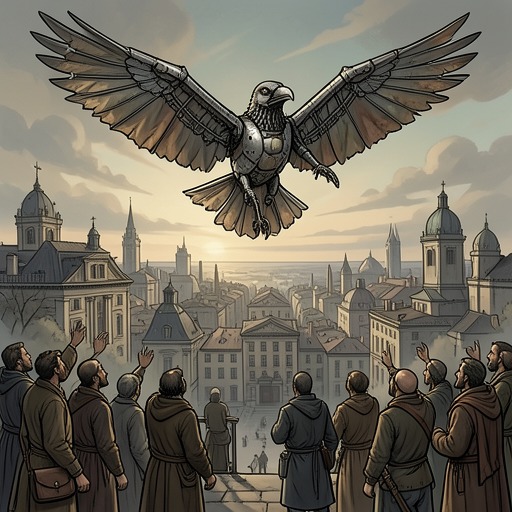
Yet the conditions that sustained this way of life eventually weakened. The species had long been biologically unstable, and some infants were unable to fly. A normal infant began flying early in its second year; if prevented from doing so, it declined and died before its third year. As a marine salt essential to the Seventh Men’s constitution became exhausted, deformities increased and the population fell, threatening the organized aerial community. Earlier custom had required the destruction of flightless infants, but leaders now spared a selected number expected to develop high intelligence, hoping that greater biological knowledge might arrest the decline. Breeding experiments pursued a wholly wingless, large-brained type. The response put survival and scientific intervention in tension with the civilization’s established standard of aerial life.
The resulting conflict culminated in defeat for the natural fliers. Their opponents’ policies ultimately included the mutilation or destruction of winged infants; the fliers’ attempt to seize power from the air failed against aircraft and explosives. The surviving population gathered on a remote, barren island, where its leaders concluded that the age of the Flying Man was over and chose collective death rather than subjection. On the ground, the assembled people could not see the beauty the leaders urged them to recognize. At the appointed signal, however, they rose into the air; the children accepted their fate once they were aloft. The multitude flew west in a double file toward a volcano and disappeared into its plume. The ending makes the ideal’s final paradox concrete: the Seventh Men could not affirm their chosen death from the ground, but in flight they could experience it as a last shared act of freedom and form.