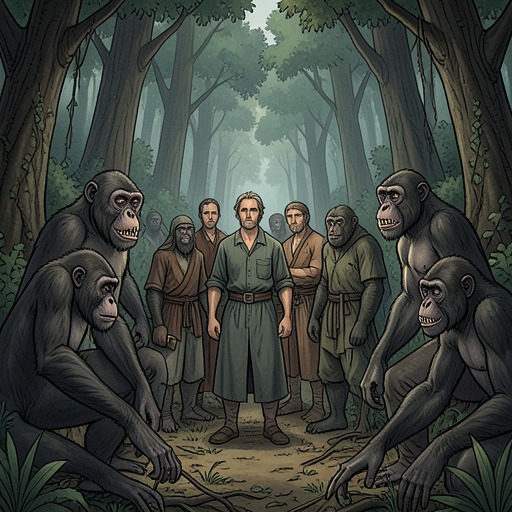
The Ape-People's Infected-Nut Attack
Last and First MenThe Ape-People's Infected-Nut Attack was a calculated use of disease by the Apes against the Second Men. Exploiting the Second Men's known susceptibility to infections carried by Sub-men, the Apes contaminated a traded food supply and sent the epidemic across Asia. The attack devastated the Second Men, but its aftermath also exposed the instability of the Apes' rule over the beings they treated as cattle.
Background and Opportunity
Friction between the Apes and the Second Men had been growing. The Apes' treatment of their Sub-men as cattle, and their delight in what the Second Men regarded as cruel absurdity, prompted the newcomers to protest. The Apes could not understand that objection; they took the Second Men's failure to appreciate their practices as evidence of deficient minds. The disputes helped drive the Apes to seek a means of freeing themselves from the Second Men permanently.
The decisive opening came from disease. The Second Men had proved highly liable to infections carried by their Sub-men relatives, and only rigorous quarantine had previously stamped out an epidemic that revealed this weakness. The Apes therefore knew that the Second Men were vulnerable to microbes against which the less-developed population had acquired greater resistance.
The Infected-Nut Attack
A particular nut was palatable both to the Apes and to the Sub-men, and the Apes had begun bartering it for additional metal. Pioneering Second Men planned to send caravans loaded with the nuts into their own territory. The Apes exploited that trade route: they infected large quantities of nuts with diseases prevalent among undomesticated Sub-men, then allowed the contaminated supplies to be carried across Asia.
The consequences were severe because the Second Men had not encountered these microbes before. The pioneering settlements were wiped out, and the epidemic killed most of the species. The Sub-men, by contrast, were adapted to the infections and even reproduced more rapidly in their presence. The disease thus turned a vulnerability within the Second Men's biological environment into an instrument of attack, while producing sharply different outcomes for the two populations.
Collapse and Aftermath
The Second Men's civilization fell apart. Within a few generations, Asia was left with only scattered groups of savages, diseased and mostly crippled. The scale of the collapse made the attack more than a local defeat: it interrupted the civilization of a species whose settlements had been expanding into the region.
The collapse did not extinguish the Second Men. Within a few centuries they had overcome the infection and begun climbing toward civilization again. A thousand years later, their pioneers crossed the mountains into Africa and encountered no opposition. By then the Apes' own dominance had ended: their bodies had become burdened with metal, and their minds were consumed by its possession, until the Sub-men revolted and devoured their former masters.
Significance
The episode turns on an asymmetry the Apes knowingly exploited: a disease that the Sub-men could withstand devastated the more highly organized Second Men. Yet the Apes' apparent victory did not establish lasting control. Their metal obsession undermined them from within, enabling the Sub-men to overthrow them. The attack therefore marks both the abrupt destruction of Second-Men civilization in Asia and the reversal of the hierarchy on which Ape power depended.