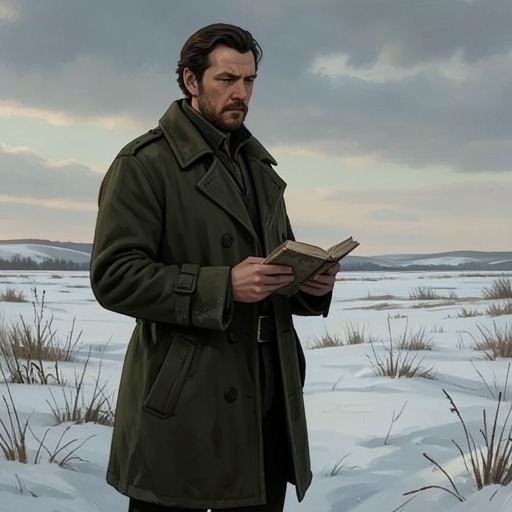
The Arctic Survivors' Schism
Last and First MenThe Arctic Survivors' Schism was the division of a small post-catastrophe settlement into two groups, one remaining under the Young Biologist of the Siberian Settlement and the other departing under its navigator. A dispute over whether to seek better land gave way to a personal crisis and armed conflict, but the survivors ultimately chose a negotiated separation. The narrative marks that parting as a turning point in human history: from it arose two distinct human species.
A settlement under strain
The community had been reduced by sickness, hurricanes, and volcanic gases before reaching a precarious equilibrium with its environment. Its prosperity brought a different danger. As life became more secure, differences of temperament grew harder to contain, and the authority that had once been essential in crisis became a source of friction in calmer periods.
The original head of the expedition had proved unable to manage the new circumstances and eventually died by suicide. The settlers then chose the second navigating officer as their chief, unanimously. His practical ability and capacity for decisive action had been vital to the group’s survival; in times of stress, his authority was absolute. But when immediate danger receded, some resented the discipline he continued to demand.
The Young Biologist of the Siberian Settlement emerged as another kind of leader: a critic of the navigator, yet also an admirer who believed the community depended on the navigator’s practical genius. Their relationship combined affection with hostility. The settlement’s future therefore rested not on simple agreement, but on the uneasy coexistence of distinct forms of authority and judgment.
The dispute and the rupture
Three years after landing, the community had established a routine of hunting, agriculture, and building. Three healthy infants brought both delight and frustration to their elders. With greater security, the navigator’s particular abilities had less scope, while scientific knowledge became increasingly important. He and the other navigators grew restless; the scientists, meanwhile, were better equipped to deal with the demands of cultivation, breeding, and prospecting.
The immediate dispute began when the navigator proposed that the party return to the ship and explore for better land. The seafarers supported him. The scientists refused, in part because they understood more clearly the scale of the calamity that had overtaken the planet, and in part because they recoiled from the hardships of the proposed journey. Their disagreement concerned both what the survivors knew about their world and what risks they were willing to take within it.
Although the dispute aroused violent emotions, mutual respect and loyalty to the community initially kept the two sides from open conflict. The restraint failed after the woman generally regarded as queen of the settlement asserted her independence in a relationship with one of the scientists. The navigator, who regarded her as sacred to him, discovered them and killed the young man in a sudden rage. The settlement then divided into armed factions, and further bloodshed followed.
A negotiated separation
The survivors soon recognized the folly of continuing the conflict. After a parley, they decided to divide the company rather than destroy what remained of it. The group staying behind consisted of five men and two women under the Young Biologist of the Siberian Settlement. The navigator took the remaining nine men and two women aboard the ship, intending to travel toward Europe in search of better land. The parties promised to send word, if possible, during the following year.
The decision restored amicable relations. Both groups worked to equip the pioneers, and the departure ended with a solemn leave-taking. Relief at the end of a painful incompatibility was accompanied by the distress of people who had long been comrades in a shared enterprise. The separation resolved the immediate dispute, but could not undo the losses or uncertainty that had preceded it.
The journey and its aftermath
The settlers who stayed behind heard nothing further from the departing group and eventually concluded that the voyagers had perished. In fact, the ship was driven west and southwest, past Iceland, then a cluster of volcanoes, toward Labrador. The voyagers endured violent storms and upheavals at sea, losing nearly half their number before they could no longer work the ship. When it was wrecked on a rocky coast, only the carpenter’s mate, two women, and the two monkeys made it ashore.
The survivors found a climate much more sultry than Siberia, though Labrador offered uplands with abundant vegetation. The man and the two women initially struggled to find food, then adapted to a diet of berries and roots. Over generations, the climate undermined their descendants’ mentality, and they sank into abject savagery, retaining humanity only through their ancestry. The account thus gives the division an uneven aftermath: the settlement and the voyagers followed separate paths, and the latter’s journey ended in near-total loss and profound degeneration.
Historical significance
The schism begins as a conflict over leadership, risk, and the limits of survival, but the narrative enlarges its meaning beyond the settlement’s immediate affairs. The departure is identified as the source of two distinct human species. That consequence makes the parting more momentous than its participants understood: a decision reached to end a painful incompatibility also becomes a division in humanity’s future.
The episode’s structure reinforces that reversal. The settlers agree to separate, equip one another, and part on amicable terms; for a time, those left behind believe the other party has simply vanished. The later account of the shipwreck supplies the missing history, showing that the apparent disappearance concealed a catastrophic voyage and a radically different fate. The schism is therefore both a negotiated end to communal conflict and the beginning of divergent human histories.