The Beginning
Last and First MenThe Beginning is the emergence of the primordial gas from which all material and spiritual existence within known time developed. The book presents it not as an absolute origin but as a boundary within a cyclic, boundless succession of events: the Beginning that lies ahead after the End is the very same Beginning that lies behind. Its apparent finality, like the End’s, reflects the limits of knowledge rather than a termination of existence.
The First Material and Spiritual Existence
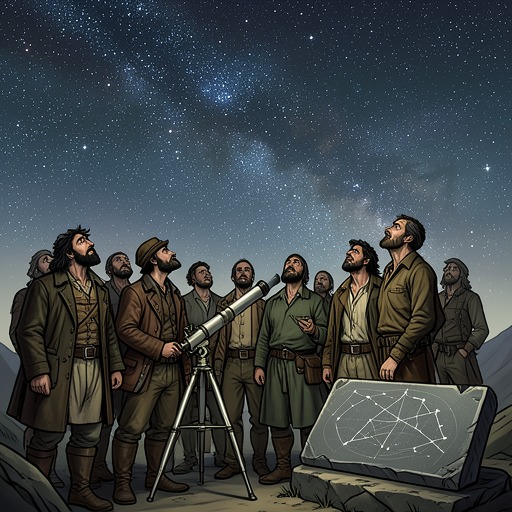
Within the spatio-temporal order known to humanity, the Beginning is the coming into existence of an all-pervading, unimaginably tenuous gas. It is described as a multitude whose population was nevertheless precisely numbered. As its members crowded together into swarms, those swarms in time gave rise to nebulae; each nebula then condensed into a galaxy, a universe of stars. The account thus traces a sequence from a diffuse primordial population to the great structures of the cosmos, while leaving unexplained how the gas itself came to exist.
The Beginning also marks the earliest point in the span of time’s known history in which material and spiritual existence develops. Stars have their own beginnings and endings, and only a very few sustain mind for brief intervals between them. Life is therefore not a permanent feature of the cosmos but a rare and temporary occurrence within the much longer history that unfolds from the Beginning.
A Boundary, Not an Absolute Origin
The names Beginning and End designate the limits of a particular spatio-temporal sphere as it appears to those within it. The book insists that these limits are not ultimate. Events lie beyond both, though their nature is unknowable; their existence is presented as necessary to the larger order. What appears to be the first event is therefore only the beginning of the sequence accessible to the account, not the start of all being.
The Beginning precedes the End by roughly one hundred million million terrestrial years. Yet the interval after the End and before the Beginning’s return is at least nine times longer. The familiar span from cosmic origin to cosmic ruin is consequently only a short section of the larger cycle, while the immense intervening period remains beyond human knowledge.
Cyclic Succession Without Repetition
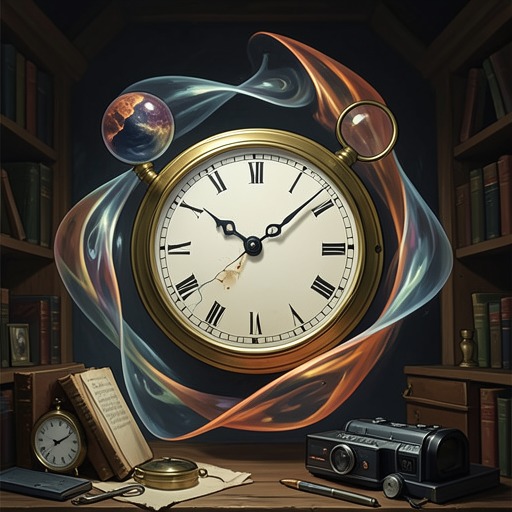
Time is described as cyclic, but not repetitive. After the End, unknowable events continue through an interval far longer than the span from the Beginning to the End; eventually, the identical event that was the Beginning occurs again. The past Beginning is not merely similar to a future occurrence: it is that future Beginning.
This identity does not imply that the cycle repeats within some further, external time. Time is understood as an abstraction from the succession of events, and there is no constant framework outside that succession against which a repeated cycle could be measured. Events succeed one another in a cycle, but there is no second timeline in which the cycle is replayed. The Beginning therefore returns without becoming a copy.
The Beginning and the Passage of Events
Every event within the cycle passes, giving way to what follows, yet each also possesses eternal being. Passage is not dismissed as an illusion, nor is an event’s eternal existence treated as cancelling its passage. The book presents these claims together as an antinomy: the racial mind apprehends their coexistence clearly, while the individual mode of understanding continues to find it mysterious.
The Beginning gives this cosmology its most concrete limit and its most unsettling qualification. It names the emergence from which the known cosmic sequence proceeds, but it cannot secure an ultimate first cause; it begins a span that ends, yet that ending opens onto a vastly longer succession and finally back to the same Beginning. Cosmic history is thus both finite in its measured intervals and boundless in its larger order.