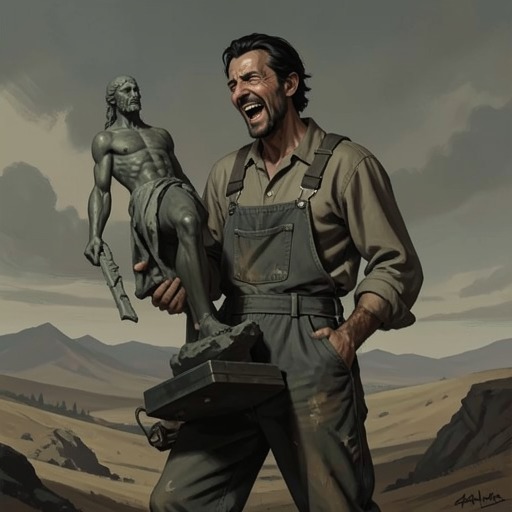
The Divine Boy's Destruction of the Idol
Last and First MenThe Divine Boy's Destruction of the Idol is the public climax of the prophet’s challenge to the worshippers gathered in Patagonia’s supreme temple. He turns a ceremony of submission into a rebuke of devotion itself: life, he argues, should be met with alertness and effort, but not with servile pleading for divine favour. His destruction of the image makes that argument an act, and the authorities’ response ends in his execution. The followers who preserve his influence accept the iconoclasm more readily than its demand that they grow beyond their own reverence for youth and life.
Setting and Stakes
The event takes place in the capital’s supreme temple, during a ceremony in which the congregation is prostrated before an image of the Creator. The setting concentrates religious authority in a single ritual scene: the worshippers’ posture, the altar, and the revered image all make adoration visible and orderly. The Divine Boy enters that order not as an unknown dissenter but as a figure whose reputation as a miraculous young prophet has already made him difficult to dismiss. His confidence and unexpected conduct briefly interrupt the hierarchy that the ceremony embodies.
His challenge is aimed not simply at the appearance of the image but at the relationship between worship and life. He argues that the worshippers’ seriousness has become childish because they treat devotion as a means of obtaining favour. In his account, their eagerness for life has itself become an obstacle to living: they cherish youth as a fixed ideal rather than continuing to mature. The stakes are therefore both religious and ethical. The image stands for a form of dependence that, in his view, keeps its devotees from taking responsibility for how they live.
The Rebuke and Its Lesson
Before the image is broken, the Divine Boy addresses the congregation and mocks the possibility that the Creator might take pleasure in their adulation. He presents their solemnity as misdirected: they are too earnest about their own wishes, yet fail to understand the wider meaning of existence. His correction develops an earlier call to remain young. Youthfulness, as he now defines it, means keeping the mind supple and responsive; growing up means gaining ever finer skill in the difficult activity of living. Neither entails surrendering vitality.
He explains this change in outlook through an episode from his own life. While climbing Aconcagua, he was caught in a blizzard, carried away, and left struggling in a snowdrift. At first, the prospect of death enraged him because he still had work he wished to do. Then his perspective shifted: he saw himself not only as the person losing the contest but as a spectator able to apprehend the larger play. From that wider view, loss could possess a value that the desire to win alone could not disclose. He understood human lives and worlds as parts of a greater drama seen through the eyes of its playwright. He survived the storm, but describes the experience as a transformation: he had discovered an intensity of life deeper than youthful energy.
That story gives the temple address its governing distinction. The Divine Boy does not counsel indifference or passivity; a game should be played with full effort. What he rejects is making victory the sole measure of the game. He compares the worshippers’ vows and abasement to attempts to bargain with the umpire, and recalls that he himself once responded to life’s apparent unfairness with anger. His new insight is that one can strive seriously while also seeing oneself as part of a larger whole. The lesson makes his attack on the image more than a rejection of a religious object: he calls for the congregation to relinquish its dependence on an external power that promises advantage.
Destruction and Punishment
At the close of his appeal, the Divine Boy urges the worshippers to break the image they carry in their hearts, then takes a large candlestick and smashes the temple’s idol. The act answers the speech with a visible rupture in the ceremony. The image that had commanded the congregation’s submission is now the object of an individual’s deliberate defiance; for a moment, the prophet’s composure and force of address silence the crowd.
The interruption does not become a lasting transfer of authority. The temple officials arrest him amid the ensuing uproar. He is later tried for sacrilege and executed. The account presents this final act as the culmination of a series of indiscretions and notes that those in power welcome the charge as an unmistakable pretext for eliminating a figure they regard as dangerous. The result is a stark reversal: the prophet who urges the congregation to free itself from adulation is himself made the focus of a growing devotion, while the institution he confronts retains the power to punish him.
Reception and Significance
The Divine Boy’s following is already popular by the time of his death, because his earlier teaching had expressed a deep Patagonian longing. His last message is accepted too, but not with equivalent understanding. The account distinguishes the followers’ emphasis on the dramatic iconoclasm from the more demanding spirit of the exhortation. The idol’s destruction is memorable and reproducible; the proposed discipline of remaining young while continually growing up is harder to sustain.
That difference gives the event its lasting irony. The prophet’s act is intended to break the worshippers’ attachment to an object of adoration, yet the spectacle itself helps secure his place in their religious imagination. His message asks them to value the play of life above victory and to stop pleading with divine power for favour; its reception turns the destruction into the most readily celebrated feature of his teaching. The scene thus marks both a challenge to religious submission and the beginning of a new form of reverence that preserves the gesture more clearly than its meaning.