The Extinction of the Flying Men
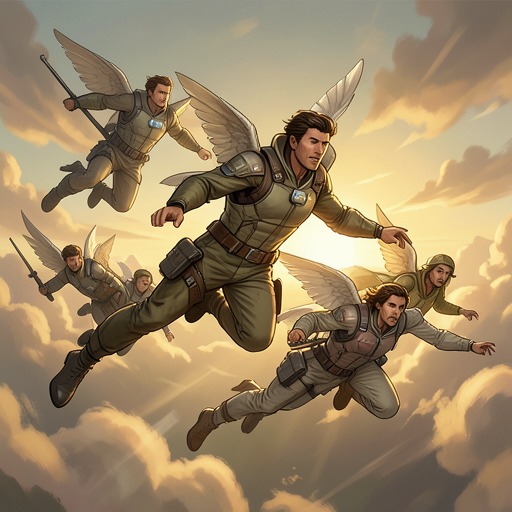
Last and First MenThe Extinction of the Flying Men concludes the rise of a flightless industrial order by carrying its conflict with the winged population to extermination. The fliers lose not only political power but the conditions that made their way of life possible: their work is compelled, their natural flight is treated as obsolete, and even the birth of winged infants becomes subject to state violence. A remnant escapes to a barren island, where its leaders declare that subjection is worse than death. The final flight, westward toward a volcano, turns the sky that had defined their freedom into the route of their collective end.
The industrial order and the loss of flight
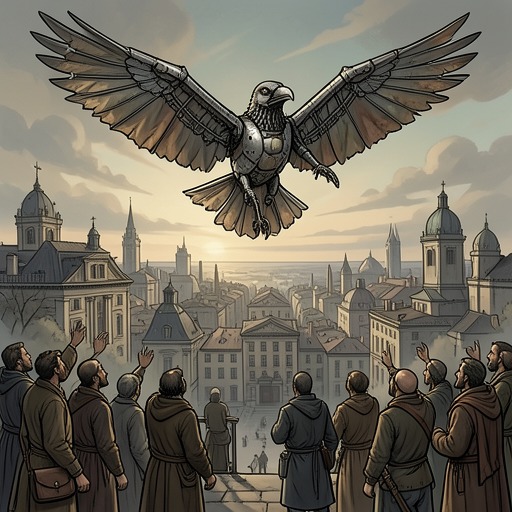
The fliers' defeat follows a transformation of both society and the air. Islands crowd with machinery and flightless industrialists, while mechanical aircraft outstrip the natural fliers. Their wings, once the basis of their distinct life, become an object of ridicule; natural flight is condemned as a barren luxury rather than recognized as a good in its own right. The new order does not merely prefer another technology. It recasts the fliers' central capacity as useless, then makes their continued existence conditional on serving those who have displaced them.
That command has material force. The cultivation of Windborne plants has been abandoned, and fishing and fowling rights are strictly controlled, leaving the fliers with little independent means of subsistence. They are ordered to work for the pedestrian world-order or starve. Long hours of ground labor bring serious ill-health and early death, so pedestrian physiologists devise a drug that preserves the workers in something like physical health and even prolongs their lives. The intervention addresses the body but not the loss at the heart of their existence: no drug restores their spirit when their normal aerial life has been reduced to a few exhausted hours of recreation once a week.
Suppression and failed resistance
The attack on the Flying Men becomes explicit in the policies imposed on their bodies and descendants. Breeding experiments seek to produce a wholly wingless, large-brained type, and a law eventually orders every winged infant to be mutilated or destroyed. These measures make the conflict more than a struggle over work or technological advantage. The industrial order seeks to remove the physical capacity on which the fliers' way of life depends and to prevent it from continuing into another generation.
The fliers answer with an aerial assault on the pedestrian population. Their bid for power is heroic but ineffective: the enemy's great aeroplanes ride them down and blast them apart with high explosive. The contrast is stark. The fliers take to the air in an effort to recover political agency, but the air has become a battlefield dominated by instruments designed for mechanical flight. Their courage cannot overcome the organized force of the system that has already made natural flight economically and legally precarious.
The remnant on the barren island
The remaining fighting squadrons are driven down on a remote, barren island. From every civilized archipelago, the surviving Flying Men flee there in search of freedom; their population has been reduced to a mere remnant. The migration excludes the sick, who commit suicide, and infants not yet able to fly, whom their mothers or next of kin stifle under a decree issued by the leaders. The passage presents the remnant as a population already shaped by the conditions of its impending end: those unable to make the flight are left behind, while the rest gather on the rocks.
About a million men, women, and children assemble there, some scarcely old enough to endure the prolonged journey. The island offers no practical refuge: the leaders recognize that nearby food cannot sustain such a multitude. Their gathering is therefore not the beginning of a viable settlement. It is the last concentration of a people who have escaped immediate control but cannot recover the territory, resources, or social conditions needed to live independently.
The decision to die free
The leaders conclude that the Flying Man's day is over. In their judgment, a high-souled people should die rather than continue under masters who hold them in contempt. They order the population to join a racial suicide intended to make death a gesture of freedom. The people receive this decision while resting on stony moorland, and sorrow breaks out among them. The speaker checks their grief, urging them to see beauty in what is to come even while they remain on the ground.
At first they cannot see that beauty. The account makes their acceptance conditional on flight: they know that, if their strength carries them aloft again, they will understand almost as soon as their tired muscles bear them into the air. This qualification gives the decision its particular tension. The people do not simply experience the announced death as beautiful; they expect that the act will become intelligible through the aerial perspective that has always distinguished them. Yet time is short. Many are faint with hunger and fear they may not be able to rise, so the order must be carried out before exhaustion closes even this final possibility.
The last flight and its aftermath
At the appointed signal, the whole population rises with a deep roar of wings. Sorrow is left behind as they fly steadily west in a double file stretching for miles. Even the children accept their fate with zest after their mothers explain what is to be done; the narration contrasts this response with the terror they would have felt if they had learned of it while still on the ground. In the air, the final act takes on the meaning the speaker has asked them to find in it.
A volcano's cone appears over the horizon and rises as the flock approaches. The leaders press toward its ruddy smoke plume, and the multitude enters the fiery breath in pairs, vanishing in turn. The image completes the reversal at the center of the event: flight, once the defining experience of life, becomes the means by which the people reach death. The narrative declares that the career of Flying Man ends there. The succeeding account describes the flightless, still half-avian race that possesses the planet and eventually produces the Eighth Men, placing the extinction at the threshold of a new society built around industry and science. The fliers' last act preserves a final claim to freedom, but it cannot preserve their people or their way of life.