The Fifth Men's Discovery That the Past Endures
Last and First MenThe Fifth Men's Discovery That the Past Endures overturned their understanding of time: events once treated as vanished could, they found, be experienced through minds that had lived them. What began as an empirical suspicion became a dangerous, generations-long investigation, and eventually a new means of entering the human past. Its triumph gave history an intimacy and force it had never possessed, while making the pain recorded in it seem as enduring as its joys.
A dispute over what survives
The first signs came from obscure biological facts. On empirical grounds, the Fifth Men began to suspect that past events were not simply nonexistent: they might have ceased to exist in the ordinary temporal sense while persisting in another manner. That possibility divided a race whose culture had long prized the formal beauty of a cosmos in which everything vanished. To one faction, evanescence was essential to the universe's nobility; to its opponents, the question could be settled only by evidence.
The disagreement threatened more than a difference of theory. The orthodox broke off telepathic communication with the rebels and planned their destruction. The rebels argued that devotion to disappearance was an inherited conviction, not a directly observed truth. At the last moment, violence was averted: the researchers were allowed to continue, and the wider race awaited the outcome. The discovery therefore began as both an inquiry into time and a test of whether the Fifth Men could endure a fundamental challenge to their shared outlook without destroying themselves.
Experiments and early failures
The investigation required extensive theoretical and practical work. Biology supplied the initial hint, but the Fifth Men recognized that accepting it would mean restating biology and the physical sciences around a new conception of the past. They pursued physiological and psychological experiments over millions of years. Temporal research sometimes occupied the race for thousands of years at a time; in other periods it receded behind different concerns. For age after age, the effort produced no decisive success.
The first promising subject was a child selected from an age-long breeding enterprise intended to master time. Scientists carefully controlled the child's physiology and subjected him to severe psychological preparation. In the presence of scientists and historians, they induced a trance and brought him out half an hour later. His first account, communicated telepathically, was too confused to interpret. After months of rest, he described an episode from his dead mother's girlhood, apparently seen through her eyes and accompanied by awareness of her thoughts. That report alone proved nothing: information might have come from a living mind. The researchers therefore put him through the trance again, despite his pleas. This time he spoke of little red people in a squat white tower, apparently referring to the Great Brains and their attendants. The account remained inconclusive, and the child died before he could finish it.
A later experiment produced stronger evidence. The next child was not tested until late adolescence. After an hour in trance, he woke agitated but managed to describe an episode historians placed in the age of the Martian invasions. He experienced himself as an old woman being hurried from a house by its inhabitants. The house stood at the head of a waterfall in a mountain valley and had a carved granite portico. A formless monster came down the valley, destroyed the house, and killed two people who did not escape in time.
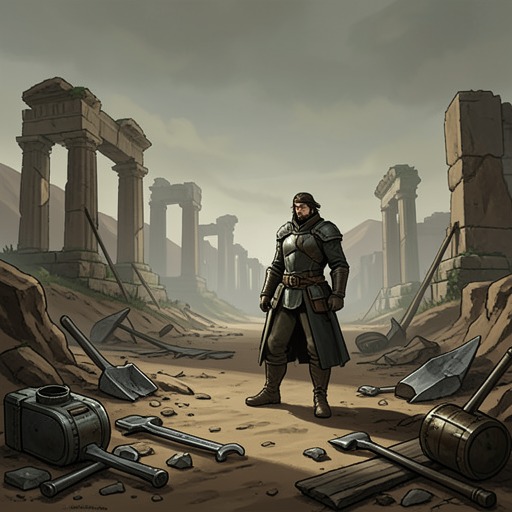
The account included a particular house unlike the usual architecture of the Second Men, suggesting an individual's distinctive choice rather than a general historical pattern. The boy's evidence helped historians locate the valley by reference to a mountain known from history. Although the valley itself had disappeared, deep excavations uncovered ancient slopes, the geological fault responsible for the waterfall, and broken pillars. This material correspondence, together with the account's historical detail, helped confirm that the experience reached into an actual past rather than merely reproducing knowledge available from the living.
From dangerous trance to a faculty
The corroborated incidents persuaded the Fifth Men, but access to the past remained perilous. In the early period, a medium could not be kept alive for more than a few weeks after an excursion. The experience brought progressive mental disintegration, followed by insanity, paralysis, and death. The Fifth Men eventually produced a kind of brain able to withstand supra-temporal experience without those fatal consequences.
Even then, the faculty was not initially under reliable control. Explorers depended on elaborate techniques and expert cooperation, and could be carried to times and places they had not chosen. As the method grew easier, it could become dangerously easy: a medium might fall into trance repeatedly, remain inert and dependent on artificial feeding for weeks or years, or experience history at a distorted pace. Events spanning a month or a lifetime could be compressed into a day; in other cases, the sequence ran backwards. Such experiences overwhelmed even the Fifth Men's powerful brains, causing maniacal behaviour and death. Some explorers also became absorbed in the past as if by an addictive drug, withdrawing from present responsibilities and sometimes suffering physical disaster through neglect.
After many more thousands of years, the technique was perfected. Individuals could then enter the experience safely at will and, within limits, select the locality in space-time they wished to inspect. They could enter only through the mind of a past organism that was no longer alive; in practice, human minds and, to some extent, those of higher mammals were accessible. The explorer did not become the past person or lose personal identity. While receiving that person's perceptions, memories, thoughts, desires, and other mental activity, the explorer retained an independent personality and memory, responding with judgment, sympathy, or criticism.
A changed sense of history
The discovery remade historical knowledge. It gave the Fifth Men more accurate access to past events and to the motives of historical individuals and the movement of whole cultures. Before this, they had known the remote past through historical schemes; now they could encounter it through first-hand experience, limited by the capacity of the exploring brain. The past that had once been a subject of study entered the individual mind with an immediacy previously associated with recent memory.
That change also altered the balance of reality. The Fifth Men had already been unusually conscious of the past, but direct experience made former lives seem present in a new way: not as distant shades but as people encountered in the fullness of their minds. The moving present no longer appeared to be the sole real instant. It seemed instead like the growing surface of an everlasting tree of existence, with the past as its enduring depth and the future still unknown.
This expanded reality brought joy and distress together. The persistence of the past meant that past happiness was not erased, but neither was suffering. Explorers who encountered regions of enduring agony could return deeply shaken. Reassurances that joy, too, endured did not always comfort them; some judged that no accumulation of delight could compensate for the torment of a single person, and that most of human history had contained more pain than pleasure. The discovery thus made historical sympathy more than an intellectual virtue: knowledge of the past could become a personal encounter with its suffering.
Legacy of access
The Fifth Men's exploration of time belonged to a much longer history of attempts to recover earlier worlds. After the First Men fell, their broken-pebble tools bore the Swastika, an emblem that had once represented an aeroplane diving to destruction and the downfall of Gordelpus and the State, but was later reinterpreted as the mark of a divine ancestor and a lost golden age. Much later, Patagonian archaeologists found durable metal printing plates in a shattered pylon in China and reconstructed the history of the earlier civilization. The Second Men, in turn, discovered the broken, weathered tablets of the Siberian Stone Library and treated them chiefly as historical evidence of the First Men's minds. These recoveries preserved traces of vanished societies, but they did not let later people experience those societies from within.
The Fifth Men's faculty changed that relation to the archive. Their work moved beyond reconstructing surviving records toward knowing and loving the past minds themselves, an enterprise later described as a supreme act of filial piety. For the Last Men, such acquaintance also had a practical consequence: when they had to turn from contemplation to the difficult work of disseminating an artificial human seed among the stars, encounters with the heroic and often forlorn ventures of earlier lives rekindled their loyalty to life. The original discovery thus endured not only as a new historical method but as a means of renewing the will to act in the present.