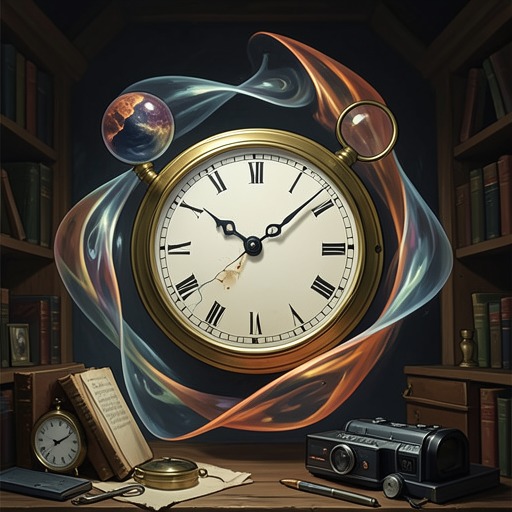
The Fifth Men's Exploration of Time
Last and First MenThe Fifth Men's Exploration of Time began as an empirical challenge to the belief that the past had vanished, and ended by changing both historical knowledge and the Fifth Men's experience of the present. Through a difficult, often lethal discipline, they learned to enter past minds and witness events from within. The result was no simple recovery of lost facts: history became an intimate, enduring presence, carrying joy and horror alike into the lives of the explorers.
From historical inheritance to a new question
For many millions of years, the Fifth Men had treated the evanescence of life as part of the cosmos's formal beauty. Their reverence for a world in which things passed away shaped their culture; the irrevocability of loss seemed to dignify existence as tragedy dignifies a work of art. They had already made the reconstruction of the past a major intellectual and cultural pursuit, with individuals devoting themselves to particular episodes of human or animal history. But this was still the work of scholarship: the dead remained distant, known through evidence rather than encounter.
That settled view began to fracture when obscure biological findings suggested that past events might not be wholly nonexistent. A dispute divided the race. The orthodox held that the universe's beauty depended on the tragic disappearance of all things; their opponents insisted that the question should be decided by evidence and sought to prove that living minds could reach events in their pastness. The conflict threatened to break humanity apart. The orthodox ended their telepathic communication with the rebels and even planned their destruction, but violence was avoided at the last moment: the researchers were allowed to continue, and the whole race awaited their findings.
Experiments and their human cost
The first campaign combined theoretical work with physiological and psychological experiments, and required the sciences to be reconsidered in light of the possibility that the past persisted. Ages of research yielded little. The first dramatic tests were conducted on children selected from a long breeding enterprise intended to master time. One child, whose brain had been carefully controlled and whose schooling had been severe, was put into a trance before scientists and historians. After half an hour, he was asked to report his experience telepathically. His first account seemed to show him witnessing a terrifying episode in his dead mother's girlhood and sharing her thoughts, but this did not establish that he had reached the past rather than received information from a living mind. Returned to the trance despite his pleas, he later described little red people in a squat white tower, apparently referring to the first Great Brain and its attendants. His account remained inconclusive, and the child died before completing it.
A second subject, tested late in adolescence, produced stronger evidence. After an hour in a trance, he emerged agitated and described being an old woman hurriedly evacuated from a house with a carved granite portico, set above a waterfall in a mountain valley. A formless monster descended the valley, destroyed the house, and mangled two people who had not escaped. The historians associated the episode with the era of the First and Second Martian Invasions. The house seemed an eccentric individual creation rather than a typical building of the Second Men. By using evidence from the boy's account to locate the former valley, investigators identified a site where no valley remained; deep excavations nevertheless uncovered ancient slopes, the fault that had formed the waterfall, and broken pillars. The landscape's buried remains corroborated an experience that had first seemed like a fragment of an impossible vision.
These and similar cases persuaded the Fifth Men that the past endured, but successful access remained dangerous. Early explorers could survive only a few weeks after returning. Their experiences initiated progressive mental disintegration, followed by insanity, paralysis, and death. The problem was eventually overcome by producing brains capable of withstanding supra-temporal experience, though the developing technique brought new hazards. At first, mediums could not choose where to go: they were carried to events by forces they could not control and needed complex procedures and expert assistance. As access became easier, it could become dangerously consuming. Explorers might remain inert in trances for weeks or years, require artificial feeding, or be thrown through many historical periods in a single day. They might experience a month or a lifetime compressed into a brief trance, or events in reverse order. Such disordered encounters could drive even the Fifth Men's powerful brains to mania and death. Others became so absorbed in the past that they neglected present life, lost their social usefulness, and sometimes suffered physical harm through failure to care for themselves.
A faculty perfected—and what it could reveal
Many more thousands of years passed before the dangers were brought under control. Eventually, each individual could enter supra-temporal experience safely and, within limits, direct attention to a desired place and period in space-time. Access was nevertheless restricted: an explorer could perceive the past only through the mind of a dead organism, and in practice could enter human minds and, to some extent, those of higher mammals. The explorer did not become the past person or surrender personal identity. Rather, the explorer experienced that person's perceptions, memories, thoughts, and desires while retaining an individual character and the capacity to judge, sympathize, or respond critically.
The Fifth Men's account of the faculty rejected both a mysterious racial memory and the idea of travelling upstream through time. The brain's access was described, metaphorically, as a partial awakening into eternity: it inspected a small tract of space-time through a past mind, as if through an optical instrument. Early distortions followed from disorderly inspection. An inexperienced explorer might rush through, linger over, or reverse the sequence of the mind being encountered, much as a reader might move at different speeds through a text. The experience belonged to living brains, so what an explorer could understand remained limited by that brain's capacity. Nor could the vision be absorbed instantly: the trance had to last long enough for the brain to reorganize and incorporate the experience into ordinary memory.
The past enters the present
The perfected faculty gave the Fifth Men a far more accurate history, insight into the motives of historical individuals, and a new understanding of cultural movements. More radically, it altered the scale of reality. The remote past, once available chiefly through historical knowledge, could now enter an individual through lived acquaintance. What had seemed like ghostly presences became vivid encounters, and the present ceased to appear the only real instant. It seemed instead like the changing surface of a vast, enduring existence, while the future remained void and the past appeared most real.
This discovery brought joy, but not consolation alone. If past events endured, then so did the pain, misery, and degradation that the Fifth Men had previously regarded as finished. Explorers who encountered regions of lasting agony returned distraught. They were told that joy, too, remained, but some answered that the delights of all other lives could not compensate for the torment of one tortured individual; in their judgment, suffering had outweighed joy through most of history. Although their own society was so ordered that suffering had to be sought as a tonic, the Fifth Men fell into despair. The tragic past haunted ordinary life, even intruding upon lovers' delight with shame and a sense of guilt.
The exploration nevertheless became more than a scientific method. For the Fifth Men, coming to know and love past minds became an act of filial piety: they sought to understand those they entered, including the least and the worst, rather than leave them outside the work of comprehension. Their relation to history thus joined knowledge to an ethical practice of attention. It also gained a practical purpose. As their physical constitution weakened and their community began to disintegrate, they had to devote their remaining strength to designing and manufacturing artificial human seeds for projection among the stars. This work was uncongenial to a people drawn to art, philosophy, and ecstatic contemplation. By revisiting the courageous and often forlorn efforts of earlier beings, they recovered the primitive commitment to life needed to undertake it, even as they retained their reconciliation with fate. Exploration of the past had begun by questioning whether loss was final; it ultimately helped the Fifth Men act against extinction without pretending that the past's suffering could be undone.