The Fifth Men's Venus-Terraforming Project
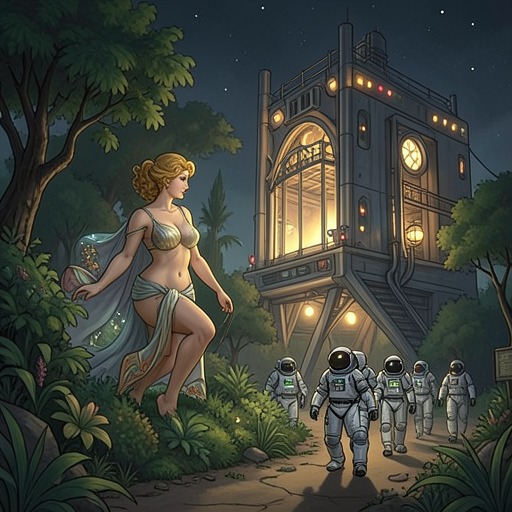
Last and First MenThe Fifth Men's Venus-Terraforming Project was an attempt to prepare another world for human life before the changing orbit of the Moon made humanity's future on Earth uncertain. Rather than transform people into beings suited to an alien environment, the Fifth Men chose to change Venus: they began research into its atmosphere and surface, planned to release oxygen through large-scale electrolysis, and developed specialized vegetation intended to establish a lasting supply of breathable gas. The project joined planetary engineering to a civilizational dilemma: the prospective home was difficult to inhabit, while the world humanity might have to leave remained precious to its inhabitants.
The choice of Venus
The Fifth Men could already travel through space, but reaching other planets did not solve the problem of living on them. Mars could not be made habitable without supplying it with air and water, a task that appeared impossible. Altering human nature instead was also rejected. It would require refashioning the human organism almost completely, and might sacrifice the existing species' harmonious constitution. The choice was therefore to adapt a planet to humanity, not humanity to a planet.
Venus offered a possible, if formidable, alternative. Its polar regions, shielded by deep clouds, were judged not unbearably hot, and oxygen existed there in abundance—but bound in chemical compounds rather than freely available in the atmosphere. With no vegetation to exhale oxygen and replenish what was lost through oxidation, the planet could not support human life as it stood. The Fifth Men concluded that Venus needed both a new supply of free oxygen and a plant life capable of sustaining it.
Research and planetary engineering
The initial work was investigative as well as practical. Since no human being could survive in Venus's natural atmosphere, researchers studied the planet from Ether ships or while wearing gas helmets. They had to understand its chemical and physical conditions before they could design organisms likely to flourish there. Their ambition was not simply to introduce familiar plants: biological research eventually produced an entire flora of specialized types intended to cover the planet's land.
The central engineering intervention was electrolysis on an extraordinary scale. The Fifth Men planned to divide part of Venus's ocean into hydrogen and oxygen, then release the oxygen into the atmosphere. The relative scarcity of salt in the ocean made this undertaking less difficult than it might otherwise have been: Venus had little dry land from which rain and rivers could carry salts into the sea. Hydrogen presented a separate problem. The engineers devised a method of ejecting it beyond the atmosphere at a speed great enough to prevent its return. Once sufficient free oxygen had been produced, the engineered vegetation was expected to replace oxygen lost through chemical processes.
Automatic electrolysing stations were established on several islands, while biological work supplied the specialized plant varieties. The projected transformation was measured in geological rather than human terms: the Fifth Men hoped Venus would be ready to receive people, and people fit to live there, in less than a million years. The account describes the plan being set in motion, not its eventual completion.
A difficult prospective home
The planet's physical character made the scale of the undertaking plain. Its land amounted to scarcely more than one-thousandth of Earth's, scattered in mountainous islands across a predominantly oceanic surface. Soundings showed extreme corrugation, evidence of a relatively recent period of mountain formation. Because Venus took several weeks to rotate, its night hemisphere approached arctic conditions while the day hemisphere was intensely hot. The resulting contrasts drove severe storms and ocean currents. Extensive evaporation kept the surface beneath cloud, with thick fogs, thunderstorms, torrential evening rain, and waves that could carry fragments of ice before night ended.
These conditions were not incidental obstacles: they defined the environment the proposed vegetation had to endure and the atmosphere the project sought to change. The Fifth Men contemplated settling a small, fragmented land area on a world of dramatic climatic contrasts, not simply transferring society to a second Earth. Their survey made the distance between a technically possible intervention and a welcoming habitat difficult to ignore.
The approaching deadline and the cost of departure
The impetus for acceleration came from observations of the Moon's orbit. The Fifth Men concluded that Earth would remain habitable for less time than the earlier estimate of ten million years allowed. Venus, meanwhile, could not be prepared soon enough unless the process was made more rapid. This pressure prompted the decision to undertake vast ocean electrolysis, bringing the planetary project directly into the question of humanity's eventual evacuation.
Yet the evidence of danger did not make departure emotionally straightforward. The Fifth Men regarded Venus with loathing and Earth with intensifying affection: its blue sky, starry nights, varied climates, wilderness, parks, plants, animals, and enduring structures of civilization made it seem almost alive. They repeatedly reconsidered their astronomical and physical theories, hoping to find a flaw that would make the Moon's behavior less frightening, but found none. The project thus stands between two forms of attachment and necessity. Venus had to be remade because it was not naturally habitable; Earth was to be left only because its future could no longer be trusted. The scale and duration of the plan register both the Fifth Men's technical reach and the limits imposed by their cosmic circumstances.