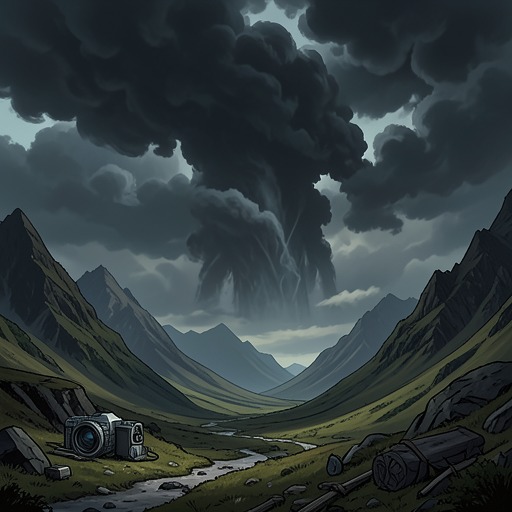
The Final Earth–Mars War
Last and First MenThe Final Earth–Mars War is the last conflict between humanity and the Martian colony, and a catastrophe in which military defeat gives way to mutual extinction. The colony attacks a humanity already fractured by social and mental deterioration. Its first assault briefly reunites the human species; continued defeat then turns that recovered solidarity into an unrestrained appetite for destruction. Humanity deploys a deliberately bred, exceptionally lethal virus despite knowing it will annihilate its own population. Within months, the colony has vanished, the disease has reached Mars, and civilization on Earth is collapsing under the certainty of death.
Background and Stakes
The war comes after a long decline in human vitality. A population once capable of elaborate social life has become increasingly disordered: personal relationships, art, research, and even ordinary pleasures have lost their force. The fear of racial insanity compounds the crisis. Desire turns toward violent excess, treason and corruption become familiar, local groups raid one another, and nationalism returns. The Martian colonists see this disunity as an opportunity for a major offensive, urged on by their home planet.
The Martian colony is itself passing through a phase of enlightenment, a stage that has previously been followed by punishment from Mars. Some colonists are considering harmony with humanity rather than war. The home planet regards this inclination as treason and seeks to overwhelm it by launching a new crusade. The invasion is thus directed not only against a divided human population but also against a possibility of accommodation within the colony. The war’s stakes include the survival of both species and the colony’s ability to suppress its own tentative pacifism.
The Offensive and Humanity’s Reunification
The first Martian attack produces a startling change on Earth. Within weeks, national governments surrender sovereignty to a central authority. Disorders, debauchery, and other perversions cease; the self-seeking, corruption, and treachery that had persisted for centuries are replaced by devotion to the social cause. Humanity appears, for a time, to have recovered its sanity.
That political and moral unity does not bring victory. The war goes badly for humanity, and the Martian forces retain the advantage. As fanatical armies arrive from Mars, the colonists abandon their tentative pacifism and pursue the war ruthlessly, seeking to demonstrate loyalty to their home planet. Human resolve hardens in response, but this is not a return to reason: humanity relinquishes its recovered sanity and becomes consumed by the desire to destroy. The movement from fragmentation to unity is therefore reversed in character. Collective purpose first checks humanity’s internal breakdown; under mounting defeat, it becomes the means by which the whole species endorses its own destruction.
The Virus and Double Extinction
A human bacteriologist announces that he has bred a virus of extraordinary deadliness and transmissibility. It can infect the enemy, but using it will also annihilate humanity. The announcement reaches the public through a broadcast, yet the choice is not debated. The weapon is put into action immediately, with the human population applauding. The decision makes the war’s central horror explicit: facing defeat, humanity does not weigh survival against victory but accepts a measure that guarantees both species’ destruction.
Within a few months, the Martian colony has disappeared and Mars has received the infection. Its population knows that nothing can save it. Humanity’s constitution is tougher than that of the animate clouds, so human beings face a more lingering death; nevertheless, people make no effort to protect themselves from the virus they have spread. Nor do they try to escape the pulmonary plague caused by the disintegrated substance of the dead colony. The weapon’s consequences thus extend beyond infection: the physical remains of the defeated enemy become a further source of mortal disease on Earth.
Collapse and Aftermath
As the expectation of death spreads, the ordinary structures of civilization fail. Disillusion paralyzes the community, and the population sinks into apathy. People stay at home, eat what they can find, sleep late, and avoid one another. Household after household is struck, with neighbors left unaided as communication and mutual support break down. The unburied dead spread corruption among the dying; cities fall silent, and the corn goes unharvested.
The account stresses the species-wide nature of the defeat: even physical suffering cannot displace the anguish of racial failure. Adults do not want to save themselves, and each knows that neighbors do not want to help. Children are the exception to the general numbness; when disease disables them, they experience terror and pain, and their elders tenderly, but listlessly, give them the last sleep. The war ends not in a negotiated settlement or a surviving victory, but in the disappearance of the Martian colony and the breakdown of human civilization. Although the new bacterium is expected to wipe out both populations completely, a small, less-susceptible human stock survives the epidemic in tropical regions, preserving a remnant from which life can continue.