The Last Men's Interstellar Seed-Sowing Plan
Last and First MenThe Last Men's Interstellar Seed-Sowing Plan is the last civilization's effort to project the potential for life beyond its homeworld, making a dwindling species' final work an act of inheritance rather than survival. The Last Men devise tiny systems to ride the Sun's radiation, hoping that some will form primitive life and begin an evolution with a bias toward intelligence. The plan does not promise to preserve human beings as they are: it wagers that descendants of an uncertain process might carry something of humanity's potential into the galaxy.
A Legacy of Power and Restraint
Humanity's approach to matter-annihilating power had once been marked by alarm as much as ambition. At a scientific meeting, a Chinese scientist demonstrated an instrument that could annihilate matter at a distance and in a chosen direction. The meeting unanimously ordered the instrument and every account of its process destroyed, refusing to place such a power in human hands. In a later age, the International College of Science guarded technical secrets, and the union of science and religion established the Sacred Order of Scientists as custodians of knowledge associated with Gordelpus. These episodes frame the long history of knowledge as something shaped by institutions, secrecy, and judgments about whether society is ready to use it.
The First World State eventually relied on coal for much of its power. Even extensive efforts to conserve fuel and develop alternatives could not prevent the exhaustion of the great Antarctic deposits; the resulting crisis contributed to the civilization's collapse. Far later, the Fifth Men achieved a society in which atomic disintegration and matter annihilation helped remove drudgery, while machinery and abundant power supported a vast communal economy. The seed project belongs to a different predicament: it draws not on a promise of limitless terrestrial industry, but on solar radiation as a means of sending life-bearing systems outward. Across these eras, power changes from a weapon to be refused, to an instrument of civilization, to a means of carrying possibility beyond civilization's end.
Design and Intended Journey
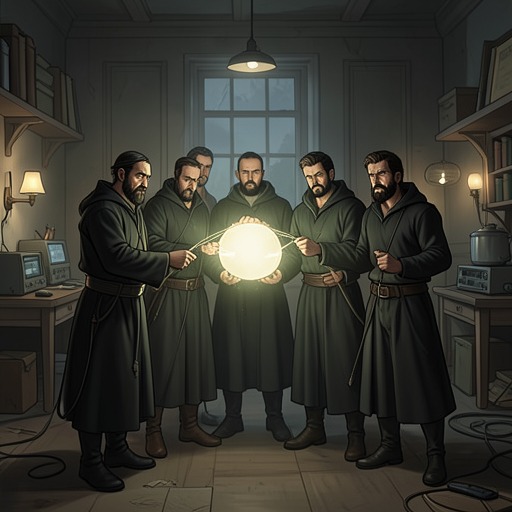
After a year-long experience in which the Last Men lived through racial mentality, they faced two tasks: one concerning the future and one concerning the past. The future task was the scattering of humanity's seed. The proposed units were minute electromagnetic wave-systems, comparable in some respects to protons and electrons, and designed to move on the pressure of solar radiation at a speed approaching that of light. Their intended journey would take them toward promising regions of the galaxy.
The units were not meant to develop directly into human beings. Under favorable conditions, they might combine into life-bearing spores and produce lowly organisms with an evolutionary bias toward essential features of human nature. The Last Men hoped to give these forms a stronger bias toward intelligence than the one present in the sub-vital atomic groupings from which terrestrial life had eventually emerged. This design makes the project a directed biological possibility, not a transport system for existing people and not a guarantee that another intelligent species will arise.
From Proposal to Manufacture
At first, the plan remained difficult and largely prospective. The Last Men expected to release the seed beyond their atmosphere in immense quantities at selected points in their planet's orbit, allowing solar radiation to carry it toward potentially suitable environments. They acknowledged two successive uncertainties: few units might survive the journey, and fewer still might encounter conditions in which life could begin. The hope was that any seed reaching favorable ground could enter a comparatively rapid biological evolution, eventually producing whatever complex organic forms its environment permitted.
About twenty thousand terrestrial years after the earlier account, the undertaking was still unfinished. Only within the preceding few years had the Last Men succeeded in designing an artificial human dust hardy enough to endure a transgalactic voyage lasting many millions of years while retaining the potential for life and spiritual development. They were preparing to manufacture it in great quantities and cast it into space at suitable points in the planet's orbit. The long interval between conception and workable design underscores the difficulty of the enterprise: its ambition was cosmic, but its progress depended on solving the exacting problem of making a minute, durable carrier of life's potential.
A Duty Under the Shadow of Extinction
The project took on its final meaning after the Last Men experienced racial mentality under the shadow of death. That collective episode left them with a new peace, blending grief, exaltation, and laughter, and changed how they understood their remaining time. The scattering of the seed became, for every one of them, humanity's supreme religious duty. Even those who acted against that duty recognized it as the last service the species could perform. They had remained beyond their proper time, the narrator says, in order to complete it.
The duty endured as their world deteriorated. By the time the undertaking had advanced toward manufacture, the Sun had grown brighter and hotter, the climate was becoming increasingly deadly, and storms had damaged great buildings. The Last Men also faced political disorder, economic breakdown, starvation, and the loss of telepathic communication. They considered whether the seeds could truly flourish: even if life took root elsewhere, it might ultimately be destroyed by fire or by the advance of cold. The project therefore promised no escape from extinction, only the possibility of an evolutionary beginning elsewhere.
Hope Without Assurance
The Last Men's own account refuses to turn that possibility into a victory. They concede that any seed's survival and successful development would depend on good fortune; even a thriving descendant would not keep humanity's original theme alive forever. Their stored experience and wisdom might vanish, and the whole mature enterprise of humankind might end with them. The project is thus at once a practical design, a collective obligation, and an act whose eventual beneficiaries cannot be known.
Its force lies in that tension. The Last Men persist not because they can prove that the seed will succeed, but because the task was conceived in a more enlightened state and has become the last office of their species. They also question whether their former selves were truly wiser, and whether a future life born from their work would merely sow a larger harvest for death. The plan does not resolve those doubts. It records humanity's final attempt to make its ending generative, while leaving the outcome beyond its knowledge.