The Last Men's Second Awakening of Racial Consciousness
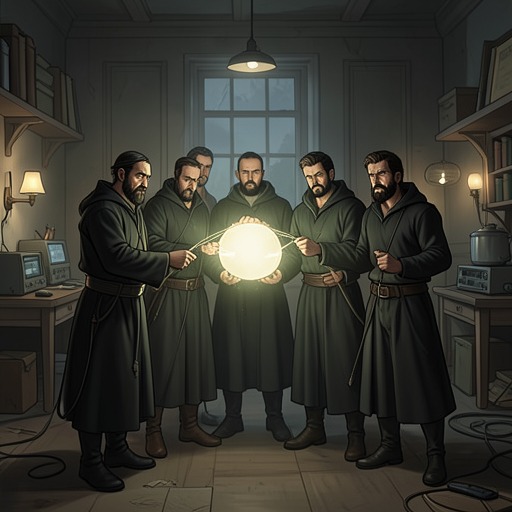
Last and First MenThe Last Men's Second Awakening of Racial Consciousness is the final great collective experience of the Last Men before their extinction. Under the shadow of a star whose violet splendour will destroy them, each individual lives for a whole Neptunian year as part of the racial mind. The experience does not cancel their grief or reverse their fate: it gives them a new peace in which grief, exaltation, and god-like laughter coexist, and sends them toward two tasks, one directed toward the future and one toward the past.
Setting and Historical Background
The awakening belongs to the last phase of a long human history shaped by repeated encounters with material limits. Earlier civilizations had depended on coal, oil, and other finite sources of power. The League of Nations had once imposed cosmopolitan control over fuel and restricted its use, but that policy could not prevent the eventual exhaustion of coal. When the First World State learned that even Antarctica's deep deposits had failed, its citizens could not relinquish the immense expenditure of power devoted to ritual flight; the resulting crisis ended in collapse.
Much later, Patagonian scientists discovered a means of releasing enormous energy by annihilating opposing electric charges in certain atoms. Their discovery offered humanity a source of power that could be manipulated and controlled, though not made foolproof. By the age of the Fifth Men, artificial disintegration of atoms and the annihilation of matter had helped abolish drudgery: machines performed transport, mining, manufacture, and agriculture, leaving people free for research, invention, art, and other demanding pursuits. Across these different ages, power repeatedly enlarged human possibility without guaranteeing that a civilization could master its circumstances. The Last Men's awakening comes after that extended record of achievement and failure, at the point when their own extinction can no longer be evaded.
The Collective Experience
Before the awakening, the Last Men had come to contemplate the human saga as a completed work of art. They could admire it not only for the promise it had contained but for its sudden and tragic end. Their sense of defeat had once made humanity seem impotent and small among the stars; it now brought them into sympathy with the myriad beings whose obscure efforts had preceded them. They regarded the most brilliant people of their own species and the lowliest prehuman forebears as spirits of equal excellence, formed in different circumstances.
That changed perspective preceded the return of racial mentality. For a whole year measured on Neptune, every individual lived in an enraptured trance as the racial mind. In that state, the Last Men resolved ancient mysteries and encountered unexpected beauties. The narrative deliberately leaves the experience itself largely undescribed: its content is called ineffable, and the account records its duration, collective form, and consequence rather than attempting to translate it into ordinary individual knowledge. Its position beneath the shadow of death makes it the flower of humanity's being, not an escape from mortality but an experience made possible within the species' final condition.
Peace and Its Consequences
When the trance ended, the Last Men possessed a peace that belonged to individuals as well as to the race. It blended grief, exaltation, and god-like laughter without reducing one feeling to another. Their reconciliation with their fate therefore did not amount to indifference. The account distinguishes the new peace from passivity: the Last Men still face the knowledge that their race will end, but the collective experience changes how they meet that knowledge and what they believe they owe to life.
The awakening immediately discloses two tasks that had not previously been contemplated. One concerns the future; the other concerns the past. This division gives the episode its structure and its consequence. The Last Men are no longer occupied only with how to live nobly through their remaining time. Their new collective understanding expands their responsibility beyond their own lifetime, both toward possible forms of life to come and toward the human beings who came before them.
The Future and the Past
The future-directed task is to scatter the seeds of a new humanity among the stars. The Last Men plan to exploit solar radiation, especially the more potent radiation expected later, to propel minute electromagnetic systems. These units must be interrelated so that under favourable conditions they can combine into life-bearing spores. They are not intended to become human beings directly, but to develop as simpler organisms with an evolutionary bias toward the essentials of human nature. The proposed seed would carry a physiological bias toward intelligence stronger than the one involved in the emergence of terrestrial life. The chance of survival and of finding a suitable environment remains small; the awakening inspires a difficult attempt, not confidence in success.
The task directed toward the past is an effort to know and love every human mind the Last Men can enter. They describe this work as an act of filial piety: knowing another being lovingly creates a new value in the cosmos. Their aim is inclusive, extending even to the least and worst of the people who lived before them, whom they seek to understand with greater insight than those people possessed of themselves. This commitment draws on the long human record preserved and recovered across civilizations: the First World State's collapse, the Patagonians' reconstruction of ancient history from durable metal plates, and the Second Men's recovery of the broken Siberian Stone Library each show how the past can survive in fragments and be reinterpreted by later generations. For the Last Men, historical understanding becomes more than the recovery of information; it is a relationship of attention and admiration.
Significance in the Final Narrative
The awakening binds the Last Men's two responses to extinction into a single episode. Their acceptance of the human story as a completed work enables them to grieve its end without treating it as meaningless; their experience as the racial mind then gives that acceptance practical consequences. They turn outward toward a possible future beyond their world and backward toward the minds that made their own existence possible.
The two tasks are not equally congenial. The Last Men would gladly spend their remaining time enriching their community and pursuing the exploration of the past, but the production and projection of artificial human seeds demand prolonged physical research and worldwide manufacture. They expect the work to continue as their own physical constitution is undermined and their community begins to disintegrate. To sustain it, they return to the past not merely as scholars but as inheritors seeking renewed loyalty to life. The awakening thus marks a transition from private reconciliation with death to collective action: the Last Men preserve their peace while struggling for a future they may never witness.