The Last Men’s awakening to racial consciousness
Last and First MenThe Last Men’s awakening to racial consciousness is the moment when individual awareness rises beyond the Group-mind and becomes the mind of the race. It is not merely the ability to communicate across the planet: the individual experiences the bodies and perceptions of the entire species as a single self. This rare, precarious state enlarges consciousness in space and time, but its beauty is inseparable from a vision of evil and defeat that ordinary minds cannot bear to recall clearly.
From individual to racial self
The awakening develops from earlier forms of shared mentality. Individuals ordinarily participate in sexual groups that function as super-individuals: each Group-mind has its own character and experience, while its members pursue different professions rather than being assigned to a single collective task. When individuals return to ordinary selfhood, they cannot retain clear insight into the group’s highest experience, but they remember enough to let it guide their conduct. The racial experience goes further. The Group-minds themselves have become specialized in functions within the mental life of the race, and an individual may, very rarely, pass beyond them and become the mind of the species.
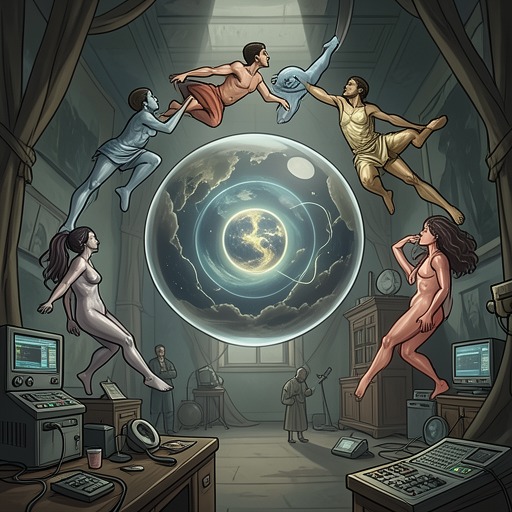
Ordinary Telepathy already allows individuals to communicate across the planet, and sometimes the entire race listens while one person addresses the world. The awakening is categorically different. A system of radiation embracing the planet and including the brains of the race becomes the physical basis of a racial self. The individual discovers that this self is embodied in all the bodies of the species: it feels bodily contact across the race, sees through every eye, and apprehends the many visual fields together. The planet’s surface becomes a continuous, varied sphere, grasped through the countless feet of its inhabitants. This is not communication among separate people but a transformation in who is experiencing.
A planet and a cosmos held together
The racial mind also stands above the Group-minds as they stand above individuals. It regards them at once with the detached attention of an observer, the sympathy and reverence directed toward living tissues, and the fascination one might feel for the varied lives of others. The account compares this breadth of regard to watching both the cells of one’s own brain and an ant hill, while also watching oneself and one’s companions struggle in a desperate venture. Above all, the racial self sees as an artist concerned with vision and its embodiment. These perspectives do not cancel one another; they coexist within an enlarged field of attention.
Perception expands beyond the planet. Through all eyes and observatories, the racial mind sees the world in its voyage and looks outward into space, combining viewpoints that would otherwise belong to separate observers: deck-hand, captain, stoker, and lookout. From both limbs of Neptune, it perceives the planets and the Sun stereoscopically. Its perceived present lasts long enough for the movement of stars to become visible: as the world travels along Neptune’s wide orbit, nearby stars shift, and some constellations acquire three-dimensional form. With the latest instruments, even the galaxy appears stereoscopically. Yet this widened sight has a limit. Great nebulae and remote universes remain marks on a flat sky, and their distance makes the racial self aware of its own minuteness and impotence.
The enlarged present and its paradox
The awakening transforms time as radically as space. Individual consciousness can hold a duration equal to the old terrestrial day within its present and distinguish rapid pulsations within that span. In racial consciousness, the present includes the whole period since the oldest living individuals were born, while the history of the species appears as personal memory, reaching back toward its infancy. The racial mind can also distinguish events as minute as one light-vibration from the next. Greater temporal breadth and precision are presented as compatible; the deeper puzzle is how a mind can experience as present an immense past during which it did not exist.
The first experience of racial mentality lasts only as long as Neptune’s moon takes to complete one circuit. The racial mind therefore exists for only that period, yet within it the whole previous career of the race appears present. The Last Men cannot resolve this apparent impossibility after returning to individual consciousness. Their recollection preserves the perplexity, but not a clear account of how the experience could have held together so much time. The episode makes the limits of individual memory part of its subject: the mind can know that it once exceeded its ordinary scale without being able to reproduce that knowledge afterward.
Beauty, horror, and the human past
The racial mode also brings philosophical insight into space and time, mind and its objects, and cosmic striving and perfection. That understanding cannot be fully communicated, or even clearly remembered once consciousness declines from the racial state. What remains is an impression of extreme subtlety and beauty, accompanied by an equally powerful awareness of horror. The Last Men recall having looked into an abyss of evil they cannot now conceive and could not endure to conceive. Yet they are convinced that even this hell was acceptable as an organic member of the austere form of the cosmos.
This acceptance does not depend on victory. The Last Men remember, obscurely but with conviction, that the long striving of the human spirit and the private cravings of individuals appeared as elements in something more admirable than either alone. Humanity’s defeats, no less than its temporary triumphs, contributed to that higher excellence. The awakening thus alters the scale at which tragedy is judged: what appears unbearable from within an individual life can be apprehended as part of a larger order, without ceasing to be evil or suffering.
The account places this capacity in a long, uneven history. The First Men glimpsed something of it through their respect for tragic art; the Second Men and, more deliberately, the Fifth Men sought it; the winged Seventh Men encountered it in flight. But those earlier experiences remained confined to a small world and its tragic story. The Last Men claim a fuller, intelligent access to the same kind of transfiguring vision, in both private and racial life and across subjects inconceivable to lesser minds. Their awakening is therefore not simply a new power of collective perception. It is the culmination of an intermittent human effort to see particular lives and historical defeats within an encompassing beauty—an effort whose deepest insight survives the experience only as partial, troubled recollection.