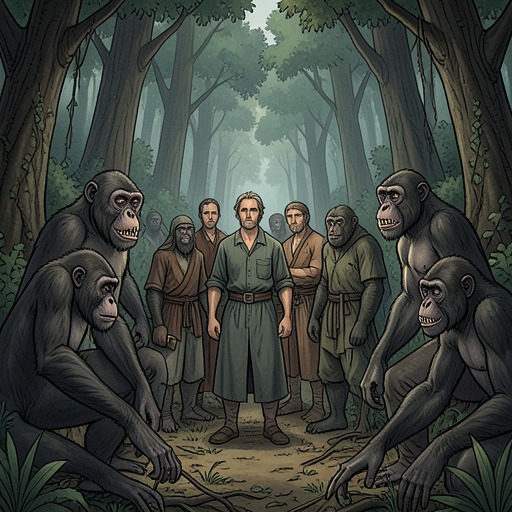
The Second Men's Expedition Encounters the Ape-People
Last and First MenThe Second Men's Expedition Encounters the Ape-People is a turning point in the Second Men's exploration of Africa: a search for metals brings them face to face with the only terrestrial species described as having evolved far enough to compete with humanity in practical ingenuity. The encounter reveals not only an unexpected rival intelligence, but also the Apes' domination of the Sub-men and the Second Men's unusual response to lethal hostility: they return in force, yet choose communication and trade over revenge.
The African expedition
By this time the Second Men had moved beyond pastoral life into agriculture, and their culture had spread across a vast region. An expedition crossed the newly formed Hindu Kush to explore Africa, where it encountered descendants of a ship's crew that had sailed from Siberia millions of years earlier. Those descendants had spread south through America and crossed the new Atlantic Isthmus into Africa. The explorers were only a small party of pioneers, searching for metals brought near the surface during a volcanic era. Their journey thus joined resource-seeking to a wider encounter with the life that had developed in the long interval since the crew's voyage. In Africa, the Second Men found not just the altered descendants of that crew, but a distinct species capable of organizing resistance to their arrival.
The Apes and the Sub-men
The Apes were diminutive and lived among the trees. Their practical abilities were evident in their use of bows and poisoned arrows, their tools, and their coordination in warfare. The Second Men's advance was opposed because the Apes resented interference with the passive Sub-men in the region. The Apes' resistance made them more than an unfamiliar forest people: they were, in the account, the only terrestrial species besides humanity to have developed enough versatility and practical shrewdness to compete with it. The explorers later learned that the Apes had made the Sub-men their dependants. The Sub-men were trained as beasts of burden and their flesh was eaten by the Apes. In a forest settlement, the explorers saw them hauling timber for an arboreal city woven from branches, while the Apes drove them with spears. The Apes also maintained authority through intimidation: an aromatic plant's juice, applied to themselves, terrified the Sub-men and kept them docile.
The attack and return
The Second Men were an amiable people and initially felt no hostility toward the Apes; they regarded their habits and ingenuity with amusement. The Apes, however, resented the presence of more powerful visitors. Gathering in the treetops in large numbers, they attacked the expedition with poisoned arrows and killed all but one of its members. The lone survivor escaped into Asia. Within a couple of years, he returned with a host. The larger party did not come to punish the Apes. Instead, the Second Men settled near the forest and found ways to communicate and barter with its inhabitants. In time, the Apes permitted them to enter the territory without opposition and begin their metallurgical survey.
Significance of the encounter
The episode turns an expedition for mineral resources into a test of how one intelligent society meets another. The Apes' ability to organize a lethal defense exposes the danger of treating them as merely curious or amusing, while the Second Men's restraint after the attack distinguishes their conduct from a simple cycle of retaliation. Their eventual access to the forest comes through communication and exchange, not conquest. The encounter also brings the Sub-men's subjection into view: they are simultaneously a labor force under the Apes' control and a population whose situation the Second Men discover while pursuing their own survey. The narrative's emphasis falls on the contrast between the Apes' ingenuity and the Second Men's capacity to respond without turning the expedition's losses into a punitive war.