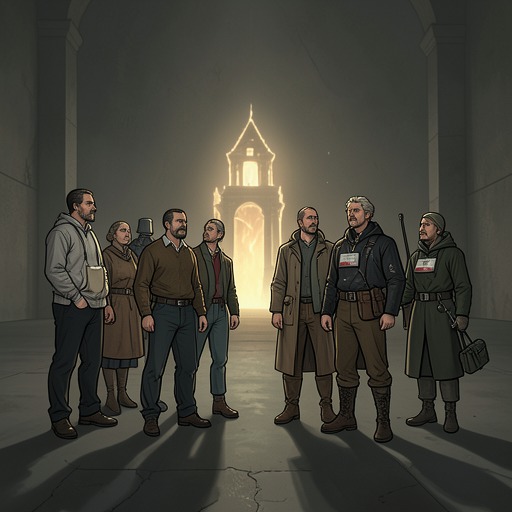
The Second Men's Religious War
Last and First MenThe Second Men's Religious War was the first and last worldwide civil war of the Second Men, turning a fragile effort at global unity into an exceptionally destructive struggle over faith. Its aftermath was not simply political collapse: the war left its survivors with an overwhelming sense of having betrayed the human spirit, and the Second Men did not rebuild a world-community for thousands of years.
Background and Religious Division
The war followed the Second Men's attempt to bring several peoples into a shared world order. That unity endured only a few centuries. Profound differences beneath the apparent agreement made wholehearted loyalty difficult, and religion finally broke the bond that all had wanted but none could fully trust.
The immediate division set an explicitly monotheist nation against a broadly pantheist world. The monotheists sought to impose their faith, making religious allegiance the cause of a conflict that engulfed the Second Men's world. The account presents the war as a failure of unity that had been willed but never securely established.
Course and Destruction
The opposing forces fought as citizen armies, using crude artillery as well as religious fanaticism. The struggle widened beyond armies and battlefields: fields were laid waste, cities burned, and contamination reached rivers and, eventually, the winds.
The violence continued even after the destruction had passed a point at which a less resilient species might have lost heart. The Second Men continued organizing it, a persistence that makes the eventual collapse more than a military defeat: the war consumed the capacity of the society that sustained it.
Collapse and Aftermath
When the breakdown came, a devastating recognition spread through the people. They felt the enormity of their betrayal of the human spirit and the tragic absurdity of the struggle. That understanding did not immediately restore solidarity. Instead, it sapped the energy needed to rebuild, and thousands of years passed before the Second Men again achieved a world-community.
The historical account says that they had learned from the war. Their later civilization avoided repeating its errors of industrial development, aided by a powerful sympathy that made people vividly conscious of one another's lives. The contrast gives the conflict a lasting consequence: its lesson shaped what followed, but only after an immense interval of disunity.
Historical Significance
The war marks the sharpest contradiction in the Second Men's history: a people capable of heroic endurance and eventual moral understanding nevertheless organized destruction on a global scale. Religion, which might have supplied common purpose, became the instrument through which latent differences overrode the desire for unity. The long delay before a new world-community shows the cost of that failure was measured not only in immediate devastation, but in millennia without a shared civilization.