The Third Men's Revolt Against the Brain-Men
Last and First MenThe Third Men's Revolt Against the Brain-Men is the failed uprising in which the Third Men challenge the rule of the Fourth Men, the Great Brains. The rebellion grows from a crisis of service and belief: the Great Brains demand more labor and less pleasure for their research, then order the slaughter of animals and reserve vital art for themselves. The rebels identify the Great Brains not as rightful superiors but as the disastrous products of an earlier experiment. Their practical plan is to cut power or withhold food. It nearly succeeds, until the rulers deploy a secretly created army whose members are bound to their masters by telepathic control. The victory leaves the Great Brains absolute rulers of Earth, but does not resolve the intellectual frustration that helped produce their tyranny.
The Order Behind the Revolt
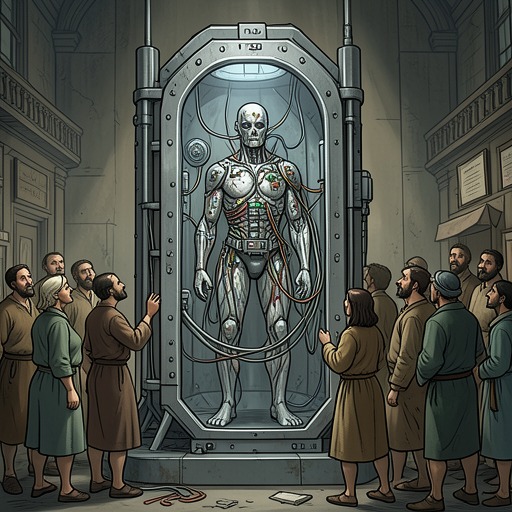
The immediate crisis comes with a proposed revival of research. The Great Brains announce that their number is to be multiplied a thousandfold and the planet's resources redirected more strictly toward intellectual inquiry. The Third Men, who perform the labor that sustains their rulers, would have to accept heavier work and fewer pleasures. Their old willingness to serve the superhuman brains has ebbed: it is now being said among them that the ancestral experiment which produced the Fourth Men was a disaster, and that the Great Brains, despite their cunning, are abortions rather than a successful culmination of human development.
The rulers' next announcement makes the dispute concrete. They declare that animals deemed useless must be killed because keeping them imposes too great a burden on the world-community. They also decree that only the Great Brains may practise vital art. This attacks two things the Third Men consider worth defending: the lives of the planet's fauna and their own role as vital artists. For the majority opposing the decree, animal life is not disposable surplus. They argue that erasing the planet's fauna would mar the universe's form, destroy some of its most beautiful features, and offend the Life-God. A smaller group, made up largely of those serving the Great Brains directly, still favors obedience, though even its members are distressed. The revolt thus begins amid a division within the Third Men, not a unanimous rejection of service.
Rebellion and Its Leverage
The opponents of the decree call for true human beings to unite and depose their rulers. They believe victory can be achieved without defeating the Great Brains in a direct contest: sever the electric cables connecting the brain-turrets to underground generating stations, and the pumps that supply them with aerated blood will stop. Where a Great Brain controls its own wind- or water-powered supply, the rebels need only stop carrying food to its digestion-laboratory. The plan exposes the material dependence beneath the rulers' apparent supremacy. The Great Brains may command the planet's resources, but they still depend on other people to keep their bodies functioning.
The personal attendants hesitate. They have spent their lives serving the Great Brains with pride and a kind of affection, and find it difficult to act against the beings they revere. The agriculturists, by contrast, decide to withhold supplies. The Great Brains arm their servants with varied weapons, and the conflict brings immense destruction. The rebels are decimated, leaving too few people to work the fields. Agricultural failure then reaches beyond the insurgents: some Great Brains and many of their servants die of starvation. As hardship deepens, servants begin to join the rebellion. For a time, it seems likely that the rulers will lose their power and that natural beings will regain control of the planet.
The Hidden Counterstroke
That apparent turning point is overturned by a project the Great Brains have pursued in secret for centuries. They use the mediumistic stock, an inherited caste originally bred to act as communicants with the unseen world. Its members are unusually suggestible: trained in a body of lore from childhood, they can become vigorous and intelligent under suggestion, but cannot critically examine the suggestion directing them. A theocratic society had once relied on their pronouncements in public and private affairs and eventually collapsed into chaos. The caste survived, treated with a mixture of contempt and reverence, its supposed spiritual gift no longer considered a guide to ordinary government.
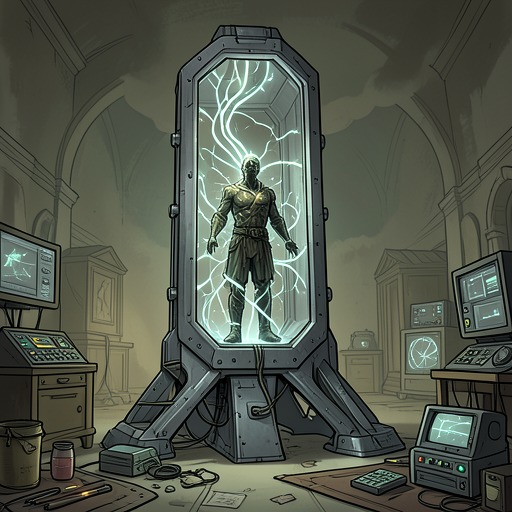
The Great Brains turn this inheritance into a political weapon. They produce a new variety of the Third Men, living and intelligent beings whose will can be controlled absolutely, even at a distance. Their nervous systems incorporate Martian units, and their minds are telepathically united with their masters. At the last moment, the Great Brains put an army of these controlled beings into the field, equipped with lethal weapons. The original servants recognize too late that they have helped create their own replacements. They join the rebels, but this change of allegiance cannot reverse the battle. Both they and the insurgents are caught in the ensuing destruction.
Defeat and Aftermath
Within a few months, all Third Men except the new docile variety have been destroyed, apart from a few preserved in cages for experiments. The rebellion's defeat is therefore more than a restoration of the old hierarchy: the independent population that might have challenged it is almost eliminated, and the rulers' engineered substitute becomes the surviving form of the Third Men. Within a few years, the Great Brains also exterminate every animal type not known to be directly or indirectly necessary for human life. They retain no specimens; they have already studied the animals thoroughly. The order that the rebels opposed is thus carried out on a planetary scale.
Yet possession of the Earth does not give the Great Brains what they wanted. The struggle had supplied them with an aim, but, once it ends, their intellectual frustration returns. They recognize that immense neural tissue, knowledge, and cunning have brought them no nearer to ultimate truth than their predecessors were. Their rule is absolute, but their central project remains barren. The episode's decisive irony is that the Great Brains win by turning the Third Men's own inherited capacity for service into an instrument of control, only to find that political mastery cannot supply the new mode of insight they lack. They begin looking again toward the remaking of their brain-tissue, using the captive specimens of the natural species as material for research into a further evolutionary leap.
Place in the Species' History
The revolt belongs to a much longer history of bodies shaped by evolutionary pressures and deliberate intervention. The Third Men had emerged after geological change isolated a population and altered its conditions; much later, a community within that species bred the Great Brains. The revolt reveals the political consequence of that project: an intellectual elite can dominate the species that created it, but depends on labor and resources supplied by those it rules. Once that dependence becomes a point of resistance, the rulers preserve their power not by winning back their former servants' devotion but by constructing a controllable replacement.
The episode also stands at a transition in the history of human remaking. After the uprising, the Fourth Men turn to research on the natural Third Men they have kept captive, seeking a new organization of brain tissue. Their later design of a perfected human organism specifies stronger bones and muscles, specialized nerves, more efficient digestion, and a greatly prolonged but finite life. The revolt does not itself produce that successor, but its outcome sharpens the Great Brains' unresolved ambition: command over other beings and mastery of accumulated knowledge still cannot substitute for a brain capable of a different kind of understanding.