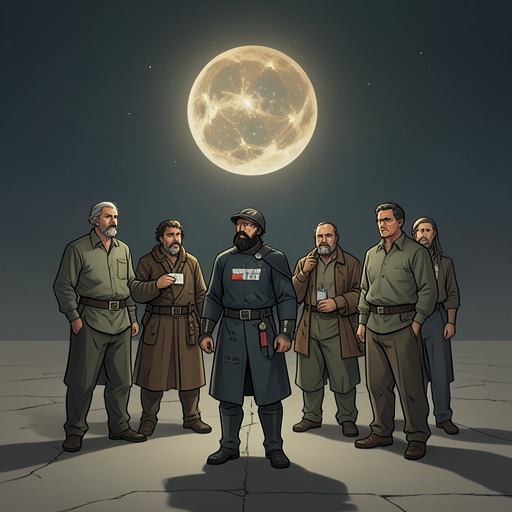
The youngest of the Last Men
Last and First MenThe youngest of the Last Men is the final child conceived before the Last Men learn that humanity is doomed and cease conceiving. Though he shares their suffering in a dying world, he is described as unusually able to withstand it and to bring peace to those around him. The Brotherhood of the Condemned looks to him for strength, and his words, rather than the narrator’s, are chosen to close the story. His importance lies in that double role: he is both a living exception among the doomed and the voice through which the ending weighs human achievement against cosmic indifference.
Identity and place among the Last Men
The brotherhood’s account identifies him by the circumstance of his birth: he was conceived last, before the discovery of humanity’s fate brought conception to an end. The narrator calls him the noblest of his generation, while also making clear that the generation itself is honored. His distinction is therefore not simply that he is the last individual born. He stands as the youngest representative of a generation regarded as a source of strength when the older survivors can no longer sustain their former confidence.
His exceptional quality is described in spiritual rather than physical terms. The narrator explains that the spirit is flesh awakened into spirituality, and says that in him this spirit can resist the tempest of solar energy longer than it can in the others. The comparison to an eclipse reverses the expected scale: the Sun’s power is vast, yet for a time the young man’s inward brightness seems to eclipse it. This is not a claim that he escapes the world’s decline. Like the others, he suffers; his distinction is that suffering does not wholly govern his response.
Among the Brotherhood of the Condemned
The Last Men have formed the Brotherhood of the Condemned to strengthen one another, maintain the human spirit, and continue their undertaking until the seed has been sown and death becomes permissible. They meet in small groups or larger companies. These gatherings do not reliably bring consolation: sometimes the members sit in silence, and sometimes speech offers only a brief light, with little warmth for those who remain distressed. The young man moves from place to place and company to company within this community, and his presence becomes something its members long to encounter.
His consolation has a distinctive manner. The narrator describes a “strange sweet raillery” that can persuade a sufferer to smile at personal pain. The detail matters because his effect is not presented as an argument that pain is unreal or inconsequential. Rather, he can alter the sufferer’s relation to it, briefly making room for a smile without denying the distress. His presence also changes the mood of the group: when he contemplates the dying world and the frustration of human striving with them, his quietness helps despair become peace.
Speech, empathy, and composure
The young man’s influence depends both on what he says and on the manner in which he speaks. His reasoned speech can open the listeners’ eyes, while, in the narrator’s account, even the sound of his voice seems to fill their hearts with exultation. The effect is communal: the brotherhood gathers to strengthen one another, but his appearance gives its members a particular source of steadiness. He is not merely a recipient of their admiration; he helps them endure the same circumstances that have weakened them.
The narrator also distinguishes his sensitivity from simple pity. He feels the suffering of others more than the rest of the brotherhood, yet is said to be “above his pity.” In context, this describes a composure that allows him to comfort rather than be overwhelmed by another person’s pain. That composure does not make him indifferent: his ability to understand distress is precisely what makes his comforting effective. His quiet response to humanity’s defeat likewise contrasts with the older survivors’ dismay, without suggesting that he has failed to grasp the scale of their loss. His words can be grave even when his presence brings peace.
The closing address and its limits
The narrator explicitly yields the ending to the young man, presenting his address as the words that should close the story. The speech begins by setting human smallness against the stars, but refuses to equate smallness with worthlessness. Humanity’s achievement may be small, it argues, yet it is actual; the human being is “a fair spirit” who is conceived by a star and killed by one. The speech thus turns the account of extinction into a question about what can remain significant when survival is impossible.
It does not offer an uncomplicated triumph. Humanity had hoped to progress further, to become the Flower of All Things and to attain all-knowing and all-admiring understanding. Instead, the speech likens it to a fledgling caught in a bush-fire: limited in knowledge and admiration, and unable to hear the Music of the Spheres that passes through the greater order of things. Even the thought that the Whole uses humanity’s destruction is examined rather than accepted as a certainty. The address asks whether agony truly enhances the Whole’s beauty and whether that Whole is beautiful at all; humanity, it concedes, cannot be sure it has heard a perfect cosmic music, or that such music exists.
The ending’s firmer claim is narrower and human-centered: humanity itself is music, and a beauty within the eternal form of things. The young man’s final movement is from doubt about cosmic purpose to gratitude for having been human, and to the hope that humanity can make a fair conclusion to its brief existence. His role is therefore not to resolve the brotherhood’s questions with proof. He gives voice to an affirmation that acknowledges uncertainty, loss, and human limitation while still allowing the survivors to go forward together with peace and laughter.