Union of Science and Religion
Last and First MenThe Union of Science and Religion transforms scientific prestige into religious authority and religious belief into a framework for governing science. Among the First Men, this was not simply a reconciliation of competing explanations of the world: it created a powerful institution around a secret that scientists did not actually possess, then made devotion to activity a sacred social obligation. Its eventual dominance shows how a civilization can sanctify the authority of knowledge while losing the habits of inquiry that might test its claims.
Scientific Authority and the Rumour of a Secret
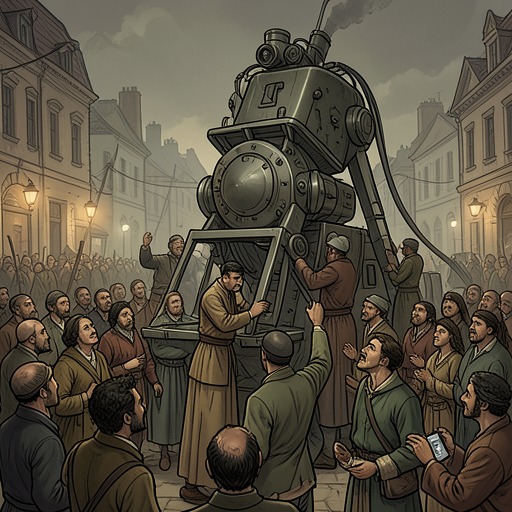
Science held exceptional honour among the First Men, but chiefly because its practical applications had changed material life. Scientific knowledge had grown too vast for any one person to master, and the scientists’ most brilliant work lay in improving industrial techniques rather than pursuing pure intellectual curiosity. Meanwhile, scientific doctrines were hardening into dogma. The scientist had become an emblem of power as much as knowledge, making extraordinary stories about scientific capabilities easier to believe.
A century after the founding of the First World State, rumours in China claimed that a supreme scientific secret could release the energy locked in the opposition of proton and electron. The legend attached the secret to the Discoverer, who was said to have entrusted it to scientists because humanity was not ready to use it. Religious traditions gave the same figure different identities: the Energists regarded him as an incarnation of Buddha, while the Regenerate Christian Brotherhood treated him as the Son of God returning to bring about a millennium. In both accounts, he had withheld a power that would transform the world and suffered for humanity’s unreadiness.
The rumour flourished within a scientific profession organized as a closed corporation. Admission to the International College of Science required examination and high fees; membership conferred the title of Scientist, permission to conduct experiments, and access to lucrative posts. Members were also said to be bound to secrecy about technical matters, and a reported case of a member’s mysterious death after revealing too much deepened suspicion. As specialized knowledge fragmented into fields that even neighbouring specialists struggled to understand, no department was eager to deny that another might possess the secret. Professional boundaries and secrecy thus lent credibility to what the scientists’ conduct left unconfirmed.
The Conference and Institutional Merger
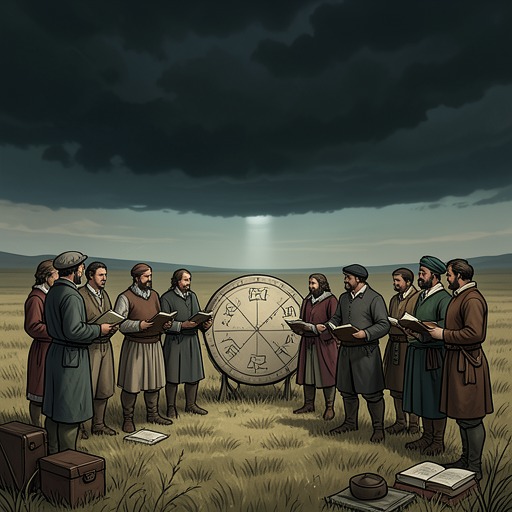
About two centuries after the formation of the First World State, its President declared the time right for a formal union of science and religion and convened leaders of both. They met on an Island in the Pacific that had become a centre of cosmopolitan sentiment and a vast, many-storied Temple of Peace. Leaders of Buddhism, Islam, Hinduism, the Regenerate Christian Brotherhood, and the Modern Catholic Church in South America agreed that their differences were differences of expression. They shared worship of divine energy, understood as either activity or tense stillness, and accepted the saintly Discoverer as a supreme prophet or an incarnation of divine Movement. Modern science, the conference asserted, made these concepts compatible.
The method of reconciliation mattered. Earlier societies had suppressed heresy through force; this conference pursued uniformity by explaining differences away, to general applause. It then carried the same logic across the boundary between religion and science. The President treated the widespread belief that some scientists possessed the secret as sufficient reason to merge their organizations for the guidance of humanity. The International College of Science was asked to nominate a select group, which the Church would sanctify as the Sacred Order of Scientists. Supported at public expense, its members were to devote themselves to science and, in particular, to discovering the most scientific manner of worshipping Gordelpus, the god of motion.
The new Order joined professional status, religious consecration, and public support in one body. Some scientists present looked uncomfortable, but most appeared pleased beneath their show of hesitation. Among the priests, too, reactions differed, though the Church broadly stood to gain by gathering science’s unique prestige into itself. The Order became a dominant force in human affairs, lasting until the downfall of the first world civilization.
From Merger to Sacred Social Order
The union supplied an institutional home for the culture’s central conviction: movement was divine. Gordelpus, the god of motion, demanded swift and intricate activity from human beings, and an individual’s hope of eternal life depended on fulfilling that demand. Although science had long since undermined belief in personal immortality as a natural human attribute, a compensating doctrine promised that people justified through action would be miraculously preserved in the swift spirit of Gordelpus. From childhood onward, muscular exertion and the control of natural forces alike could satisfy the sacred duty to produce motion.
Scientific activity itself acquired a devotional purpose. The scientists’ principal undertaking became the mathematical description of ritual movements, industrial machinery, and observable natural phenomena. The records entered the Sacred Order of Scientists’ archives. This immense work was believed to transfer evanescent movement into the eternal being of Gordelpus. Quantification therefore did more than support practical industry: within the merged order, it served as a religious means of preservation.
This faith also constrained what counted as acceptable inquiry. Reasoning was permitted within official work, but research and experimentation required costly licences, granted only when a proposed aim could be shown to increase world activity. Criticism of established practice was treated as dangerous, while new methods inconvenient to the Sacred Order of Scientists were suppressed. Mathematical description flourished, but the use of reason to question the civilization’s ends did not. The union’s prestige thus accompanied a narrowing of scientific freedom, not an open-ended enlargement of it.
Ritual, Control, and the Limits of the Union
The worship of activity shaped private conduct as well as scholarship. Instinct was revered as a source of divine energy, but its impulses were subordinated to the supposed fundamental instinct of worshipping Gordelpus through action. Sexuality, considered both sacred and dangerous, was strictly regulated: public reference to it was restricted, and sexual activity and knowledge were barred until a person passed the aviation test known as Wing-Winning. Those who never passed remained excluded. After initiation, people could enter an indissoluble domestic marriage and, if they met a more demanding aviation standard, additional symbolic unions that could be dissolved but were not to be discussed publicly. These rules show how the civilization’s sacred ideals governed eligibility, knowledge, and intimate life.
The merger’s authority could also be exposed by a scientific decision that refused the promise of power. At a scientific meeting, a young Chinese scientist demonstrated an instrument capable of initiating the annihilation of matter at a distance and in a chosen direction, and of inhibiting the process. He presented it as both a perfect means of destruction and a source of potentially unlimited constructive power. The meeting nevertheless voted unanimously to order the instrument and every account of its operation destroyed. The episode does not establish that the later religious institution caused this decision; rather, it offers a pointed contrast between a scientific body confronting the danger of a technology and a civilization that later sanctified the belief that scientists guarded a world-transforming secret.
The union’s deeper failure emerged when material conditions deteriorated. The First Men’s civilization concentrated its energies on maintaining its established routines, and, after millennia, essential power sources were exhausted. By then the race lacked the mental agility to meet the crisis, and the social order collapsed. The Sacred Order had made science and religion mutually reinforcing sources of authority, but its rituals and controls did not ensure the capacity for adaptation. The resulting civilization could describe movement with extraordinary precision and worship it as eternal, yet could not respond effectively when the material basis of its activity failed.