United States
Last and First MenThe United States is presented as one of the central powers of the First Men’s history: a confident nation whose financial reach and mass culture extend across the planet, and whose rivalry with Europe and China repeatedly turns economic dependence into political crisis. Its influence helps bind the world together, but it does not dissolve national antagonisms; at crucial moments, it intensifies them.
A planetary power
In the era following the European conflicts, the United States openly claimed responsibility for the planet’s welfare. It was widely feared and envied, respected for its enterprise, and often despised for its complacency. The account emphasizes the material reach behind this reputation: people around the world used products from the United States, and its capital supported local labor in every region. Its press, gramophone, radio, cinema, and television carried its ideas and popular entertainments across borders, making its cultural presence difficult for other societies to escape.
That reach was also selective. The narrator argues that mass communication transmitted the least admirable traits of the United States more effectively than its rare achievements, so that its influence could corrupt other societies as well as its own more thoughtful citizens. The criticism is not that the country lacked intellectual or creative capacity, but that its scale of influence made the distinction between its best and worst consequential for the whole world. The United States could therefore shape distant lives without persuading them that its leadership deserved their trust.
Finance, Europe, and the limits of unity
The United States’ economic power affected Europe even when it did not rule it directly. American finance contributed to Russia’s industrial organization, reaching across a vast territory from the Baltic to the Himalayas and the Behring Straits. This dependence created a political distortion: Russia’s official communist creed survived, but its practice was undermined by the influence of Western finance, especially capital from the United States. Germany became the object of Russian hostility, although the account identifies the United States as the more important force behind Russia’s economic transformation. Dependence made resentment difficult to direct at its actual source.
European opposition to that reach grew alongside anxiety about American business influence. After the Russo-German War, Europeans increasingly feared that their own societies would fall under the same financial domination as Russia. The European Confederacy pooled armaments and placed the sovereignty of its member nations under a common authority, ostensibly to preserve peace. The United States interpreted the arrangement as directed against itself and withdrew from the League of Nations, while China remained within the League in the hope of using it against its rival. Europe’s unity was thus real but insecure: the nations increasingly shared a fear of the United States even where they lacked a deeper common loyalty.
War across the Atlantic
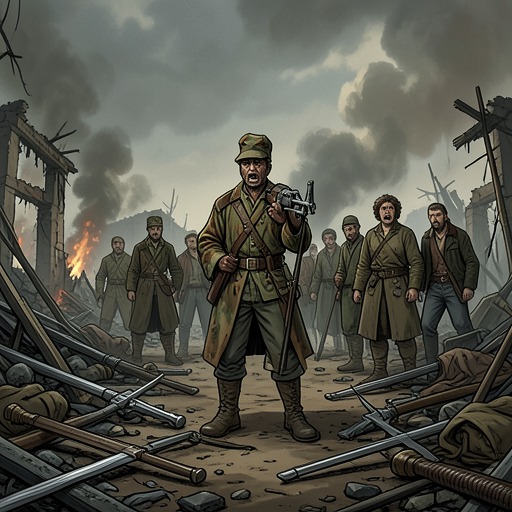
The Euro-American conflict grew out of prolonged friction rather than a declared intention to fight. Europeans resented the presence of a powerful American business class whose influence constrained their daily lives; Germany, though less economically dominated, was not free of conflict with the United States. Both sides understood that war could destroy prosperity and might prove fatal to Europe, but an escalating chain of incidents overcame that caution. A murder in South Italy was followed by inflammatory press exchanges, the killing of an Italian in the Middle West, a massacre of Americans in Rome, and the dispatch of an American air fleet to occupy Italy. The European air fleet intercepted it, and war was underway before either side formally declared it.
The later defeat of the American fleet did not end the danger. The American commander had been instructed to demonstrate force above England while peace was being negotiated; large businesses had threatened a boycott if the government committed unnecessary violence in Europe, since destroying Europe would destabilize American finance. But the fleet’s unprecedented annihilation provoked such intense anger that the peace faction was submerged. The narrative presents this reversal as a bitter consequence: the hostile act by a Chinese individual had not saved England but instead helped doom it. Military power, corporate interests, and the prospect of peace pulled policy in different directions, and the catastrophe changed which of those forces prevailed.
Rivalry over fuel and the world order
A later contest with China repeated the pattern of interdependence turning into confrontation. After the Euro-American War came a century of smaller national conflicts and then a century of strained peace. The population was increasingly internationalist and pacifist in conscious belief, while the older impulse toward tribal conflict remained ready to return. Economic integration did not remove that tension; it made disputes over shared resources a threat to the whole system.
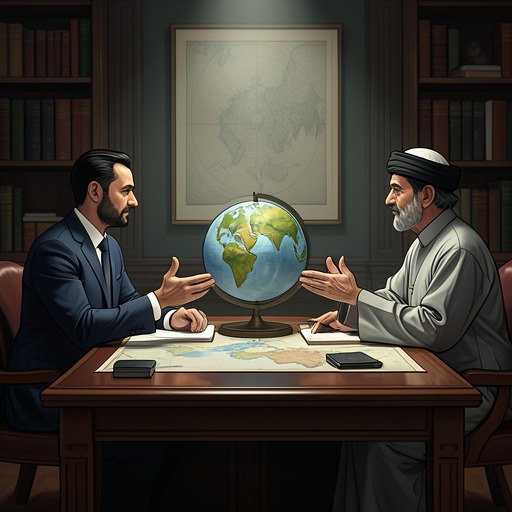
Fuel became the immediate focus. Following an earlier oil famine, the League of Nations established cosmopolitan control over existing oil and coal fields and restricted fuel use to purposes for which no alternative power source could serve. This policy endured even after the League itself was superseded. When new, immense fuel deposits were found in Antarctica, however, they lay beyond the jurisdiction of the World Fuel Control Board. The United States moved first, viewing the supply as a means of national advancement and of extending its influence. China, fearing that expansion, demanded that the deposits be placed under the Board’s authority. After years of intensifying dispute, both powers returned to nationalism and war seemed nearly inevitable.
The eventual move toward world unity involved the United States as well as China. Concerted action by cosmopolitan business interests in both countries crippled their military governments through passive resistance. In China the change was almost bloodless; in the United States, disorder lasted for several weeks as the government tried to suppress the resistance under martial law. The population’s desire for peace helped make opposition to the old governments irresistible, despite the shooting of some business magnates and the killing of workers in the unrest. The resulting World Financial Directorate coordinated a system in which industries were nominally governed by their members but, in practice, controlled by dominant individuals. Unity was achieved roughly three hundred and eighty terrestrial years after the European War, but only after the First Men’s collective judgment had been seriously damaged. The United States thus stands both as an engine of world integration and as a power whose influence helped make that integration unstable and costly.