United States–China Relations
Last and First MenUnited States–China relations are a central measure of the First Men’s recurring conflict between cosmopolitan cooperation and national loyalty. The two powers become rivals not because they are economically separate, but because their interdependence carries competing claims to shape the world: the United States presents its culture and institutions as universal, while China seeks to modernize without surrendering its own political and cultural direction. Their eventual treaty halts a devastating war, yet produces unity on terms that leave the balance between cooperation and Americanization unsettled.
Unequal interdependence
China’s rise takes place amid overlapping foreign influences. It is described as partly American in its economic connections, substantially shaped by Russian culture, and still fundamentally Eastern. Having learned from militant Bolshevism during its own unification, China develops a vigorous, centralized political order and a stronger sense of social solidarity. Yet individualism remains embedded in its society, alongside a deeply unequal class of wage workers. This mixture makes China neither a simple extension of the United States nor an insulated alternative to it.
The United States, meanwhile, exercises influence well beyond its borders through capital, commerce, and mass communication. Its products and investment reach across the planet; its press, radio, gramophone, cinema, and television carry American ideas into daily life. The narrator emphasizes the asymmetry of this cultural traffic: it is chiefly the more vulgar elements of American culture that travel through these channels, damaging the standing of the United States even as they extend its power. China’s exposure to American influence is therefore both material and cultural, and the spread of that influence becomes a source of distrust as well as connection.
Rivalry shaped by finance and institutions
The financial relationship between the United States, Russia, and Germany provides an early model for the later contest with China. American capital increasingly sustains Russian industry, while Russia continues to identify Germany, rather than its actual financial partner, as the embodiment of capitalism. The United States encourages this hostility because it wants to retain control of Russian finance. The account thus shows how economic influence can operate indirectly: the power most responsible for a dependency may escape the resentment directed at a more visible rival.
As the international system divides into larger blocs, China and the United States become the leading poles of competing loyalties. The League of Nations had acquired real authority and had helped prevent minor conflicts, but it could not reliably restrain major powers when national passions overcame their commitments. After Europe’s destruction, the League is dominated by China and no longer represents cosmopolitanism as clearly as it once did. Those committed to a broader human loyalty work to bring the United States back into its orbit. A later attempt to make the League a universal authority over pooled armaments fails: the organization splits into two rival bodies, each claiming universal standing while in practice reflecting American or Chinese power. Institutional language about world unity does not erase the competition over who will direct it.
The struggle over world order and fuel
After the Euro-American War and a century of lesser conflicts, the United States and China endure a long, strained peace. Their populations are formally internationalist and pacifist, and the global economy is tightly organized; nevertheless, the old tribal impulse remains, while prolonged security leaves people without a peaceful outlet for the adventurous and combative instincts the narrator attributes to them. The two powers’ hostility is therefore not simply a disagreement between governments. It is presented as a political rivalry that can reactivate deeper collective loyalties despite widespread conscious opposition to war.
A dispute over Antarctic fuel turns this tension into a direct contest. The League of Nations had established international control over oil and coal after an earlier shortage, and that policy remained in force after the League itself was superseded. But the large Antarctic deposits lay outside the World Fuel Control Board’s jurisdiction. The United States moved first to exploit them as a resource for its own advancement and its effort to Americanize the planet. China, fearing that outcome, demanded that the deposits be brought under international control. Their disagreement joins a concrete contest over access to energy with a broader dispute over whether American leadership or a multilateral system should govern the world’s resources.
The immediate trigger is separate from that underlying fuel conflict. After a scandal involving child labor in Indian factories, the United States protests in a manner that assumes a right to police the world’s morals. India rejects the intervention, and China tries to mediate by offering to address the abuse if the United States withdraws its accusations. A violent raid on an American bank in China, and the killing of its manager, then precipitate the declaration of war by the West against the East. The book distinguishes the long-running structural causes from the contingent incident that makes conflict unavoidable: the resource dispute and rivalry over authority have prepared the ground, but the outbreak still depends on a particular escalation.
War, estrangement, and negotiation
The ensuing conflict lasts a quarter of a century. Both sides begin with little formal armament because war has been outlawed, but civilian aircraft are used to deliver poison, explosives, disease agents, and other weapons. The United States has the military advantage, while its dependence on foreign trade and investment makes it especially vulnerable economically. In America, poverty and class tensions worsen, including conflict between workers and the military governing caste created by wartime conditions. The initial nationalist fervor gives way to fear of the enemy, and the governments on both sides come to depend on the continuation of war even as business and workers seek to end it.
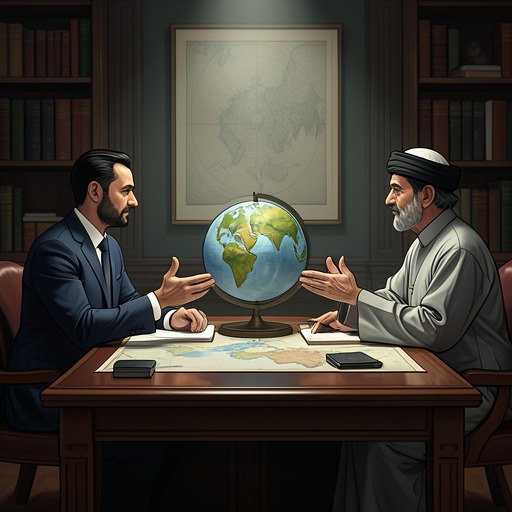
Long separation hardens mutual contempt into claims that the opposing people are fundamentally different. American religious authorities portray the Chinese as soulless and destined to be displaced; the official Chinese view casts Americans as regressive and dangerously acquisitive. These portrayals turn political and economic competition into an apparent moral and biological opposition. Yet the growing desire for peace among ordinary people on both sides persists beneath the propaganda. Representatives of finance and labor eventually arrange a secret meeting in the Pacific, where the two negotiators reach agreement on practical measures despite profound differences in their cultural assumptions.
Their plan is to overthrow the wartime governments simultaneously and create a World Finance Directorate made up of leading commercial and industrial figures alongside worker representatives. The proposed body would reorganize the world economy, bring industrial conditions in the East closer to those of the United States, and end the American monopoly over Antarctica by placing the region under the Directorate’s control. This settlement trades national sovereignty for coordinated economic management. It addresses the immediate fuel dispute while also embedding the United States’ industrial model in the proposed global order.
The agreement nearly breaks down when the American representative insists that China adopt American religious, educational, and social reforms. The Chinese representative resists the premise that American standards should be imposed externally, but accepts the terms after arguing that an Asian movement should develop its own version of the new doctrine. The treaty is signed with a secret codicil, witnessed by the Daughter of Man. The negotiations thus yield a public framework for cooperation and a concealed additional agreement, while leaving cultural authority contested rather than genuinely settled.
Unity and its limits
The Directorate’s establishment, about 380 years after the European War, marks the achievement of world unity, but the narrative stresses that this arrives after serious damage to the human mind. Coordinated business and popular resistance disable the military governments: the change is nearly bloodless in China, while the United States experiences several weeks of disorder before its government collapses. The new system resembles guild socialism in its public structure, yet remains individualistic in practice, with powerful individuals controlling industries. Unity therefore reorganizes authority rather than distributing it evenly.
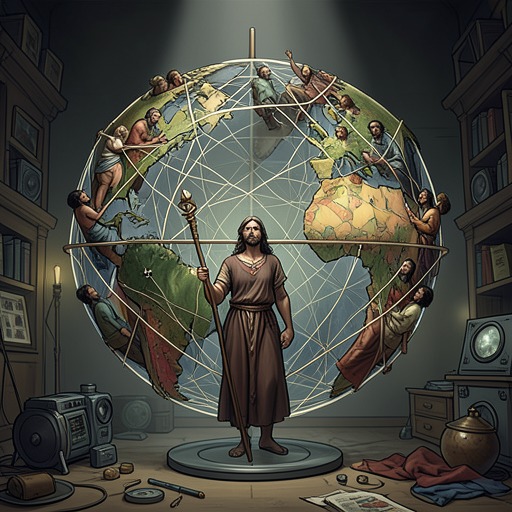
Relations with China improve in part through the American president’s tact and his association with the Daughter of Man, whose image becomes a symbol of human unity. His account of their connection wins him prestige in both regions, and the Chinese public’s initial coolness warms toward something like affection. The narrative credits this personal and symbolic influence with helping Americanization proceed without disorder. In China, the Energists—an apparently native movement that interprets Buddhism through the sanctity of action—gain control of education, while Chinese thinkers adapt the doctrine to affirm quiescence as a balance of forces. The resulting creed incorporates a specifically Chinese interpretation, even as American ideas increasingly shape the institutions that teach it.
This rapprochement does not mean that the two societies have become culturally identical or that the conflict’s unequal terms have vanished. The treaty ends war by placing global economic reorganization in a body that includes both commercial leaders and workers, but its program explicitly brings Eastern industry closer to American conditions. China’s religious and intellectual life responds by adapting, recasting, and locally propagating the new doctrine rather than merely receiving it unchanged. The relationship’s decisive pattern is therefore neither simple reconciliation nor uninterrupted antagonism: the two powers achieve political unity through mutual necessity, while disputes over cultural influence and the meaning of that unity remain visible within the world order they create.