Universal Music
Last and First MenUniversal Music is the Third Men’s conviction that music is not merely an art or a passing human pleasure, but the underlying reality of existence. It offers a way to reconcile the brevity of individual lives with the promise of continuance: a melody can cease in time and yet remain capable of returning, while the human soul, understood as musical, may share that eternal life. The belief begins in intensely felt communal music and becomes the spiritual foundation of a world-spanning religious and political order. Its history also exposes a lasting tension between lived experience and institutional control: a faith born in spontaneous musical communion is eventually disputed over whether genuine salvation belongs to the individual or to the system that claims to interpret music for all.
Origins in Collective Experience
The Third Men are described as especially responsive to hearing and to the emotional force of sound and rhythm. Their attraction to Universal Music emerges against the pressure of short lives and an intense attachment to life. For them, the prospect that an individual’s melody must either fade into senility or be cut short altogether seemed a flaw in existence. Music offered a language in which that loss might be understood otherwise.
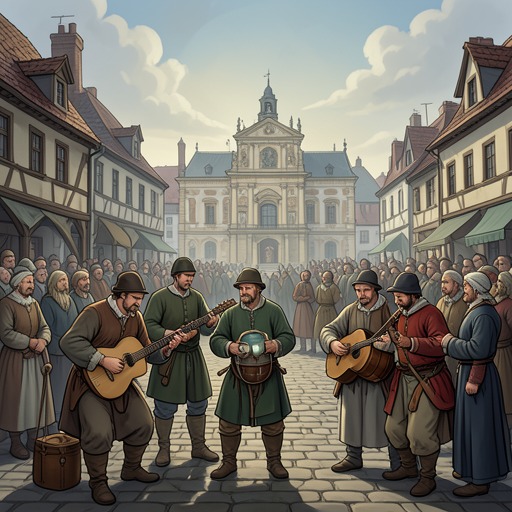
In their leisure, groups of peasants, taking time from difficult and often tragic work, sang or played the pipe and viol. Concentrating on music’s variety of tones and rhythms, they experienced it as a presence that could transport them into a world more beautiful and more real than daily life. They came to regard each melody as a spirit with its own existence, and a symphony or chorus as one spirit present throughout its members. Listening together seemed to dissolve the boundaries between individuals, making them one soul through communion with music. Universal Music thus begins not as a formal theory, but as an interpretation of shared experience: people feel carried beyond their separate selves, then imagine music as the reality that makes that union possible.
The Prophet’s Doctrine of Musical Eternity
The prophet was born in a highland village where belief in music was already powerful, though it had not yet been formulated as doctrine. As a young musician, he moved peasant audiences to intense joy and sorrow, then developed their faith into a teaching: music is reality, while everything else is illusion; the universe’s living spirit is pure music; and each individual, despite possessing a mortal body, has a soul that is musical and eternal.
The doctrine turns on a paradox. A melody exists by passing: it happens, ceases, and appears to be consumed by silence. To stop it while it is sounding would be to kill it. Yet music can occur again after silence, fresh and alive, without being aged by time. Its home, the prophet taught, is outside time—and is also the homeland of every person and living thing with a gift for music. Those seeking immortality must awaken their dormant souls into melody and harmony. Their place in eternal life depends on the degree of their musical originality and proficiency. Universal Music therefore makes musical experience both a glimpse of timeless reality and a measure of spiritual standing.
From Popular Faith to World Rule
The prophet’s teaching and passionate melodies spread rapidly. Music sounded across pastures and cultivated land, but the government tried to suppress it, in part because it was thought to interfere with agricultural productivity. The wider threat was social: its emotional appeal reached courtly women and challenged a refinement maintained over centuries. The new faith also unsettled inherited rank. Its adherents declared that aristocratic birth and mastery of established musical forms mattered less than spontaneous emotional expression through rhythm and harmony. Persecution did not extinguish the movement; it strengthened it through the example of adherents who, according to the faith’s account, sang triumphantly even when persecuted to death.
The sacred monarch announced that he had converted, partly in sincerity and partly as a political act. Bureaucracy gave way to an enlightened dictatorship, and the monarch took the title Supreme Melody. The social order was reshaped to favor the peasants, and the ruler, supported by their religious zeal and the faith’s rapid spread, conquered the world and founded the Universal Church of Harmony. The prophet, meanwhile, had withdrawn into the mountains to develop his art in quiet. The emperor’s official bands and choirs eventually reached him there. After a struggle, he was taken to the capital and held in the High Temple of Music, where he was called God’s Big Noise and made an oracle for the world government. The official music performed at the temple and by visiting delegations drove him into madness within a few years, a condition that made him more useful to the authorities.
The Empire’s Musical Law and Its Contradictions
The Holy Empire of Music gave the Third Men order and purpose for a thousand years. Rulers interpreted the prophet’s sayings into a legal system whose claimed divine authority gradually displaced local codes. Its starting point was a religious fiction—that every human being was a melody, requiring completion within society’s greater musical theme—but its practical expression took the form of rules that tacitly treated each person as a biological organism with needs, rights, and social obligations. The musical language could therefore cloak an intricate system of common sense, even as it preserved the story of a supernatural musical order.
The empire’s history also qualifies any simple account of Universal Music as a liberating faith. Spontaneous song had once challenged the authority of aristocratic forms, yet the victorious church could turn the prophet’s ideas into a state doctrine administered by rulers. The prophet himself, confined and used as an official oracle, became an especially stark instance of the distance between the religion’s promise of inward communion and the government’s use of musical authority. Its institutions supplied cohesion and a common legal order, but the very success of that order made its interpretation of the faith contestable.
Schism and Competing Paths to Salvation
Toward the end of the empire’s millennium, a new sect argued that ecclesiasticism had smothered the religion’s true spirit. The founder, they maintained, had preached salvation through individual musical experience: an emotional communion with Divine Music. The church had gradually replaced this subjective encounter with attention to objective forms and principles, making salvation depend on technical rules of melody and counterpoint. The rebels further argued that churchmen and statesmen had distorted divine musical laws to serve social convenience, so that the music’s genuine spirit had been lost.
A counter-revival answered them from the other direction. It mocked the rebels’ inward, self-concerned pursuit of salvation and urged people to value music’s divine and exquisitely ordered forms rather than their own emotions. The dispute therefore turns on two competing claims to the same eternal reality: whether music saves through a person’s direct, inward experience or through the forms that can be studied, regulated, and made the basis of social order. Universal Music remains powerful in both accounts, but its meaning is no longer settled. The schism reveals the central instability of the doctrine: music can be understood as a force that breaks down individual boundaries, or as an ordered structure whose authority governs individuals from without.