Venerian Natives' Resistance and Extinction
Last and First MenThe Venerian Natives' Resistance and Extinction is the encounter between the Fifth Men’s attempt to make Venus habitable and an intelligent civilization already established in its ocean. The settlers’ preparations altered the natives’ environment, and the natives fought to stop the invasion. With the Moon expected to fall and humanity’s survival tied to migration, coexistence gave way to a planned destruction of the oceanic population. The campaign resolved an immediate obstacle to human settlement but left the Fifth Men with a lasting burden of guilt and a changed sense of their place in the universe.
The Migration Crisis and Its Stakes
Humanity’s need for another world arose from a danger that science had failed to explain or control: the Moon was approaching Earth, and its eventual fall seemed certain. The Fifth Men therefore faced a choice between advancing their migration to Venus and risking the destruction of humanity. Their capacity to pursue that plan rested on technologies that had transformed material life. Earlier, the discovery in Patagonia that certain atoms could be made to release immense energy had opened a new power regime; by the age of the Fifth Men, atomic disintegration and the annihilation of matter supplied energy on a scale that had abolished ordinary drudgery. This capacity made a large engineering project conceivable, but it did not make Venus an empty or consequence-free destination.
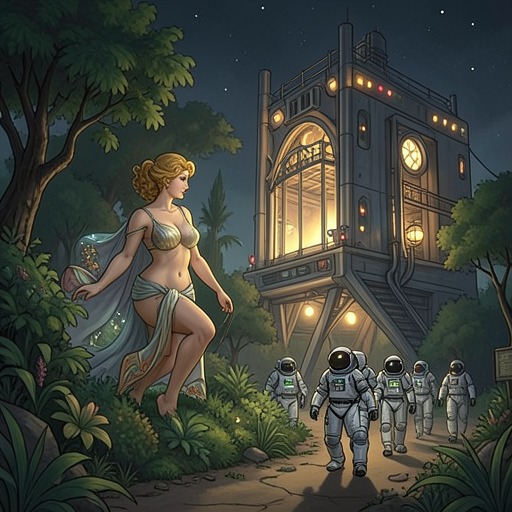
The preparation of the planet required electrolysis stations, which were intended to release oxygen into the atmosphere until it approached the composition of the air humans needed. Surveying the ocean and establishing infrastructure were thus not incidental activities: they were parts of a transformation that would make Venus more suitable for human life while changing the conditions on which its existing organisms depended. The settlers initially believed that an ocean without dissolved free oxygen could not support life. That assumption shaped their early understanding of the world they intended to colonize.
Discovery of an Oceanic Civilization
The conflict became unmistakable after several electrolysis stations were wrecked, apparently by submarine eruptions, and surveying vessels began to explode mysteriously. One damaged ship returned with a spherical object attached to its sounding apparatus. The object consisted of small riveted metal plates and had been fastened there with a hook. As the crew tried to bring it aboard, it struck the hull and exploded. The incident showed that the danger was not simply geological: the ocean contained beings capable of making and using destructive devices.
Investigation disclosed a vast ecosystem, with life ranging from microscopic forms to organisms as large as whales. These creatures did not depend on photosynthesis and ordinary chemical processes for their energy. Their tissues drew power from the controlled disintegration of radioactive atoms, elements especially abundant on Venus. Among the ocean’s species, one intelligent kind had become dominant and built a civilization on this radioactive power. The Venerians were roughly swordfish-shaped, with three manipulative organs that could extend from within a long, blade-like structure. They moved with a screw-like motion, steered with three fins, and possessed several sensory capacities. Their unfamiliar anatomy and way of life made their intelligence difficult for human observers to interpret, but their tools and organized civilization made it impossible to dismiss them as mere animals.
Resistance and the Failure of Accommodation
As human activity on Venus expanded, resistance by the Venerians intensified. Unable to leave the deep ocean without being destroyed by the loss of pressure, they attacked the settlers’ island installations from their own environment. They hurled explosives at the centres of the islands and undermined them through tunnels, seriously disrupting electrolysis. These attacks inflicted damage on human operations, but they also made clear that the natives were opposing the continuing alteration and occupation of their world.
The Fifth Men tried to understand whether an arrangement could be reached, but every effort to parley failed. The settlers therefore faced a moral question as well as a strategic one: what right did humans have to interfere with a world already inhabited by intelligent beings, even if the natives’ mental life remained incomprehensible to them? The dilemma recalled humanity’s earlier experience of Martian invasion. Those invaders might also have believed themselves superior, while the Fifth Men now risked repeating their crime against another people.
The human judgment of relative intelligence was uncertain. The Venerians appeared to have a narrower mental range, but the Fifth Men recognized that their own measure could be mistaken: an intelligence might exceed human understanding precisely because it was different. The settlers nevertheless reasoned from the evidence available to them, and judged themselves the higher type. They also knew that the Venerians’ dependence on radioactive matter imposed a long-term limit. Those atoms continually disintegrated; Venus had more of them than Earth, but not an inexhaustible supply. Ocean research indicated that the native population had once been more extensive and that the increasing difficulty of obtaining radioactive matter was already constraining its civilization. The Venerians faced eventual decline, the Fifth Men concluded, though human settlement would hasten it.
The Destruction of the Native Population
The hope of colonizing Venus without seriously harming its inhabitants failed for two connected reasons. The Venerians continued to resist even when their attacks also caused their own deaths. Meanwhile, electrolysis released oxygen into the atmosphere, and the ocean absorbed some of it. Dissolved oxygen damaged the natives’ oxygen-sensitive tissues. The Fifth Men could not simply stop the process: they needed the atmosphere to reach a level compatible with human life. Before that point had been reached, it was already evident that the native organisms were being harmed and that they would be exterminated within a few thousand years at most if the transformation continued.
The settlers chose to end that process of attrition by force. By then they could travel and establish settlements on the islands, and they built powerful submarines to search the ocean and destroy its native fauna. This was not an accidental consequence hidden from the decision-makers. The Fifth Men understood that their colonization and the oxygenation of Venus were lethal to the Venerians, and they deliberately converted a projected, slower extinction into an organized campaign. Their rationale combined necessity, a judgment of human superiority, and the belief that the natives were already doomed by the depletion of their energy source. None of those arguments erased the fact that the human project was destroying an existing intelligent life.
Aftermath and Significance
The slaughter had opposed effects on the Fifth Men’s collective outlook. Its horror produced persistent guilt and disgust at the thought that humanity had been driven to kill in order to survive. That distress joined two other shocks: the failure of science to explain the Moon’s approach, and an older, irrational guilt born of sympathy with the suffering of the past. Together these pressures tended toward racial neurosis, weakening confidence in humanity and in its command of history.
Yet the same events could also generate a different response. The failure of science became a challenge rather than merely a defeat, opening possibilities that had not previously been imagined. The suffering of the past likewise seemed to invite a future capable of transforming its meaning. The Fifth Men’s growing understanding of the Venerians deepened this contradiction: as the campaign proceeded, the human forces acquired insight into the beings they were killing and learned to admire them. The narrative thus presents the extinction not as a clean victory over an obstacle, but as a collision between survival and responsibility. The settlers secured the conditions for human life on Venus by destroying a civilization they could neither fully comprehend nor successfully persuade, and the moral consequences became part of the civilization they were trying to save.