Venus
Last and First MenVenus became humanity’s second home only after the Fifth Men concluded that Earth would not remain habitable. The planet offered a possible refuge, but not an empty or naturally hospitable one: its dense atmosphere lacked oxygen, its shallow ocean covered almost the entire surface, and its native marine life included an intelligent civilization. Making Venus suitable for humans meant transforming a living world whose inhabitants had reason to resist that transformation.
Environment and Native Life
Venus was a world of dense, moist air and a nearly planet-wide shallow ocean. Its surface was so hot by day that humans in their existing form could scarcely survive even at the poles. Later investigations found that the poles, shielded beneath great depths of cloud, were not as unendurable as first supposed. Even there, however, the planet’s conditions demanded adaptation and long-term planning rather than simple settlement.
The absence of free oxygen had led terrestrial explorers to assume that the ocean could not support life. That assumption proved wrong. Venus’s seas contained organisms ranging from microscopic forms to creatures as large as whales, including both stationary and free-swimming species. Their biology did not depend on photosynthesis: life drew its energy from the controlled disintegration of radioactive atoms in their tissues. Venus was especially rich in such atoms and retained elements that had long since disappeared from Earth.
Among these organisms, the Venerian swordfish-like beings had achieved the greatest intelligence and dominated other species. They were about the size and shape of swordfish, swam with a screw-like motion of the body and triple tail, and steered with three fins. Three manipulatory organs, usually sheathed inside the long sword, could extend as branched muscular tentacles. Their civilization and command of radioactive power made them more than an unusual feature of the environment: they were an organized native society with the capacity to act against the newcomers.
From Planetary Crisis to Refuge
The choice of Venus followed the Fifth Men’s recognition that Earth faced a long-term but decisive danger. The Moon’s accelerating approach meant that it could enter a critical zone and break apart in less than ten million years; its fragments would then fall to Earth, with impacts capable of making the surface uninhabitable. The Fifth Men treated that prospect not as a remote abstraction but as a problem that had to govern human policy. Attempts to inspect the future directly failed, leaving the approaching catastrophe as a risk they could infer but not experimentally resolve.
Mars and Venus were the only neighboring alternatives considered. Mars had already lost both water and atmosphere, making it an unsuitable destination. Venus had a dense atmosphere and abundant water, but no free oxygen, no vegetation to replenish it, and temperatures that made most of the planet inhospitable to humans. The Fifth Men rejected the alternative of radically redesigning the human organism: they believed it would require almost complete refashioning and could sacrifice the species’ existing constitution. Their project therefore turned toward altering Venus instead.
The energy technologies that made such a project conceivable belonged to a much longer history of resource use and failure. The League of Nations had once established international control over oil and coal, restricting oil to uses for which no other power source would serve. Later, the remaining oil supply gave out in less than three centuries, and coal from Antarctica became essential to civilization. When even those deposits were exhausted, the first world-civilization collapsed. Much later, Patagonian scientists discovered how to release immense energy by annihilating the positive and negative charges in certain atoms. That discovery offered an effectively inexhaustible, controllable source of power, though not one guaranteed to be safe in careless hands. By the age of the Fifth Men, matter-annihilation supplied the power for advanced industry and interplanetary travel.
Terraforming and Conflict
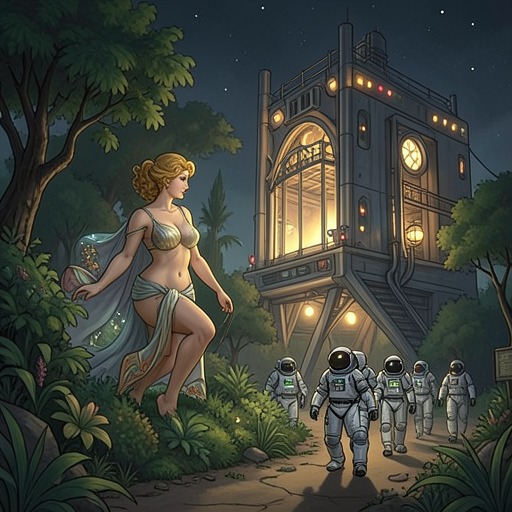
The Fifth Men planned to make Venus’s atmosphere breathable by introducing oxygen and establishing vegetation capable of sustaining it. Because the planet’s oxygen was bound in chemical compounds, they proposed splitting seawater through large-scale electrolysis and allowing the released oxygen to mix with the atmosphere. The hydrogen had to be removed; a method was devised to eject it beyond the limits of the atmosphere. Research into the planet’s conditions was carried out from Ether ships or by explorers wearing gas helmets, since the natural atmosphere remained unbreathable to humans.
The work soon encountered resistance. Several electrolysis stations were wrecked, apparently by submarine eruptions, and surveying Ether ships mysteriously exploded. The explanation came when a damaged vessel returned with a large sphere attached to its sounding apparatus. A hook fastened the artificial object to the line; it had been assembled from small riveted metal plates. As the crew prepared to bring it aboard, it struck the ship’s hull and exploded. The device showed that the damage was not merely a geological hazard: intelligent ocean dwellers were deliberately obstructing the human project.
The settlers had assumed that an ocean without dissolved free oxygen was lifeless. They now understood that the Venerians depended on the ocean and resented its depletion. Their resistance gave the environmental transformation a political and ethical dimension: the human plan to make Venus habitable was also a plan to alter the conditions of a world already inhabited by beings capable of defending it. The available account establishes the conflict and the Venerians’ opposition, but does not reduce their actions to a natural obstacle or describe the whole outcome of that struggle.
Migration and the Venusian Era
As the Moon grew larger in the sky, its effects on Earth became immediate. It periodically turned day into night and night into a ghastly day; enormous tides and damaging weather had already diminished the planet’s amenities and injured the fabric of civilization. Humanity therefore left reluctantly. The migration took centuries, carrying the remaining human population to Venus along with representatives of many other organisms and the most precious treasures of human culture.
The destination could not support the same scale of human society as Earth. The population had to be reduced to one hundredth of its former size. Since each person in the terrestrial community had served a function within a vast social and cultural network, the smaller Venusian society would necessarily be mentally poorer: its members would no longer be enriched by the same intricate and varied human environment. Resettlement thus preserved the species while imposing a profound loss in social complexity.
Humanity’s sojourn on Venus lasted longer than its entire career on Earth, from its earliest human ancestors through the final evacuation. The biological human type remained more constant there than it had on Earth, but Venusian culture was still highly varied. The planet’s significance in the larger history is therefore double. It was a refuge made necessary by the instability of Earth, and a new home whose conditions and inhabitants forced humanity to confront the limits of treating another world as simply a resource for survival.