Venus electrolysing station
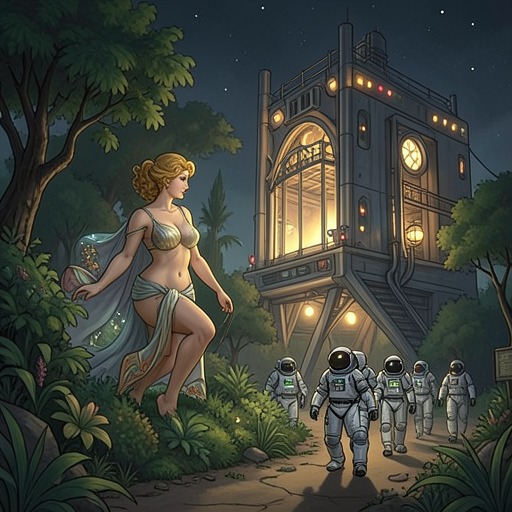
Last and First MenThe Venus electrolysing station was an automatic installation on the islands of Venus, built to split seawater into hydrogen and oxygen as part of a planetary transformation project. The stations were intended to help make Venus habitable for the Fifth Men before the homeworld could no longer support them. Their work carried a double consequence: it altered the planet toward human needs while contributing to the destruction of the Native Venerians and the crisis of conscience that followed.
Purpose and Design
The Fifth Men could not settle Venus in its natural state. Although oxygen was plentiful there, it was chemically bound, and the planet had no vegetation to replenish free oxygen in the atmosphere. Researchers therefore planned to introduce specialized plant life, but first needed to establish enough free oxygen for the vegetation and, eventually, human settlers to survive. Since the planet’s natural atmosphere was uninhabitable to humans, research had to be conducted from Ether ships or by investigators wearing gas helmets.
The proposed conversion required both biological preparation and a much larger chemical intervention. Scientists decided to split part of Venus’s ocean into hydrogen and oxygen through extensive electrolysis. The ocean was relatively low in salt because the planet had little dry land from which rain and rivers could carry salts into the sea. This made the undertaking more practicable than it otherwise would have been. Oxygen from the process would enter the atmosphere; the hydrogen, which had to be removed, would be expelled beyond the atmosphere at a speed that prevented it from returning.
The plan joined this engineered oxygen supply to a designed planetary ecology. Biological research produced specialized kinds of vegetation intended to cover the land and, once established, replenish oxygen lost through oxidation. The stations were founded on several islands, and the projected timetable was less than a million years for Venus to become fit for human settlement and for humans to become fit to live there. They were thus not simply industrial facilities: they were part of a long, coordinated effort to remake a world’s atmosphere and living systems.
A Hostile and Unfamiliar World
The stations operated amid conditions that made the project dangerous even before conflict with the planet’s inhabitants became clear. Venus had a small, mountainous archipelago rather than extensive continents. Its slow rotation created a sharp contrast between the cold night hemisphere and the hot day hemisphere, driving severe storms and currents. Thick fog, thunderstorms, torrents of evening rain, and ice on the waves at night made the ocean a difficult environment to survey and work in.
Several stations were wrecked, apparently by submarine eruptions, while Ether ships surveying the ocean mysteriously exploded. The explanation emerged when a damaged vessel returned with a spherical metal object attached by a hook to its sounding apparatus. The artificial object exploded after it struck the ship’s hull. The incident indicated that intelligent oceanic life existed and was actively resisting the terrestrial project. What humans had assumed to be an ocean incapable of supporting life was in fact inhabited by diverse organisms, including intelligent species whose biology depended on radioactive atoms rather than photosynthesis.
As the Fifth Men’s activity on Venus expanded, the Native Venerians increasingly sought to stop it. Unable to leave the deep ocean, where the pressure was necessary to their survival, they attacked from beneath the surface, using explosives against island centres and tunnels to undermine them. Their resistance seriously hampered electrolysis. Efforts to negotiate failed, and the stations’ continued work became part of a conflict between human settlement and an existing, intelligent population.
Environmental and Moral Consequences
The intended benefit of electrolysis became inseparable from its harm. As the process released more oxygen into the atmosphere, some dissolved back into the ocean. The oxygen damaged the oceanic organisms, whose tissues began to oxidize. The Fifth Men could not stop the process before the atmosphere reached a concentration suitable for humans without jeopardizing the terraforming project. The stations therefore helped produce conditions that would make Venus more hospitable to settlers while making its ocean increasingly lethal to its native life.
The conflict was not presented as a simple choice between harmless settlement and hostile resistance. The Fifth Men recognized that the Venerians were intelligent, and compared their own invasion with the earlier Martian invasions of humanity. They also considered whether the natives might possess forms of understanding beyond human judgment. Yet the apparent necessity of migration, the approaching danger to the homeworld, and the evidence available to human observers weighed in favor of continuing the project. The Venerians were also thought to face eventual decline as the radioactive matter on which their life depended became scarcer, but this did not remove the human role in hastening their destruction.
The consequences grew more severe as the work continued. Native attacks caused damage and deaths, while oxygen entering the sea added a slower, pervasive danger. The Fifth Men ultimately determined that the Venerians should be destroyed to spare them the prolonged effects of the process. By then settlers could live on the islands, and humans built powerful submarine vessels to scour the ocean and destroy its native fauna. The stations were one component of this planetary project, not its only instrument, but their purpose and continued operation were bound to the chain of events that led to the extermination campaign.
Place in the Fifth Men’s History
The Venus electrolysing station embodies the practical ingenuity and moral limits of the Fifth Men’s migration. It converted an environmental obstacle into an engineering programme: ocean water became a source of atmospheric oxygen, hydrogen became a substance to eject, and native vegetation became part of a planned planetary system. Yet the machinery’s apparent precision did not make the project ethically neutral. The transformation affected a living ocean and could not be paused once human survival had been tied to its completion.
The slaughter left a lasting mark on the Fifth Men. It produced guilt and disgust at the thought that humanity had been driven to kill in order to survive, compounded by loss of confidence when science failed to explain the danger threatening the homeworld. At the same time, some regarded the crisis as a challenge and the killing as a terrible necessity carried out without hatred. In this divided response, the station’s historical significance exceeds its technical function: it stands within a story in which the means of preserving humanity also make humanity responsible for the destruction of another world’s inhabitants.