Young Biologist of the Siberian Settlement
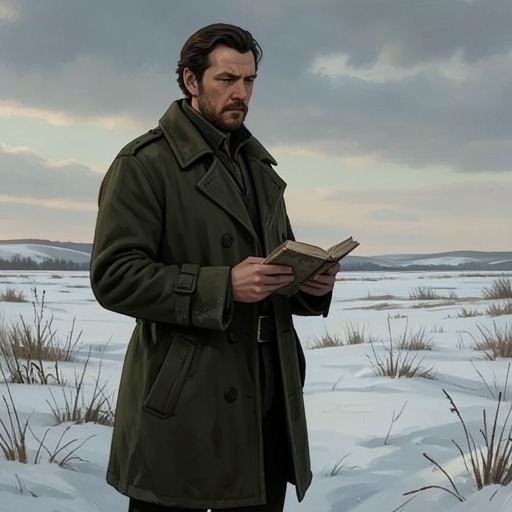
Last and First MenThe Young Biologist of the Siberian Settlement was one of two contrasting leaders among the isolated survivors of a planetary catastrophe. A junior scientist rather than an experienced navigator, he became the head of the party that stayed in Siberia when its members divided over whether to remain or sail in search of better land. His importance lies not only in helping preserve that community, but in shaping its deliberate effort to carry knowledge across a future so long that civilization itself might become legend. The records his group made were eventually recovered by the Second Men, who valued them as history and found in one text an unexpectedly living spiritual inheritance.
Identity and the Settlement’s Crisis
The catastrophe left only thirty-five people alive out of a human race of two hundred million, all of them near the North Pole. In the harsh aftermath, sickness, storms, and volcanic gases reduced the survivors further. The Young Biologist emerged as a natural leader alongside the expedition’s original head, the second navigating officer, who eventually became the community’s chief. The two men had markedly different strengths: the navigator excelled when survival demanded immediate initiative, while the biologist belonged to the scientific party whose knowledge became increasingly useful as the settlement established a routine.
Their relationship combined affection with friction. During periods of danger, the navigator’s authority was accepted as essential. In calmer times, some resented his insistence on discipline. The biologist was critical of him, yet also admired him and believed that the party’s survival depended on the navigator’s practical genius. Their mutual respect did not erase their differences; instead, it allowed the community to function while circumstances required both decisive action and patient knowledge.
Leadership and the Parting
Three years after landing, the settlement had built a routine around hunting, agriculture, and construction, though its numbers and vitality had diminished. Security altered the balance between its leaders. The navigator’s talents were less useful to settled life, while the scientists’ expertise mattered more for such tasks as breeding plants and poultry and searching for minerals. When the navigator proposed taking the ship to explore for better land, the seafarers supported him and the scientists refused. They understood more clearly how the catastrophe had changed the planet and opposed the hardship of the proposed voyage.
A later personal conflict turned the dispute into violence. The woman regarded as the settlement’s queen asserted her independence from the navigator by choosing one of the scientists as her partner. The navigator killed the young man, and the community split into armed factions before its members recognized the destructive folly of the conflict. They resolved to divide rather than continue fighting. The Young Biologist was placed in charge of the party that remained: five men and two women. The navigator took nine men and two women aboard the ship, hoping to reach Europe and promising to send word if possible. The departure was marked by solemn affection as well as relief. The parties never reunited, and the separation ultimately gave rise to two distinct human species.
A Plan for Preserving Human Knowledge
The Young Biologist understood the settlement’s predicament on a scale beyond immediate survival. The scientists estimated that the planet would remain largely uninhabitable for millions of years, while volcanic energy slowly escaped through vents. Only a narrow fringe of the Siberian coast could sustain people. The survivors could not restore their former civilization, but they might preserve a remnant capable of waiting for more favorable conditions. His response was to make the community both a living seed and a custodian of its inheritance: it had to continue its population and preserve as much as possible of the culture that preceded the disaster.
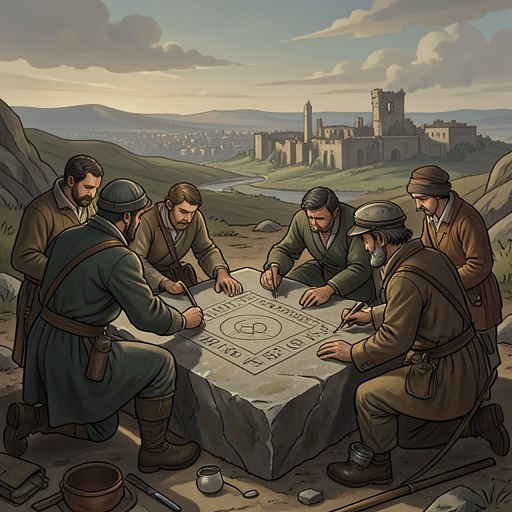
That purpose became a practical, collective undertaking. During the long winters, the adults assigned one another areas of knowledge and drafted accounts on slate. The group reviewed the drafts, then engraved accepted material on hard stone tablets. Over the years they recorded outlines of human and terrestrial history, physics, chemistry, biology, psychology, and geometry. Each contributor also summarized a particular field of study and added a personal statement of views about existence. The settlers devised a large pictorial dictionary and grammar so that people in the remote future might decipher the library. They stored thousands of tablets in a carefully prepared cave, making durable records for readers they could never meet.
The plan could not ensure that later generations would accept its burden. The children were cherished and taught intensely, yet their education was mishandled: they were both pampered and oppressed, and the elders’ expectations made them weary of the future they had been assigned to serve. As the young people resisted the imposed ideals, intellectual work increasingly fell to the aged. The archive’s survival therefore depended not on unbroken agreement, but on the founders’ persistence and on occasional renewals of interest among their descendants.
The Archive’s Later Life
One such renewal began when a boy, in early Patagonian adolescence, became curious about the hind limbs of a seal. Encouraged by the old people, he made further biological observations, imagined the wider history of life on the planet, and grew loyal to the cause his elders had served. His discovery did not reverse the settlement’s longer decline, but it shows how the scientific inheritance could become meaningful again through observation rather than compulsion. Across generations, the population fluctuated from as few as two men and one woman to a few thousand. Material survival continued, even as life in the isolated environment and intensive inbreeding contributed to a decline in mental vigor and subtlety.
The stone library was eventually found by engineers of the Second Men while they prepared to sink a shaft for subterranean energy. Its tablets were broken, weathered, and disordered; the engineers reconstructed and interpreted them with the aid of the pictorial dictionary. The Second Men did not treat the collection chiefly as a source of scientific or philosophical instruction. They valued it as a vivid historical document that offered a clearer picture of the earlier species than anything else that had survived the volcanic epoch.
Among the recovered material was a particularly consequential record: the Young Biologist’s account preserved much of the sacred text of the Life of the Divine Boy, including the prophet’s final words. Those words had baffled the Patagonians, but the Second Men recognized in them an experience familiar to their own history, though it had long been associated with unhealthy states of mind. They were beginning to seek a healthier expression of that experience, and the ancient text helped provide one. The biologist’s preservation project thus carried more than technical knowledge forward. A record made for a distant future became, for another human species, a source of historical understanding and spiritual recognition.