general senescence of the species
Last and First MenGeneral senescence of the species names a slow physiological deterioration that weakened the First Men’s bodies and minds, eroding their distinctive capacity for prolonged youth. It was not the sole cause of their post-collapse decline, nor an inevitable law of human evolution: it was a historically produced vulnerability whose effects combined with catastrophe, exhaustion, and social failure to make recovery exceptionally difficult.
Meaning and mechanism
The narrator introduces the term cautiously, as a tempting label for a subtle change in the First Men’s physiology. In each individual, chemical equilibrium had become less stable, and tissues grew less able to compensate for the wear and tear of life. The species was therefore losing its unusual gift of prolonged youth: not simply through a sudden epidemic or a single generation’s aging, but through an accumulating change in the bodily conditions on which resilience depended.
The account attributes this vulnerability partly to the First Men’s way of life. For thousands of years they had existed under excessive pressure in a biologically unnatural environment, without finding a way to compensate their nature for the strain. The deterioration was thus neither presented as pure accident nor as a predetermined endpoint. The species’ own constitution made it susceptible, while its environment and history aggravated that susceptibility.
From civilizational collapse to prolonged decline
The concept is central to the contrast between the First World State before its fall and the helplessness that followed. Historians might expect a population that had sustained a world civilization to rebuild within a few generations; instead, human conditions deteriorated toward savagery. The narrator identifies multiple causes. A microbe-driven epidemic of insanity and impaired intelligence incapacitated people during the crisis itself, while widespread disillusionment, fatigue, and private preoccupations obstructed collective reconstruction after the epidemic had passed. General senescence was the deeper, more lasting physical burden within this cluster of causes.
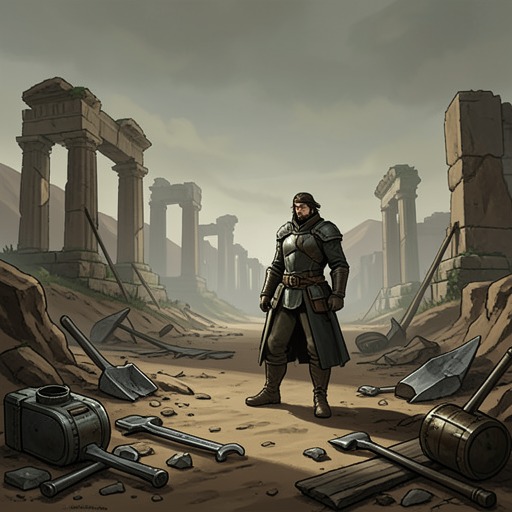
The survivors’ circumstances made that burden consequential. Only a tenth of the population survived the great disaster, and the remaining people were largely descended from the old order’s agriculturists. Without power, machinery, or chemical fertilizers, they struggled to stay alive; the second generation knew civilization mainly as a legend. Agriculture and defense against marauders consumed their days, while the family or tribe of families became the largest durable social unit. The senescence account does not make these conditions the biological cause of decline; it helps explain why a population already reduced to such circumstances could not readily recover its former capacities.
Species change and biological constraints
The book’s later species histories distinguish this condition from other forms of biological vulnerability. The Second Men, for example, faced a different danger: their brains increasingly outgrew the bodies and circulatory systems supporting them. Cramped brains and failing circulation accompanied rising congenital imbecility and acquired mental illness. Their crisis arose from a specific mismatch in physical development, not from the First Men’s gradual loss of prolonged youth. The contrast makes clear that the narrative treats species decline as a set of historically particular constraints rather than one universal mechanism.
Nor does general senescence describe an irreversible fate for every human species. After the Second Men had remained in a racial trance for about thirty million years, geological change isolated some of them on an island continent. Cooling conditions altered the germ-plasm and produced extensive biological variation; over time, a better-adapted type consolidated into the Third Men. This later emergence does not amount to a direct cure for the First Men’s condition. It shows instead that environmental change and inherited variation could produce a new species after a prolonged period of stagnation, without making evolution a simple or guaranteed march toward improvement.
Design, lifespan, and the longer view
Later makers attempted to control bodily limitations through deliberate biological design. After centuries of experiment, they induced tendencies toward stronger bone and muscle, specialized nerve tissue, and improved brain efficiency. They also developed symbiotic microorganisms to make digestion more efficient and redesigned tissue repair and the regulation of growth and senescence. Their planned human type would reach maturity at two hundred years and remain vigorous for at least three thousand; at the first serious sign of decay, its heart would stop. The designers rejected perennial life, choosing a finite lifespan for a being intended as transitional rather than as life’s final expression.
The account of the much later population offers a striking contrast with the First Men’s lost prolonged youth. Its average life lasted nearly a quarter of a million terrestrial years, while infancy, childhood, and adolescence unfolded over centuries and millennia. These later figures do not establish that the earlier species’ senescence was simply reversed. They show how widely human life cycles could differ across species and historical eras. General senescence of the species is therefore best understood as a specific diagnosis of the First Men’s vulnerability—and as a warning that civilization rests on biological capacities that history can erode.