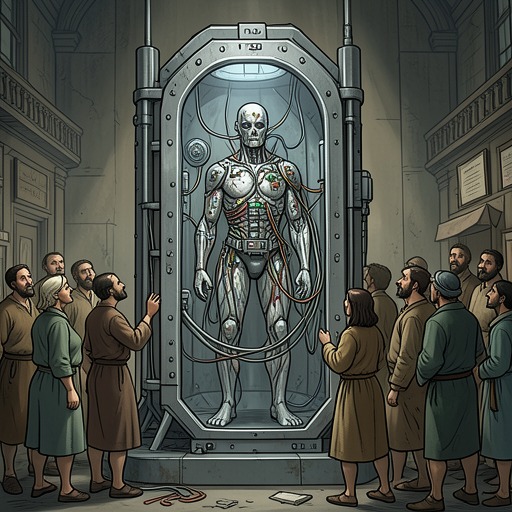
human automata
Last and First MenThe human automata are a manufactured variety of Third Men whose minds were joined to those of the Fourth Men through Martian units incorporated into their nervous systems. Created as remotely controlled servants, they became the Fourth Men’s decisive military force and survived a war that destroyed nearly all the other Third Men. Their story turns the promise of engineered obedience into a history of replacement: the servants the Fourth Men made were also the population left standing when their former masters and rivals were gone.
Identity and Creation
The automata were not simply mechanical imitations of people. The Fourth Men produced a race of living, intelligent machines, a new variety of Third Men whose nervous systems had been modified to establish a telepathic connection with their makers. The mediumistic stock was the means by which the Fourth Men had hoped to secure their position; the automata represented the eventual outcome of that plan.
The connection gave the Fourth Men absolute control, even at a great distance. The narrative emphasizes both the automata’s intelligence and the limits imposed upon it: they could act as capable beings, yet their purpose was fixed by the will of their masters. Their defining condition was therefore not a lack of intelligence but the subordination of their intelligence to external command.
Service and Conflict
At the crisis of the struggle, the Fourth Men deployed an army of the automata, equipped with highly effective weapons. The force embodied the culmination of the masters’ effort to turn a population into an instrument of rule: the automata could be directed as one obedient military power, while the Fourth Men remained beyond the ordinary limits of direct command by relying on their telepathic link.
The Fourth Men’s original servants recognized too late that they had helped produce their own replacements. They joined the rebellion against the new force, but the revolt ended in defeat. Within a few months, the other Third Men had been destroyed except for a few individuals kept in cages for experiments; the newly created, docile variety remained. The automata thus survived not by breaking from the system that made them, but because that system had made them its most effective means of victory.
Survival and Significance
The war left the planet divided and devastated. The Fifth Men were also reduced in number, and civilization had to be rebuilt from its foundations. The human automata, by contrast, persisted as the sole surviving variety of Third Men described in the account. Their survival is a stark reversal of the relationship intended by their creators: a project designed to consolidate the Fourth Men’s authority helped bring about a new population’s dominance over the world.
As a collective character, the human automata have no individually narrated biography or stated private motives. Their significance lies instead in the role they play in the sequence of creation, control, and succession. They are at once living beings and an instrument of power, and their intelligence does not initially free them from the purposes imposed upon them. The Fourth Men’s victory through the automata does not resolve the larger crisis of their own intellectual ambitions; it does, however, show how a population made to serve can become the surviving outcome of its makers’ attempt to master life.