mediumistic stock
Last and First MenThe mediumistic stock was a hereditary caste of trance-prone communicants, created by the Third Men in the hope of obtaining guidance from the dead. Its supposed access to another world was, in the narrator’s account, an effect of training and extreme suggestibility, not genuine communication. The stock’s history turns that mistaken belief into a political vulnerability: first its members were treated as authorities, then as holy figures removed from ordinary affairs, and finally their susceptibility became a tool for the Great Brains’ remote control of a new human species.
Origins and Intended Purpose
The mediumistic stock arose from the Third Men’s changing ideas about immortality. Some believed that approved living beings passed at death into a happier world, where they continued in creative service to a deity. They also believed that communication between the worlds was possible, and that terrestrial life had reached a point at which the afterlife could be more fully revealed.
The proposed means was selective breeding: produce exceptionally sensitive mediums to guide the living with advice from beyond, while increasing mediumistic powers in the population generally. A theocratic nation pursued this project over many centuries and eventually established an hereditary caste of communicants. Its members’ supposed office thus joined biological specialization to religious authority.
Trance and the Failure of Authority
The communicants appeared, during mediumistic trances, to converse with inhabitants of the other world and receive instructions about earthly affairs. The account explains these experiences otherwise. Trained from childhood in the lore of the unseen, they developed elaborate fantasies from that material while in a trance. Outside it, they were described as lacking initiative and intelligence; under suggestion, they could become vigorous and capable, but their abilities remained bound to the suggestion and could not turn critically upon it.
The theocratic society made the communicants’ pronouncements a reference point for private and public life. That dependence ended in political chaos. The contrast is central to the stock’s portrayal: the same trance that believers read as a channel of divine instruction was, in practice, a condition in which the communicants could not assess the authority directing them.
Survival as Sacred Remnant
After the theocratic society fell, another Third Men community—the one devoted to breeding the Great Brains—came to dominate the planet. The mediumistic stock nevertheless persisted. It was regarded with half-contemptuous reverence: its members were still thought to possess some special divine quality, but were considered too holy for their pronouncements to govern mundane affairs.
That status preserved the caste while severing its religious prestige from practical political authority. The communicants remained present in the social order as a revered remnant of a failed system, even as the dominant community developed a different way to make use of their distinctive susceptibility.
Exploitation by the Great Brains
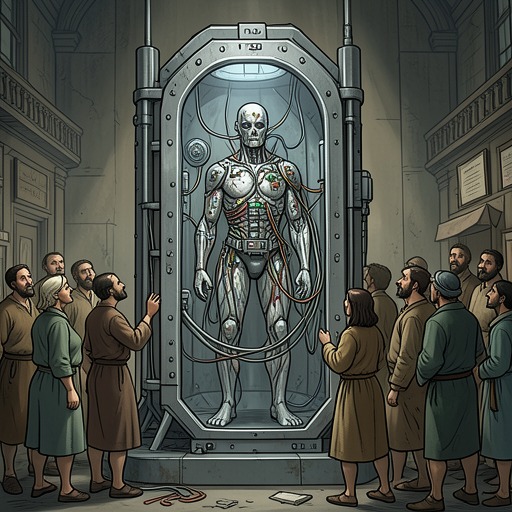
The Great Brains had intended to use the mediumistic stock to secure their rule over the natural species. Their eventual solution was a new variety of Third Men: living, intelligent machines whose wills could be controlled absolutely from a distance. This species was telepathically united with its masters, with Martian Subvital Units incorporated into its nervous system.
The stock’s history therefore culminates not in the promised revelation of an afterlife but in its exploitation as an instrument of control. The Great Brains’ remotely governed creations entered the conflict against the natural species; within months, nearly all the older Third Men were destroyed, with only a few specimens retained for experiments. The communicants did not themselves direct that conquest, but the capacities once framed as sacred made them useful to a regime seeking obedience without resistance.