psycho-physics
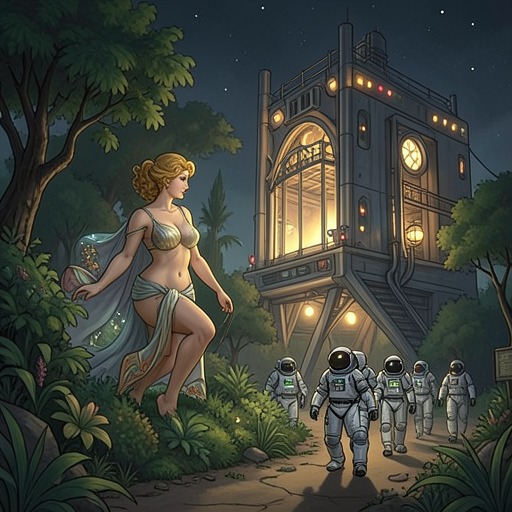
Last and First MenPsycho-physics is the Fifth Men’s attempt to bring psychology and physics into a unified account of reality. By treating the concepts of each discipline in the terms of the other, it made the physical universe appear structured according to principles also found in art. Yet this intellectual achievement left a profound limit in view: an aesthetically ordered cosmos offered no evidence of a conscious artist, and no mind was known to be capable of comprehending the whole.
Formation of the Unified Science
The Fifth Men had mastered the physical paradoxes that had perplexed the First Men and developed extensive knowledge of both the cosmos and the atom. Their science nevertheless remained vulnerable to fundamental revision: discoveries repeatedly shattered its foundations, obliging them to reconstruct the whole discipline on a new plan. Psycho-physics seemed at last to provide firmer ground. It did not simply place psychology beside physics; it held the older disciplines together as if they had entered into a chemical combination.
The method worked in both directions. Fundamental concepts of psychology received physical meanings, while fundamental concepts of physics were stated in psychological terms. The achievement was therefore a reorganization of explanation, not just an accumulation of further facts about matter or mind. The book presents it as a turning point in the Fifth Men’s search for a science capable of relating what earlier inquiry had treated separately.
The Cosmos as an Aesthetic Order
The unification led to a striking discovery: the most fundamental relations of the physical universe were found to be of the same nature as the fundamental principles of art. For the Fifth Men, this made artistic creation more than a specialized cultural pursuit. If aesthetic principles were embedded in cosmic relations, the making and apprehension of forms belonged to the same broad order as the investigation of physical reality.
That connection resonated with a society whose cultural life gave exceptional weight to art, science, and philosophy. Fifth Men made works in many forms, from spoken patterns and music to moving coloured shapes, constructed objects, and common utensils shaped for aesthetic significance. They generally valued arts unfolding in time as well as space, a preference consistent with their particular fascination with time. Psycho-physics supplied a conceptual ground for taking such artistic activity seriously as a way of engaging with the structure of the universe.
Mind, Body, and the Earlier Second Men
The book gives an earlier, socially embodied instance of a close relation between mental and physiological life in the culture of the Second Men. There, the connection affected ideas of sexuality and conception: casual relations were understood as distinct from intercourse arising from a deeper union of minds, and conception was associated with that more intimate communion. Psychologists had also devised autosuggestion that could facilitate or prevent conception. This account is not identified as psycho-physics, but it offers a historical contrast to the Fifth Men’s later, systematic effort to formulate psychology and physics within one science.
The contrast matters because the Second Men’s account concerns how mental intimacy was understood to affect a particular bodily outcome, whereas psycho-physics is presented as a general framework for the fundamental concepts of two disciplines and for the relations underlying the physical universe. The earlier example makes the mind-body connection concrete in social life; the later theory extends the ambition of integration to the cosmos itself.
The Unresolved Limit
The apparent solidity of psycho-physics did not become a proof that the universe had been designed. The Fifth Men found aesthetic order in cosmic relations, but no evidence that a conscious artist had produced that order. Nor was there evidence that any mind would develop far enough to appreciate the Whole in both its detail and unity. The science thus joined mind, matter, and art conceptually without erasing the gap between finding order and understanding it completely.
That unresolved gap gives psycho-physics its distinctive significance. It offered the Fifth Men a powerful synthesis after repeated scientific upheavals, and made the universe legible through principles shared with artistic creation. At the same time, its deepest implication remained a question of intellectual reach: an ordered whole could be recognized without being fully apprehended, and aesthetic intelligibility did not establish a conscious author.