Animal Migration as a Warning
Leave the World BehindAnimal Migration as a Warning gives animal movement significance beyond spectacle: the Deer and Flamingos appear amid human confusion, and a later report identifies the Deer as part of a mass migration associated with disaster. The account does not explain what has prompted the migration. Instead, it places observable animal behavior beside human uncertainty, suggesting that the animals’ movements register a change whose meaning people are only beginning to grasp.
Unusual Movement and Human Disruption
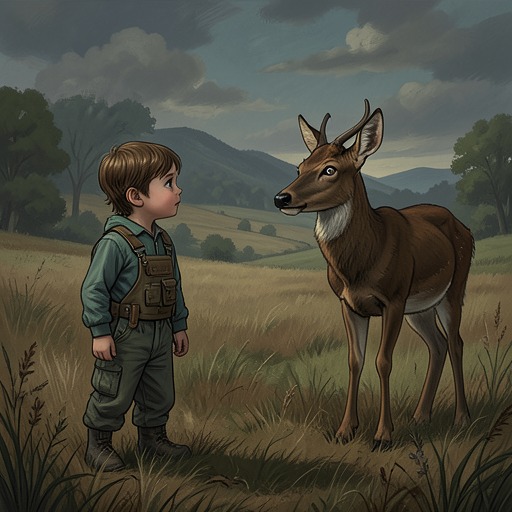
The first image of the Deer comes in the wake of The Noise. More than a thousand cross property lines and stampede through gardens without stopping to nibble. The movement is large enough to overwhelm ordinary ways of taking in a scene: the narrator notes that the eye cannot encompass the later migration in full, while the earlier herd is already too numerous to treat as a few animals passing through. Their route cuts across human divisions of land, making boundaries that seem settled from a human perspective irrelevant to the animals’ passage.
The people nearby are not in a position simply to watch. Homeowners are distracted by shattered windows and screaming children; the passage also notes that the children’s eardrums have been irreparably affected. The Deer therefore enter a scene in which human attention and security have already been disrupted. Their movement is conspicuous, but it competes with immediate human consequences for notice. The animal presence does not arrive as a calm natural spectacle set apart from the crisis: it unfolds within the same unsettled moment.
The Noise also connects several people’s separate reactions. Amanda has plunged into the woods and found her family, by instinct or luck; Clay stops beside an empty road, gets out of the car, and looks toward the heavens; Ruth is startled while filling the coffeepot and drops a spoon. The Deer, too, respond to the disturbance by moving through gardens. These parallel reactions do not establish a shared explanation for what is happening. Instead, they place human and animal responses in the same field of disruption, where an abrupt event produces movement before it produces understanding.
Flamingos at the Pool
A later encounter shifts attention from the Deer to Flamingos at the Washingtons’ house. G. H. gets out of the tub and walks toward the house to switch on the light inside the pool, a feature normally appreciated during parties. In the water, he and his companion see a pink Flamingo splashing. As their eyes adjust, they count more: one becomes two, then six. Some stand on the lawn with a backward gait; two fly over the fence and land in the pool, where they dip their heads beneath the surface.
The scene preserves uncertainty about what the birds are doing. The people wonder whether they imagine the pool contains food, but no explanation is confirmed. The Flamingos are not reduced to a settled message for human observers: the account attends to their movement, their close-held wings opening in flight, and the intelligence perceived in their eyes. Their presence is striking partly because it interrupts the familiar purpose of the pool, a party amenity now occupied by birds whose arrival the people cannot readily explain.
A Migration Named as a Disaster Signal
Danny later clarifies that the Deer he has seen are not merely a family group. He calls the movement a migration and says he has never seen so many, estimating a hundred or two hundred before conceding that he cannot guess. The passage then widens the scale beyond what an observer can count: people with relevant knowledge put the number at around thirty-six thousand Deer in the county. This distinction between an individual witness’s limited estimate and the larger figure makes the event difficult to apprehend directly, even as its extent becomes clearer.
The Deer Danny describes are not the same ones Rose had seen; they are moving to join those animals. That detail turns separate sightings into parts of a larger movement. The narration names the migration a disaster response and a disaster indicator, then describes disaster as unfolding. It does not identify a single cause or say that the animals disclose precisely what is coming. Their movement instead becomes evidence that a significant disturbance is underway, while the people still lack a complete account of it.
Rose’s remembered route into the woods offers a smaller, individual counterpart to this mass movement. She recalls the direction through trees and over a low hill, and the account says that city life has not dulled her instinct. Her steps scarcely register on the leaves, and her body knows there is no predator nearby. This moment is not identified as part of the countywide migration, nor does it explain the Deer’s behavior. It does, however, place a person’s animal-like sensitivity to surroundings beside the animals’ own movements, complicating a strict division between human interpretation and nonhuman perception.
Significance and Limits
Across these scenes, animal presence first appears as something people encounter without a reliable framework: Deer cross gardens after The Noise, and Flamingos occupy the pool and lawn. Only later does Danny’s account give the Deer’s movement a collective scale and explicitly connect migration with disaster. The shift is important: what initially looks like an extraordinary sight becomes part of a broader pattern, while the explanation remains incomplete.
The concept therefore makes animals consequential observers of change without claiming that they provide a readable forecast. The Deer’s numbers, direction, and convergence matter, and the Flamingos’ unexpected arrival sharpens the sense that familiar surroundings no longer behave as expected. Yet human characters still have to infer significance from what they see; the narrative supplies no mechanism that explains why these animals are moving. The warning lies in the disparity between the scale of their movement and the limits of human knowledge, not in a fully decoded message from nature.