Archie and Rose explore the woods
Leave the World BehindArchie and Rose’s exploration of the woods begins as an escape from boredom and adult supervision, but it carries them from sibling play into a landscape charged with imagined danger and unexplained change. They find a shed whose window looks into the house, then discover another home farther among the trees; all the while, the narration makes clear that events beyond their understanding are already reshaping the world around them.
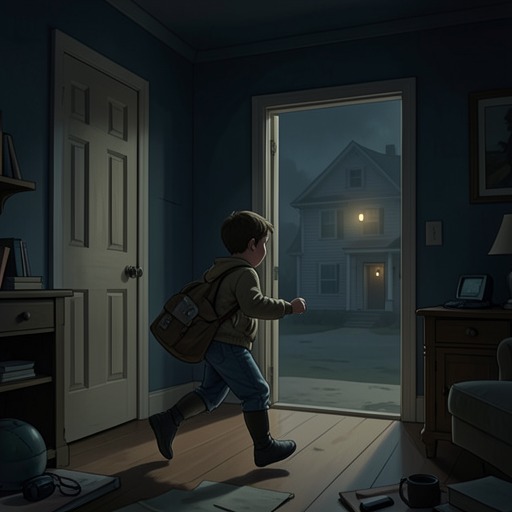
Leaving the Adults
The children are bored by their leisure and outnumbered by the grown-ups, so Archie and Rose recover a sense of alliance by leaving the pool and moving into the grass and shade. The narration describes them as cooperating again as if they were much younger children, joined in an unstated purpose. Rose suggests going into the woods because she has seen deer that morning and wants to investigate. Archie dismisses the animals as ordinary, comparing them to squirrels or pigeons, but his scorn does not end the expedition.
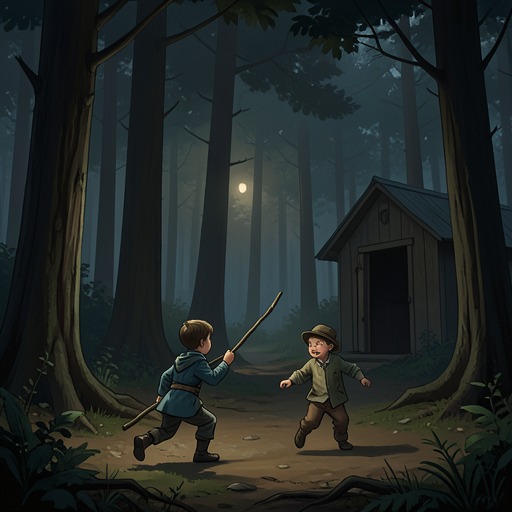
The woods offer Rose a place where the adults cannot see or bother them, and she imagines finding evidence: footprints, tracks, proof. Their search is less a response to a definite danger than a way to make the unfamiliar legible. Archie throws a stick into the trees like a javelin; Rose moves ahead toward a swing hanging from a tall tree. Nearby stands a small shed that might be a playhouse or a tool shed. Beyond it, the grass gives way to dirt and trees. The setting turns their casual walk into a succession of thresholds: away from the pool, beneath the trees, and toward a structure whose purpose they cannot tell.
The Shed and the View
Rose is cautious about the shed because anything might be inside. She hesitates before pressing the notch by its handle and pulling the weathered metal door open. It creaks loudly. Inside is only a scattering of dried leaves in one corner, an emptiness that disappoints her even though she cannot name what she expected to find. Archie does not enter; he calls the place boring. The scene gives their exploration a small, concrete suspense, then withholds the discovery Rose had half-imagined.
Archie recasts the shed as a possible place to sleep. On the ground, he reasons, a person would face snakes and rabid animals; four walls, a roof, and a window would be comparatively luxurious. His practical account changes when he pauses and imagines what the window is for: “So he can see.” He explains that it offers a perfect view into the house. Rose steadies herself on his forearm as she looks through it and confirms that the house is visible. Archie recognizes the room where she is sleeping and describes how, at night, a lit bedside lamp could make her visible from the dark. The idea turns an ordinary window into a device for watching, and the children’s play briefly acquires the shape of a threat. Yet the threat remains conjectural: the shed is empty, and no watcher appears.
A House Beyond the Woods
The siblings continue farther through the trees. The narration places their sun-pinked, nearly naked bodies among thick grass, cooler shade, spider silk, and the excitement of being afraid during an adventure. Their movement is compared to that of young fawns: hesitant and ungainly, but graceful in their youth. Archie swings from a low tree limb, drops to the ground, and admits that he knows nothing about deer. His earlier dismissal gives way not to an explanation but to the limits of what he knows.
Then Rose spots a roof, a clearing and lawn, a brick house like the one where they are staying, a pool, and a sturdy wooden swing set. She whispers, “Archie, look,” as if the sight calls for reverence. Archie identifies the place simply as a house. Ruth had told them there was nothing farther out, but they have walked beyond the area she knew. For Archie, the discovery means other people may be nearby; he immediately thinks of the Wi-Fi he could have accessed if he had brought his phone, which he left charging in his bedroom. Rose considers the swing set and wonders whether the children who use it have outgrown it. Their thoughts turn the unknown house into an ordinary neighboring household, a place that might offer familiar amenities rather than danger.
Rose asks whether they should go up, but Archie declines and turns toward what he believes is the way back. The choice ends their direct approach to the house without resolving who lives there or whether anyone is present. As they leave, a tick burrows into Archie’s ankle without his noticing. The unnoticed bite is one small sign that the woods contain risks the children neither see nor register; it also contrasts with the vivid dangers Archie had imagined around the shed.
Wandering Amid the Unseen Change
Their return is not immediate or purposeful. Archie and Rose walk at an easy pace, moving through shade, leaves, insects, sweat, and cooler air without knowing how long they have been gone or what they originally meant to do. They are less interested in reaching a destination than in continuing together through the woods. The narration emphasizes that they do not think about their parents during this stretch. Clay is driving nearby, less than half a mile away, close enough that the children could run to him, but they cannot hear the road and do not know he is there. Their private wander has therefore brought them physically near rescue while leaving them unaware of the connection.
The children are not truly afraid; they are described as being at peace. Their bodies seem to register what their minds cannot name, while their speech recedes into a private language the narration cannot make out. Above them, leaves shift and sigh, and unseen insects rustle. The narrator suggests that the insects know something is coming and will hold still against the bark before the change arrives. This foreboding is set against the children’s calm rather than presented as knowledge they possess.
The larger frame makes that gap consequential. The darkness over Manhattan is tangible, but the children do not understand the events gathering beyond the woods; the narration also points to deaths, a missing plane, and a crude-oil spill occurring during the disruption. Their exploration does not cause or explain the crisis. Instead, its small-scale discoveries—the empty shed, the window, the neighboring house, the unnoticed tick—place curiosity and ordinary childhood experience alongside a world whose logic has changed. Archie and Rose keep walking, absorbed in shade and one another, while the narration lets the reader see how much lies outside their field of understanding.