Archie and Rose’s sibling relationship
Leave the World BehindArchie and Rose’s sibling relationship is defined in the crisis less by what they say to each other than by where they go and whom they try to protect. Archie’s invitation to Rose after the frightening noise is a small act of older-brother care; later, when Rose disappears, he sets out to find her while already suffering from unexplained bodily changes. Their bond moves between ordinary childhood and sudden danger, with each sibling’s vulnerability visible in a different way.
Kinship and the First Response
After the noise, Amanda suggests that Rose go to her parents’ bed with a book. Rose looks to her mother for direction, uncertain whether to obey the strange woman, and Amanda reassures her. Archie, meanwhile, is acutely aware of his own embarrassment: he has urinated in his swimsuit when the sound frightened him. He does not confess this. Instead, he tells Rose to come with him, offering her company as he goes to take a shower. The narration marks the invitation as a big brother’s kindness, making this brief gesture the clearest early expression of their sibling bond.
The moment joins care to concealment. Archie’s shame is private, but he does not withdraw entirely into it; he includes Rose in his departure. Nothing indicates that he explains his fear or asks her to comfort him. His response is practical and understated, a way of staying beside his younger sister while both children are being moved out of the adults’ conversation about the noise. Their relationship appears in this ordinary, unceremonious act rather than in a speech about family loyalty.
Different Ways of Facing the Disturbance
The siblings respond to the unsettled house differently. Archie takes a hot shower, then lies in bed with his phone, turning to its hidden album after the television proves unavailable. Rose is also sent to bed, but the room and her book do not hold her attention. Wrapped beneath her parents’ comforter, she notices the detergent, bath soap, her own skin, and her parents’ lingering scent. The bed offers comfort, while her book about adolescence feels less like escape than preparation for a future she expects to enter.
Rose’s thoughts keep returning to the woods and the bang overhead. She remembers the deer she had seen and the lack of traces left on the ground, and she watches the rain from the house. The contrast with Archie is not simply that one is brave and the other afraid: the evidence gives Archie a private bodily reaction to the sound, while Rose’s attention turns outward, toward animals, weather, and what may be happening beyond the house. Each child is unsettled, but they do not process the uncertainty in the same way.
Rose’s Initiative
Rose does not remain in bed. She gets up, stretches, and feels powerful and alive; she goes to the window, expecting that something she cannot yet name will appear. Looking through the glass door, she notices a crack in the pane that was not there before. She understands that the earlier noise was not thunder, even though the rain and the flat sky might have offered an easy explanation. Her reasoning is explicitly distinct from her parents’: she senses that the family’s troubles are larger than a sound overhead, and believes she has seen the problem and can try to solve it.
That resolve is briefly interrupted by an ordinary family promise. Amanda had said that they would bake a cake when it rained, so Rose puts aside her book and goes to the kitchen. Her insistence that she can do it herself is audible while the family sits around a television that shows nothing. The scene places her growing independence inside a familiar domestic ritual: the cake is made from a box and rises in the gas oven, while rain sounds across the house. For Archie and Rose, the crisis has not erased childhood routines, but Rose’s attention to what may need solving already sets her apart as someone unwilling simply to hide from it.
Disappearance and the Search
When Rose is later missing, Archie’s response becomes more direct. He puts on his Vans and leaves the living room to join his father in looking for her. His gums have tender, empty spaces where his teeth were; the loss is not an abstract worry but a physical condition he feels as he moves toward the back door. The narration dwells on his bodily vulnerability, yet he goes out all the same. His destination is explicit: to find his sister.
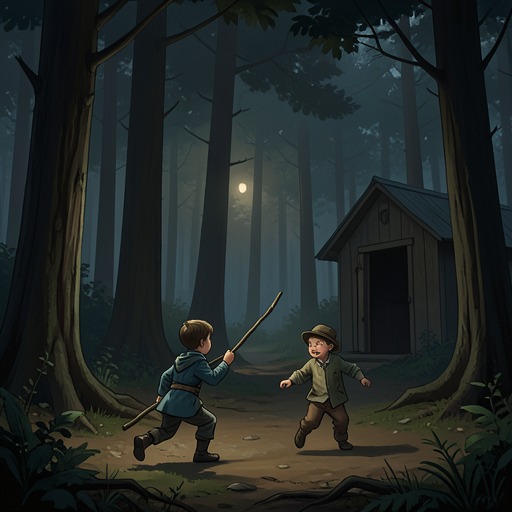
Before joining the search, Archie passes the little shed. He knows Rose is not inside, but looks anyway. He believes she has gone back into the woods, although he cannot explain how he knows this or bring himself to say it aloud. His knee then feels wrong and gives way; he bends over and begins to retch, bringing up water and a little blood. The sequence makes the search costly in immediate physical terms, without suggesting that Archie understands what is happening to him. His instinct about Rose and his inability to articulate it coexist with the sudden failure of his own body.
The adults are searching too, but the siblings’ movements sharpen the relationship’s stakes. Rose has earlier felt that her parents do not regard her as grown or take her seriously; now she is absent, and Archie acts on his conviction that she has returned to the woods. When Clay asks where Archie is, Amanda can hold only the fact of Rose’s disappearance in her mind. Archie has already gone to look. His care for Rose is therefore expressed not as certainty that he can protect her, but as a decision to follow the possibility that she needs to be found.
The Sibling Bond Under Pressure
The relationship is presented through a pattern of modest, concrete actions: Archie calls Rose along when he retreats to shower; later, he checks the shed despite knowing she is unlikely to be there, then goes toward the woods. Rose’s parallel movement is toward independence: she leaves the bed, rejects the reassuring explanation that the noise was thunder, and decides she should try to solve what she believes is wrong. The siblings do not have the same understanding of the crisis, and the evidence does not show them discussing it together. Their connection instead emerges through proximity, attention, and action.
The contrast between Archie’s hidden shame after the bang and his later willingness to go searching gives his early kindness added weight without turning it into a grand declaration. Likewise, Rose’s self-direction does not make her invulnerable: she is the child who disappears, while Archie is the brother whose body is already failing as he goes after her. The relationship’s significance lies in that unsettled reciprocity. Each is a child confronting something the adults cannot readily explain, and Archie’s repeated movement toward Rose makes sibling care one of the few intelligible responses available to him.