Civilizational Collapse and Collective Denial
Leave the World BehindCivilizational Collapse and Collective Denial is the novel’s account of a catastrophe that arrives not as a wholly unforeseeable rupture, but as the exposure of dangers people had repeatedly learned to live beside without responding to them. Environmental damage, political instability, and dependence on interconnected infrastructure form a long background to the blackout. As ordinary services fail, the crisis reveals both how much daily life relied on systems that had seemed invisible and how readily people had mistaken that reliance for safety.
Accumulated Warnings and Everyday Denial
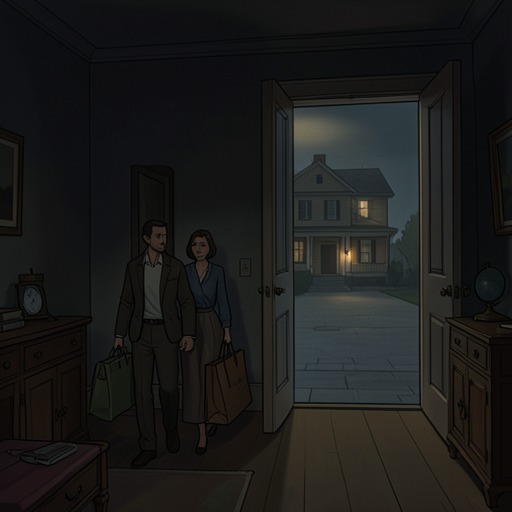
The warnings are already present in Clay’s thoughts when he returns to the house after becoming lost. He recalls rising seas, repeated discussion of Greenland, a particularly bad hurricane season, disease, and troubling political and economic signs. These concerns do not arrive as one coherent explanation for the emergency; they crowd together among ordinary obligations, including the imminent start of classes and the expected response from an editor at The New York Times Book Review. The juxtaposition makes the crisis feel continuous with the world Clay already knows, rather than cleanly separated from it. Even while fear makes him imagine unprecedented possibilities, everyday routines retain their claim on his attention.
The novel places that distracted awareness beside the accumulated evidence of environmental and political change. Amanda and Clay’s imagined winter trip to Paris turns quickly toward the threat of flooding: the Louvre had moved thirty-five thousand works of art to protect them from the Seine. But Amanda’s fear that a war might engulf the world still frames catastrophe as something recognizable, with national borders offering some kind of protection. The narrative widens beyond that expectation. In a confused international emergency, planes sent from Rome, New York, to meet another approaching from western Africa kill roughly four hundred people before reaching the borders. The episode resists a single, orderly account of what is happening; danger develops through overlapping events and failures of information, faster than familiar explanations can contain it.
Infrastructure and the Limits of Information
At the house, the first signs of breakdown arrive through devices that ought to clarify events. Amanda’s phone displays only a fragment of a New York Times alert reporting a major blackout on the East Coast of the United States; when she tries to open the news, the application fails. The screen is not merely a source of information that happens to be unavailable. Its partial message makes the emergency legible enough to provoke alarm, but not legible enough to explain or guide action.
The television offers a related failure. Ruth turns it on and finds the emergency broadcast system screen, a sequence of beeps, and no report. Amanda supposes that it may be a test, a small reassurance that cannot be verified. The household is left to interpret silence through guesses about what has gone wrong. As power and communications become uncertain, the systems that normally distribute news and organize public response cease to function as dependable authorities.
Water makes that dependence more immediate. G. H. explains that an electric pump fills the reservoir, so a power failure would also interrupt the supply. He understands that residents of upper Manhattan apartments will face dehydration after their water stops, although the family’s own power is still on. The house’s continued service offers temporary relief but not proof of safety. Later, as Archie is carried inside, the pool filtration system begins its scheduled cycle and marks ten o’clock. Its ordinary mechanical routine survives long enough to provide a time, an almost incidental measure of continuity amid the family’s uncertainty. The contrast between this functioning system and the wider loss of dependable services shows how partial and uneven the breakdown can be.
Family Vulnerability and Generational Responsibility
The crisis turns public warnings into intimate questions of protection. At night, Clay watches his sleeping children and reflects on the rising ocean, the future they may inherit, and the limits of parental care. He considers the previous generation’s dependence on plastics, petroleum, and money, while recognizing the helplessness of trying to keep a child safe in a world whose conditions cannot be controlled. Amanda, meanwhile, finds Archie hot and tries to determine whether this is fever, summer heat, or illness. The signs available to her are bodily and immediate, but they offer no clear diagnosis of what the family is facing.
The novel sets these private responses against a longer record of suffering and ecological loss. The deaths of Lebanon’s cedars, the disappearance of the river dolphin, renewed Cold War hostility, the discovery of fission, and boats capsizing with Africans are described as evidence that had been available all along. Phones repeatedly brought reminders of worsening conditions, yet information alone did not overcome the desire to look away. The failure is therefore not simply a lack of facts. It is a collective habit of treating each warning as separable from ordinary life until their accumulated consequences become impossible to set aside.
Collapse Beyond the Household
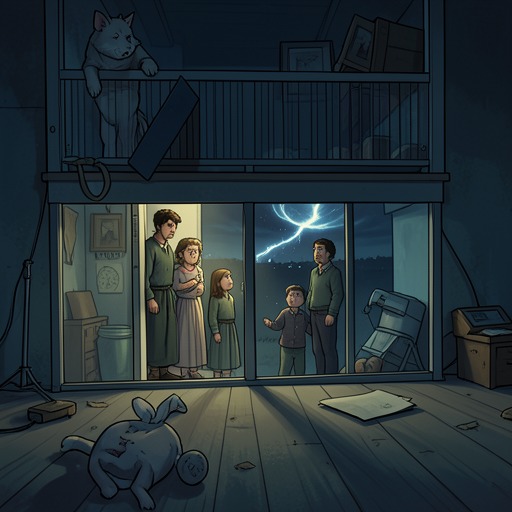
The crisis eventually exceeds the family’s immediate experience. In the morning, the narrative moves across different places and circumstances: some people try to flee, some do not know that anything is wrong, and some continue at jobs that will later seem useless. Governors declare states of emergency but cannot determine how to communicate them. Others attempt to preserve familiar routines or prepare for disruption, while the failure to communicate with satellites leaves even distant communities strangely cut off. These simultaneous responses make collapse uneven: the emergency is widespread, but knowledge of it and the ability to act are not shared equally.
In Brooklyn, residents drive toward the city without police to control their speed, while spoilage and uncollected garbage accumulate and trapped commuters become unclaimed dead. The urban breakdown gives physical consequence to the earlier failures of communication, electricity, and water. Elsewhere, the story records a storm’s destruction of a jail in Waycross, Georgia, where forty staff members had left fifteen hundred men exposed to the elements. The collapse does not erase existing inequalities; it magnifies the vulnerability of people already subject to neglect and confinement. At the same time, the narrative refuses to make moral virtue a guarantee of survival: the scale of the disaster exceeds the social judgments people had relied on to distinguish who deserved safety.
Significance and Narrative Perspective
Civilizational collapse here is both systemic and perceptual. The familiar world does not vanish at one instant: news becomes inaccessible, emergency broadcasting supplies sound without explanation, water proves dependent on electricity, and ordinary work continues in places where its usefulness has already begun to disappear. By moving between the family’s rooms and a wider social panorama, the narrative makes the crisis legible through mismatched scales—an unreadable phone alert beside global disruption, a child’s uncertain illness beside failing public systems.
The collective denial is not presented as a lack of every warning or as a single decision by a unified society. It consists of repeated acts of compartmentalization: a dangerous trend becomes background, an emergency screen may be only a test, and familiar routines seem capable of continuing because they have continued until now. The eventual breakdown exposes the cost of that reasoning. What had seemed distant and gradual is experienced at once as a loss of information, services, mobility, and confidence that institutions can protect anyone. The novel’s account of collapse thus links ecological and political warnings to the fragile infrastructure of daily life, showing how a society can possess abundant signs of danger and still fail to imagine the world those signs are describing.