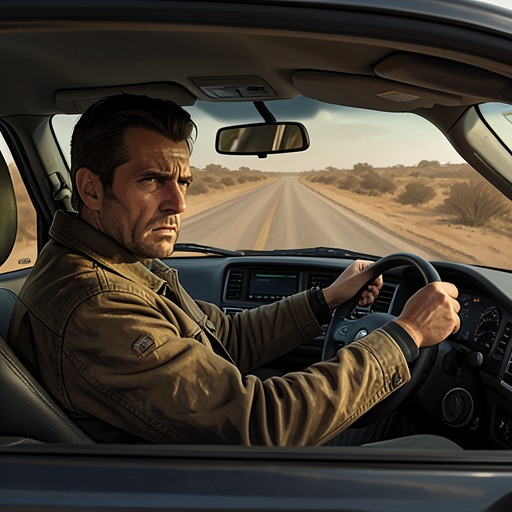
Clay drives into town for news
Leave the World BehindClay drives into town for news in an effort to turn helplessness into purposeful action, but the errand exposes the limits of his confidence: he becomes lost, cannot use his phone, and leaves an urgent encounter without understanding what the other person needs. The trip makes the search for information physical, while showing how little control Clay has over the failing systems on which he depends.
Purpose and Departure
The journey begins with Clay insisting that he should be the one to go. He wants to reassure the others and says that driving into town is the only way to learn what is happening. Although he presents the decision as a practical step toward getting to the bottom of the crisis, the narration also identifies his investment in being seen as capable and good. He wants to take charge, and the trip offers him a chance to cast himself in that role.
G. H. has already described information as essential to making choices and assessing risk. Clay nevertheless declines to involve G. H.'s friend and says he will seek out a newspaper or someone who knows more. G. H. does not join him, noting that Ruth may not approve. Clay tells the others to stay behind, partly because he worries about further driving and partly because he wants his departure to look considerate. His motives combine concern for the group with a desire to be its competent protector.
The Road and Its Disorientation
At first Clay proceeds in a self-consciously composed manner. He opens all four car windows, enjoys the dry heat and the change from gravel to asphalt, and drives slowly to make himself feel brave. He passes cultivated fields and an egg shack, but even familiar-seeming country details do not offer reliable guidance. He waits for the GPS to register, although he has recently found the route to the shore. His confidence that he knows what he is doing sits beside small signs that the journey is already beyond his command.
Clay stops to smoke, raises the windows, and checks his phone out of habit. It shows him nothing. As he drives on, the ordinary automatic quality of driving becomes part of the problem: he can keep moving without attending closely to where he is going. He realizes that he has reached a larger two-lane road but cannot be sure it is the intended one. The directions are in Amanda's notebook, back at the house, and he cannot simply reverse them in his head. What he regards as an obsolete skill becomes a concrete obstacle once the device and written directions are unavailable.
The landscape offers repeated fields, trees, and glimpses of roofs, but no firm orientation. Clay cannot tell whether turning back or continuing would be more sensible. He circles or retraces roads whose surroundings shift from familiar to strange, and on a dusty shoulder turns the car around. Looking from the other direction, he notices details he missed before, including the painted McKinnon Farms sign, a horse, and the remains of a burned building. Yet these observations do not restore his route. He passes possible turnoffs without the egg shack he remembers and begins to suspect that he may be searching for a landmark that is not on this road at all.
A Failed Search for Information
Clay's phone is still not working, and he recalls that discovering why it is unavailable was the purpose of the errand. That recognition sharpens the gap between his stated mission and his actual progress: he has driven out to demonstrate control, but cannot obtain information or reliably find his way. He reassures himself that he is only turned around, not truly lost, and keeps driving because he does not know what else to do. At McKinnon Farms, he pauses in the driveway to smoke, unwilling to continue down toward the buildings because doing so would mean admitting how worried he has become.
His sense of time is uncertain. He remembers checking the car display when he left and estimates that fourteen minutes have passed, then questions his estimate. He calculates the duration of his cigarette and uses the short total to persuade himself that he cannot really be lost. The effort to measure time becomes a way of managing fear rather than a dependable guide. The first day of the vacation already seems much further away than it is, and Clay feels a powerful desire to see his children. He considers abandoning the trip and returning to the city, but his decisions come late, after the uncertainty has accumulated.
The Encounter on the Road
After trying several turns, Clay sees a woman across the main road. She beckons him, and he stops and lowers the passenger window. She speaks rapidly in Spanish, appearing to have something urgent to communicate. Clay understands very little. He hears a word as beer when she is saying deer, and she also says words relating to a telephone and electricity, but he fails to grasp their significance. Her speech grows more urgent; she weeps and asks him a question he cannot understand or answer.
The encounter turns the communication failure from an inconvenience into a human crisis. Clay considers how a working phone might have let him try a translation tool, and whether he could have invited her into the car, but neither possibility becomes useful action. He is himself lost, and he fears her urgency without being able to interpret it. Her fear affects him even without a shared language: he recognizes that she is afraid and that he should be afraid too. The narrative makes the communication gap consequential not because Clay learns what she is saying, but because he understands enough to know that she needs something and he cannot provide it.
Clay apologizes, starts to close the window, and drives away quickly. He had initially meant to investigate the driveways, but now wants distance from the woman more than he wants to return to his family. The retreat contradicts the helpful, reassuring figure he hoped to be when he set out. The trip ends without news from town, without a restored phone connection, and without assistance for the woman. Its failure leaves Clay still separated from the people waiting at the house and more conscious of the limits of his ability to protect or reassure them.
Narrative Significance
The drive links the blackout's broad uncertainty to small, practical failures: a silent phone, inaccessible directions, roads without familiar markers, and words that cannot be understood in time. Clay's confidence is repeatedly asserted and repeatedly undermined by circumstances. Even routine skills, such as following a route or estimating how long he has been driving, lose their reliability when the systems that ordinarily support them are unavailable.
The road also exposes the difference between wanting to help and being able to help. Clay leaves with a stated plan to find information for everyone, yet his need to feel in control shapes the errand as much as concern does. When the woman seeks his attention, the same limits that have made him anxious prevent him from responding meaningfully. His departure is therefore not simply an unsuccessful search for news: it is a test of his self-image as protector, ending in uncertainty and withdrawal rather than mastery.