Clay’s failed attempt to investigate the blackout
Leave the World BehindClay’s failed attempt to investigate the blackout turns a practical errand into an encounter with fear, disorientation, and shame. He sets out hoping to learn what is happening, but never reaches town or finds an explanation. Instead, he loses his way, hears the noise that has already unsettled the household, and returns to the house with no information to offer. His delayed account of the trip makes the failure consequential: the family must reckon not only with an unknown crisis but also with how little any of them can establish about it.
Purpose and Uncertainty
The household has already received a fragmentary warning. Amanda’s phone displays a news alert from The New York Times reporting a major blackout on the East Coast of the United States, but the application will not open. The alert gives the crisis a name without supplying a usable explanation. Later, Ruth switches on the television, which shows the Emergency Broadcast System screen and emits repeated beeps but no news. Against this thin, frustrating background, Clay’s drive is an attempt to turn uncertainty into knowledge: he means to go into town and get to the bottom of what is happening.
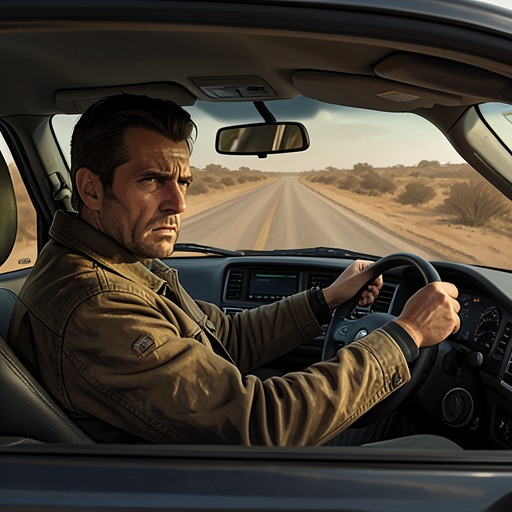
That purpose matters because the trip is not simply a failed journey. The family is trying to decide what can still be trusted, and information would give their fear some direction. Clay returns without having seen anyone or anything that might clarify events. His account eventually establishes that he drove down the lane, passed an egg stand, and thought he knew where he was going, only to realize he was wrong. He drove around and turned back, becoming genuinely lost before finding the road leading to the house. The ordinary landmark promises eggs, but it cannot guide him reliably through a landscape whose roads he thought he knew.
The Noise and the Turn Back
The unexplained noise interrupts Clay’s attempted investigation and changes its emotional stakes. In his recollection, he has started driving after stopping for cigarettes and gathering his thoughts. When the noise comes, his response is not a determined effort to discover its source: he slows the car and is overcome by the wish to be home. Clay recognizes the vanity in imagining himself as the family’s protector. He does not want to protect them so much as to be protected himself. Frustrated tears and a sense of being utterly lost replace the confidence implied by his errand.
Clay waits eight minutes, expecting the noise to return. It does, but this time over Queens, too far away for him to hear. The contrast does not make the sound easier to bear. Solitude makes it unbearable, yet so does the thought of other people facing it: crowds form in Queens, panic spreads, people run and weep, and the police barely attempt to maintain order. Clay’s experience thus shifts from private fear to a glimpse of public disorder without yielding any explanation of either. He has witnessed no cause and gained no practical intelligence; the noise remains a force that he can only endure and fear might recur.
Return and Concealment
After losing his way, Clay finds the turn he has been looking for and recognizes the road up the lane to the house. His arrival brings an abrupt reversal. A moment earlier he had considered bundling his family into the car and leaving; now the painted brick of the house seems familiar and welcome. He cries from relief, looks at the sky, the car, and the trees, then runs inside, already trying to recount what he knows. The homecoming restores a sense of safety, but it does not resolve the danger that drove him out.
When Amanda asks what happened, she holds his hand. Clay says flatly that he did not go into town. Pressed further, he admits only that he did not get very far before hearing the noise and coming back. He later explains that he had a cigarette, then another, and was gathering his thoughts before he started driving. His incomplete account is a lie born of shame, not evidence that he has discovered something and is withholding it. Amanda had been waiting and feared he was dead; her anger at his return without news reflects both that alarm and the practical disappointment of learning that he has nothing to help them understand the situation. G. H. tries to keep the conversation focused on what they have actually learned.
The Later Admission
The truth becomes harder to keep concealed when the family considers another journey. Amanda asks Ruth to draw a map because the GPS is no good, and the plan is for everyone to go together. In front of his son, Clay puts a hand on his shoulder and admits that he got lost before. He then gives the fuller account: he had set out to investigate, passed the egg stand, misjudged where he was, drove around, and could not understand how he found his way back. He describes hearing the noise and fearing he would lose his mind before the correct turn appeared.
This disclosure changes what the family can assume about a proposed trip. Amanda initially hears the confession as a relief: Clay has not had the chance to encounter anyone or anything that could make the danger more concrete. She can still imagine explanations such as an industrial accident or controlled explosions, and that the power loss might have an ordinary cause. But Clay’s account also undermines confidence in the idea that the route is simple or that he can guide them by memory. His admission accompanies the suggestion that he can show them the way and that they should all go, turning private embarrassment into information the family needs to weigh together.
Significance
The failed trip exposes the difference between access to a signal and access to knowledge. A news alert appears on Amanda’s phone, but its application will not open; the television produces only beeps. Clay travels in search of answers and returns with none. Even the household’s continued electricity offers little certainty: G. H. explains that Manhattan water depends on an electric pump filling a reservoir, so a power failure would also threaten the water supply. The family’s apparently intact house and utilities are not proof that the wider systems they rely on will continue to work.
Clay’s drive also recasts protection as vulnerability. He leaves under the pressure of wanting to act, but the noise and his disorientation reveal that he cannot make himself a dependable rescuer simply by taking the car. His relief at seeing the house and his shame at admitting what happened are both understandable responses to a crisis in which ordinary competence no longer guarantees control. Around him, events are already widening beyond the family: the narrative describes people in different places facing breakdown unevenly, some unaware of it and others trying to flee or preserve familiar routines. Clay’s small, unsuccessful journey brings that larger instability down to the scale of a wrong turn, an unanswered alert, and a frightened return.