East Coast Blackout
Leave the World BehindThe East Coast Blackout begins not with a clear account of its cause or extent but with failed attempts to learn what is happening. A phone can display the words of a headline without opening the report; a television can summon the Emergency Broadcast System without providing news. As the power failure spreads beyond the characters’ immediate view, the novel makes visible the interdependence hidden inside ordinary routines: when electricity falters, communications, water, transport, and emergency services become uncertain together.
First Reports and Uncertainty
While the adults talk in the kitchen, Amanda checks on Archie and Rose, then pauses in the dark hall with her cell phone as a light. Its recognition feature does not work in the darkness. When the screen does wake, it shows a news alert from The New York Times: a major blackout has been reported on the East Coast of the United States. Amanda can make out only a few words. Tapping the alert does not open the story; the phone remains on a blank white screen. The alert gives her a small informational advantage over the Washingtons, but not an explanation.
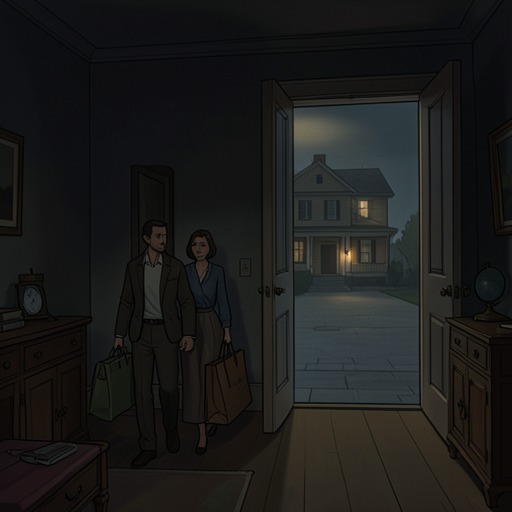
The Washingtons, returning from New York City, describe a journey through darkness. They had not discussed what they were seeing in the car because they were afraid. G. H. identifies a blackout as the likely explanation, adding that the couple live on the fourteenth floor. On the drive, they saw nothing but darkness until the glow of their own house appeared through the trees. That light seemed to offer safety even though it could not explain why the house still had power while the city did not. The contrast between their dark journey and the illuminated house is an early measure of how unevenly the outage is experienced.
Amanda names the event before G. H. has explained it, using the alert’s fragmentary information. Clay is surprised that the crisis is a blackout rather than something worse and initially treats the word as if it settles the matter. The adults reach for possible explanations: wind, hurricane season, fallen branches, or trouble in the city. None is established. Amanda points out that the lights still work in the house, while G. H. wonders at their continued power. The intact lights do not resolve the uncertainty; they make the boundary between functioning and failed systems harder to understand.
Light, Broadcasts, and Broken Information
The house’s electrical supply becomes a focus of attention. After a sound of wind against the kitchen window, the lights flicker four times, then hold. The four adults breathe in sharply and exhale when the illumination continues. The moment turns an ordinary fixture into evidence to watch: the lights may be on, but their persistence feels contingent. Clay imagines the power going out and tries to reassure himself that the house is far from the city, while recognizing that electricity is not something the family can take for granted.
The television offers no firmer account. Ruth switches it on to the Emergency Broadcast System: a blue screen, white lettering, beeps, and a quiet hiss. The signal repeats without delivering news or reassurance. Amanda suspects it may be a test, but the possibility does not answer whether anyone is transmitting information about the emergency. The broadcast system is present as a form, yet its expected function—communicating useful instructions—remains out of reach.
Later, Amanda wakes Clay and shows him four alerts on her phone. One repeats the report of a major blackout on the East Coast; another reports Hurricane Farrah making landfall in North Carolina; a third announces an East Coast power failure; the last is followed by nonsensical letters. The sequence enlarges the apparent scale of the crisis while making its causes and connections less legible. The phone can collect headlines, but attempts to open them still fail. The resulting information is neither wholly absent nor adequate: enough arrives to suggest a regional emergency, while the machinery needed to clarify it cannot connect.
The Hidden Dependencies of Power
The blackout’s consequences are not confined to dark rooms. G. H. realizes that water supply depends on electricity: an electric pump fills the reservoir serving the upper apartments in Manhattan. If the power fails there, the water does too. He imagines residents on the highest floors becoming delirious from dehydration in the days that follow. The house’s working lights and the city’s interrupted supply thus mark more than a difference in illumination; they point to the dependence of basic necessities on systems that are usually unnoticed.
The novel places that dependence alongside failures elsewhere. It describes machines that support life ceasing to function after backup generators fail in Miami, Atlanta, Charlotte, and Annapolis. A woman named Deborah dies after spending six hours trapped on a stalled F train beneath the Hudson River, while other passengers pass her body. Delta loses a plane between Dallas and Minneapolis amid disruption to air-traffic control. A pipeline spills crude oil in Wyoming, and a television star dies after being struck by a car that ambulances cannot reach. These incidents vary in setting and immediate circumstance, but together they show what happens when power and the systems organized around it cease to provide their ordinary protections.
The accounts do not establish one confirmed cause for every failure. The characters consider weather, the blackout, and an earlier noise, while the wider narration entertains the possibility of an attack and the difficulty of proving responsibility through broken wires and networks. Elsewhere, people cannot communicate with satellites; state emergencies are declared without a working means to tell the public. The breakdown is therefore also a breakdown of verification and coordination. A disaster may be reported, speculated about, or declared, but those acts cannot guarantee that information reaches the people who need it.
Uneven Continuity and Wider Significance
Against these failures, small routines continue. At the Washingtons’ house, the pool filtration system starts its scheduled cycle and tells G. H. that it is 10:00 a.m. Its cheerful whir and gurgle register a functioning mechanism amid Archie’s medical crisis. The detail does not suggest that the larger emergency has passed; instead, it shows how a local system can keep time while the structures beyond it become unreliable.
The wider picture is uneven too. Some people pack cars in search of safety, some continue going to work, and some do not yet know anything is wrong. Governors declare states of emergency but cannot work out how to communicate them. People who trusted the system begin to question that faith, while others who stockpiled supplies feel vindicated. The outage is not a single, uniformly experienced moment: it arrives through different degrees of knowledge, access, and exposure, and its effects continue to multiply beyond what the characters can see.
The East Coast Blackout consequently functions as both an unfolding emergency and a test of the assumptions that make ordinary life feel secure. Electricity is not merely a convenience in the novel; it is bound to the flow of news, water, medical support, transport, and public response. A headline that will not open and a broadcast that will not inform are small versions of the larger crisis: systems remain recognizable even as their promises fail. The surviving lights at the country house offer temporary relief, but they cannot establish what has happened, how far the failure extends, or what will keep working next.