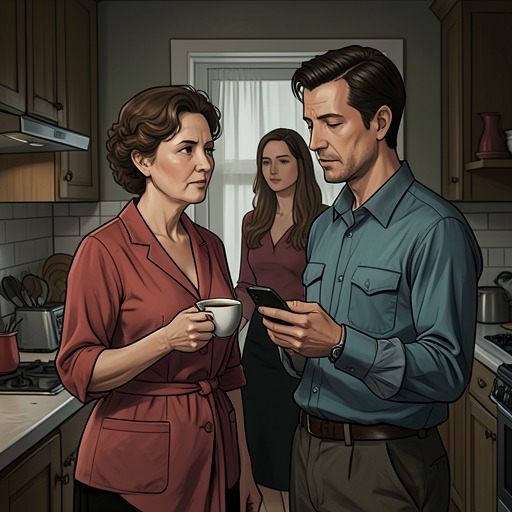
George and Ruth’s marriage through the blackout crisis
Leave the World BehindG. H. (George Washington) and Ruth’s marriage through the blackout crisis is shown not as an escape from fear but as a partnership built from familiar habits, mutual reading, and imperfect reassurance. Decades together allow them to anticipate each other’s gestures; they do not, however, make them equally willing to name what is happening. As the lights remain out and communication fails, their shared routines become both a refuge and a measure of how much ordinary life has been interrupted.
A practiced partnership under pressure
When G. H. and Ruth arrive at the house and meet Clay and Amanda, the couple present themselves almost as a unit. Ruth corrects G. H.’s apology to include them both, in a formulation so practiced that Clay takes it as evidence they are married. The small adjustment captures a habit of speaking for one another, though it also leaves Ruth with her own alertness to the strangers’ presence. Amanda remains wary; Ruth’s composed manner does not make the encounter feel entirely safe to everyone.
G. H. takes responsibility for explaining why they came. He treats the explanation as a husband’s task, the sort of practical burden he assumes another husband will understand, and tells Clay that they had tried to call but had no service. Clay responds that reception in the area is often poor. G. H. allows the point while making clear that he does not believe the present failure is ordinary bad reception. His manner keeps the exchange civil, but his knowledge of the crisis is not yet something he is prepared to lay out fully.
Their position in the house makes the question of belonging newly visible. Ruth grips the railing and insists on the fact that it is her house; G. H. answers that the visitors paid for it and that he cannot simply put them out. His reluctance is not just courtesy. He privately recognizes that something is truly wrong and does not want to disclose how strongly he had anticipated trouble. The couple must therefore manage hospitality and danger at once: Ruth asserts their claim to the home, while G. H. accepts the guests’ presence without pretending that he has control over the larger emergency.
The house as memory and shelter
The house carries the history of their family, especially through the basement finished for Ruth’s mother. The elderly woman had moved in with them at ninety after the Chicago winters became too difficult and there was no one left there to keep watch over her. Ruth arranged the sale of her mother’s house and the distribution of its proceeds among her siblings, then made a place for her in the guest room. The basement was designed with her needs in mind, including an exterior ramp that would have spared her the stairs. She died before she could visit it. In the blackout, the rooms intended as care for one generation instead offer shelter to the couple and their unexpected guests.
G. H. leads Ruth downstairs, turning on lights as he goes and warning her to watch her step. The passage unsettles his assumptions: although he had never feared darkness as a boy, he now feels how strongly light signifies safety. Ruth, meanwhile, remembers the house through its furnishings and the possessions they normally unlock at the start of a stay: swimsuits, sunscreen, a picnic blanket, pantry staples, drinks, and the tools of preparing familiar meals. Their usual ritual of reclaiming these objects and moving comfortably through the house has been displaced by uncertainty. When she admits that she is scared, G. H. answers with the immediate fact of their location and with the store of canned tomatoes he believes could last for months. His reassurance is practical, but its certainty is greater than the evidence warrants.
Ruth’s own efforts to make the basement livable remain precise and domestic. She showers, changes into clothes left in a dresser, and is uncomfortable at the thought of the people upstairs seeing her in them. Fresh towels and clean bedding offer small forms of order; they cannot restore the easy intimacy with the house that the couple usually expects. The crisis has not erased their habits so much as made each one conspicuous, revealing how much their sense of home depends on ordinary access to possessions, privacy, and light.
Fear, concealment, and disagreement
Their responses to the blackout differ most clearly in what they say aloud. G. H. tries to imagine a harmless explanation that might restore confidence, even picturing a ridiculous news report about raccoons knocking out power or a junior contractor making a mistake. He thinks of the market recovering and of people who might profit from having bet against confidence. But his private reasoning is much darker. He understands electricity as a commodity and considers a New York City blackout too consequential to dismiss as a normal disruption. The curve he follows in his work had warned him against complacency; to him, the crisis feels less like a surprise than a promise fulfilled.
At bedtime, Ruth asks what he thinks has happened and makes clear that she does not want to be humored. G. H. tells her that it will become something they laugh about once they learn the explanation, while the narration establishes that he does not believe this. His lie is intended as comfort, not proof that he feels secure. He is thinking of their ordinary home in Manhattan, the darkened city seen from above, and the distant observers who might have a clearer view than those on the ground. The scale of those thoughts stands against his mild prediction of an amusing explanation. Distance may clarify the spectacle, but it offers the couple no immediate answer.
Ruth later challenges the idea that fear can be dismissed as hysteria, pointing out that G. H. was frightened too. He agrees that something happened but retreats into a general observation rather than naming its meaning. She brings him coffee; he accepts her presence, yet the exchange also shows her refusing to let his composure define what they both experienced. Their marriage permits blunt recognition as well as protective evasion. Ruth knows him well enough to hear the gap between his explanation and his fear, and G. H. knows her well enough to recognize that she is not asking merely to be soothed.
Family concern and mutual care
Ruth’s fear has a particular focus: Maya and the boys. At sixty-three, she reflects that she was not raised simply to do what was expected, but to persuade men to do what she wanted. The thought places her present appeal within a longer understanding of how women exercise influence. She confesses her fear directly and worries that her daughter is probably trying to call. G. H. puts a hand on her shoulder and identifies Maya as their daughter, then asks Ruth not to worry about that just now. The gesture acknowledges her distress even as his words try to set a limit on it.
That limit cannot settle Ruth’s concern. She can keep wider fears about the ice caps and the president at bay by concentrating on the smaller, intimate scale of her own life, but the blackout has reached that scale too: she cannot be sure she can contact her daughter. The marriage’s central pattern in these scenes is therefore not that one partner supplies certainty to the other. G. H. offers shelter, food, and a deliberately hopeful account; Ruth brings practical care, challenges evasions, and names the family she fears for. Their decades together give them ways to protect one another, but the crisis makes clear that neither can promise the safety the other wants.