Good Samaritan Principle
Leave the World BehindThe Good Samaritan Principle takes shape as a choice to offer shelter when the blackout has made ordinary plans unsafe. Clay uses the principle to justify letting G. H. (George Washington) and Ruth stay in the vacation house, even as Amanda questions who they are and whether they belong there. The episode presents assistance not as a settled virtue but as a decision made amid fear, incomplete knowledge, and assumptions about race and class.
The Decision to Offer Shelter
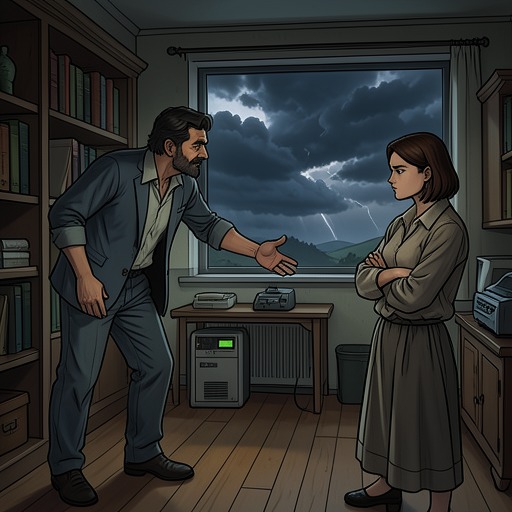
G. H. explains that he and Ruth cannot drive into the city or climb fourteen flights to their home, so they have come to the house they own in search of safety while they try to understand what is happening. Clay accepts their account and says he understands. Amanda is less certain: she wonders whether the arrangement could be a con and whether the couple might be staff rather than the owners. She points to the keys and an envelope G. H. took from a drawer, but interprets these details as possible tricks rather than proof.
Clay does not claim to know the full story. He acknowledges that he is poor at recognizing faces and reflects on his difficulty recognizing Black faces in particular. Even with a sharp sliver of doubt, he argues that the couple should be allowed to stay because it is the right thing to do. The principle therefore operates without certainty: Clay chooses to help before he can resolve every suspicion, while Amanda’s concern for the children makes the cost of misplaced trust feel immediate.
Virtue, Self-Image, and Material Motives
The decision is framed as more than a calculation of risk. Clay tells Amanda that they are going to be Good Samaritans, turns off the television, and stands, marking a shift from discussion to action. Yet the narration complicates the moral language: Clay understands that invoking what is right will matter to Amanda, who cares about being the kind of person who acts morally. The text observes that morality can become vanity, exposing the possibility that generosity may also serve a person’s image of themselves.
Money shadows the choice without being made its stated reason. Clay has wondered whether a thousand dollars could be a ruse, and when he commits to letting the couple stay, he chooses not to mention that sum. The episode does not establish that money determines the decision; instead, its presence makes the family’s motives less pristine than the label of Samaritan might suggest. Their help is real, but the scene leaves room for mixed motives and unresolved caution.
Recognition and Racialized Suspicion
The encounter begins with an unexpected visitor at the door. The porch light reveals a Black man in his sixties, dressed in a rumpled blazer, loosened tie, and striped shirt, holding up his hands in a gesture that could be conciliatory or defensive. The narration notes how quickly an observer might read him as harmless or reassuring, and how familiar such a gesture would be to Black men of his age. The first act of judgment is already shaped by the conditions under which he must present himself to strangers.
Amanda’s doubts sharpen when she remembers the formal email address associated with the house. She had not pictured its owners, and recognizes that the image she might have formed would have been wrong. Her sense that the house did not seem like one where Black people lived feeds her suspicion that G. H. and Ruth could be a handyman and maid. The decision to help thus emerges from a scene in which access to the house and credibility as its owners are being assessed through racialized expectations. Clay’s willingness to act against his own uncertainty offers a counter to those assumptions, but it does not erase the suspicion that precedes it.
The Limits of Good Intentions
The principle does not guarantee that people will understand one another or respond effectively to need. Later, while lost, Clay encounters a woman speaking rapidly in Spanish. He can tell that she is distressed and trying to communicate something urgent, but he does not understand her; panicked and focused on finding his family, he cannot make sense of her message. The scene contrasts the earlier, deliberate offer of shelter with a moment when helpful action is impeded by language, fear, and a narrowed attention.
Nor does the sheltering decision dissolve the vulnerability that surrounds the household. G. H. reflects that he and Ruth have kept to themselves locally and worries how people in the area will regard them as Black outsiders associated with wealth. The Good Samaritan Principle names an action Clay chooses, not a reliable social order in which trust and assistance are assured. Its significance lies in that distinction: doing what seems right can begin with an uncertain act of hospitality, while the fears and inequalities that make such hospitality difficult remain in place.