Light and darkness
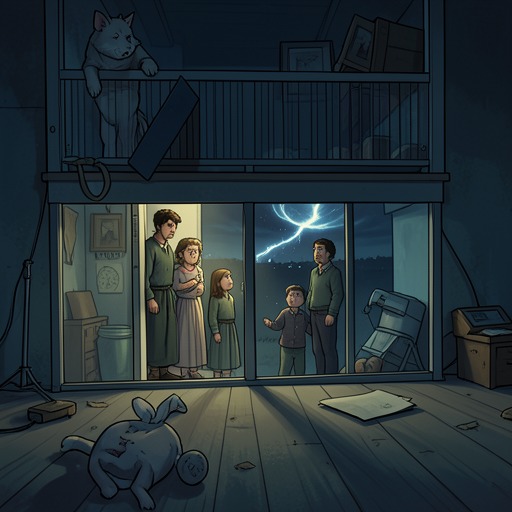
Leave the World BehindLight and darkness is a recurring motif through which the novel makes the blackout’s threat tangible before anyone can explain it. Light initially seems to hold danger at bay, but its flickers and its dependence on failing systems expose the insecurity beneath that comfort; darkness, meanwhile, is not merely an absence of illumination but a rupture in the ordinary signs by which people orient themselves and trust the world.
Light as a fragile reassurance
At the Washingtons’ house, the power remains on even as news of a major blackout on the East Coast of the United States reaches Amanda through a faint alert from The New York Times. She has to use her cell phone as a light in the hall, where it fails to recognize her face. When its screen finally wakes, the alert appears, but the application will not open. The phone offers a fragment of information and then becomes a blank, unresponsive surface. Its light helps Amanda move through the house, yet it cannot deliver the fuller explanation she wants.
In the kitchen, the four adults look toward the pendant lights after Amanda points out that the lights are still working. Their attention turns electricity into something visible but not understandable: its presence offers no guarantee about its cause or duration. Wind strikes the window, and the lights flicker four times. The brief disturbance prompts an involuntary intake of breath; when the lights hold steady, the group exhales. The episode gives illumination a double meaning. It does keep the night outside for the moment, but the repeated flicker also makes the household feel that its safety could depend on a signal no one knows how to read.
Darkness, contrast, and uncertainty
Ruth’s reflection on darkness emphasizes how rarely people encounter it without some counterpoint: starlight, light leaking beneath a door, or the glow of an appliance usually marks its edges. Darkness is legible because a little light lets people recognize it as darkness. In the blackout, that familiar contrast becomes precarious. The motif therefore concerns not only whether a room is lit but whether anyone can interpret what they see and distinguish a temporary disturbance from a larger change.
The emergency broadcast screen sharpens the problem. Ruth switches on the television and finds a vintage blue field carrying the words identifying the Emergency Broadcast System. Beeps repeat over a quiet hiss, but no report follows. The screen is illuminated, and the broadcast apparatus appears to be operating, yet neither delivers usable news nor reassures the people gathered to watch it. The contrast between the visible signal and the absent message echoes Amanda’s phone: devices still glow, but their ordinary promise of connection and explanation has weakened.
Light, safety, and hidden infrastructure
When G. H. leads the group downstairs, he switches on the lights as they go. He recognizes, to his own surprise, how strongly light has come to signify safety and darkness its opposite. Ruth grips the railing and insists on the house as her own, while G. H.’s tenderness in warning her to watch her step makes the practical use of light part of their care for one another. The scene also unsettles his earlier confidence: even someone who had not feared darkness as a boy now feels its changed meaning in a house where the power’s persistence cannot be taken for granted.
The apparent solidity of illumination depends on networks beyond the room. G. H. has imagined the planes over Manhattan as the city goes dark, then the satellites photographing them, and the crew aboard the space station looking down from farther away. That widening sequence makes the blackout visible at increasingly distant scales, while also underlining how little the people in the house can know from their position on Long Island. The lights overhead do not tell them whether the city is safe, what the satellites can see, or what the event means. G. H. privately recognizes that this is not an ordinary fluctuation in the market; nevertheless, he tells Ruth that they will laugh about it when they learn what happened, a reassurance he does not believe.
The crisis also threatens forms of infrastructure that light can conceal. G. H. explains that Manhattan’s upper-floor water supply depends on an electric pump filling a reservoir. If power fails, water will fail too, and residents in the highest apartments may become delirious from dehydration in the following days. At the country house, the electricity still works, and G. H. credits the well-made building even though he knows that is not the real explanation. The connection between power, water, and bodily survival makes the household’s lit rooms less a refuge than a temporary point in a vulnerable system.
From domestic signals to a changed world
Later, when Archie is brought inside after choking or seizing, G. H. leads the awkward ascent up the wooden steps. The pool’s filtration system starts its scheduled cycle, its whir and gurgle marking ten o’clock in the morning. That familiar machine continues to keep time even amid the boy’s alarming condition. Its cheerful regularity stands against the uncertainty surrounding his body: machinery can still perform its routine, but routine no longer guarantees that the larger world is intact.
The perspective eventually expands beyond the house and its working lights. As Rose walks through the woods, the narration ranges across places where people do not know what is wrong, cannot communicate with satellites, or continue jobs that will prove useless. Others try to flee, declare emergencies without being able to tell people, or discover that their confidence in the system was naive. The passage places those unequal experiences beside Rose’s continued movement through the trees. Light and darkness thus cease to be simply the difference between a powered house and a dark city: they become part of a wider divide between what people can perceive, what they can communicate, and what they are prepared to acknowledge. The motif’s central tension is that light can provide momentary orientation without providing knowledge, while darkness reveals how much safety had rested on systems people could not see.