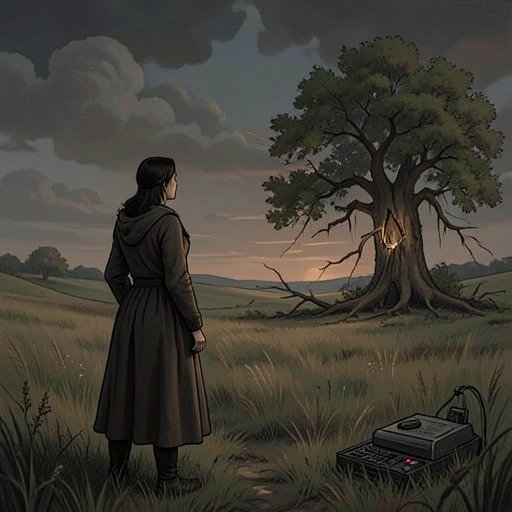
Long Island
Leave the World BehindLong Island’s countryside gives the crisis a deceptively sheltered setting: a house, familiar roads, and farmland that seem to promise refuge, yet offer little understanding of what is happening beyond them. The island’s quiet becomes meaningful in itself, interrupted by a vast aerial disturbance and shadowed by signs that the emergency extends beyond human experience.
Setting and Isolation
The Washingtons’ house stands amid roads and open fields that G. H. (George Washington) and Ruth have treated as their own place without learning much about the people around it. When G. H. (George Washington) and Clay set out for help, G. H. (George Washington) tries to make the unfamiliar route legible by marking a bend and McKinnon Farms on a map. The gesture exposes how little he knows of the countryside he occupies: he cannot say whether the McKinnons still run the farm bearing their name, and he and Ruth had not gone around to meet the neighbors after buying the house.
That distance is also social. G. H. (George Washington) imagines how local people might regard Black strangers arriving in an $80,000 car, and recalls that he and Ruth have felt conspicuous and tense enough to avoid stopping at the grocery store or gas station. The house offers physical shelter, but not uncomplicated belonging; in G. H. (George Washington)’s eyes, the beauty of the place cannot erase his distrust of a community he does not know.
The Sound Over the House
The island’s apparent quiet is broken by a noise so immense that the narrative describes its reach as roughly fifty miles across. Ruth has noticed that the usual traffic—planes and helicopters—is absent, and G. H. (George Washington) agrees. Against that silence, the sound prompts speculation that it might be a sonic boom. The memory of a Concorde flight taken for their fifteenth anniversary gives the possibility a familiar reference point, but the event is far beyond an ordinary holiday recollection: aircraft dispatched from Rome, New York, have diverted from their usual northward route toward the open sea to intercept something approaching the nation’s eastern flank. The cause remains unidentified.
The noise also joins the house to a much larger emergency without clarifying it. Its scale turns the sky above a small domestic refuge into a site of national danger, while the absence of routine air traffic makes the disturbance feel more—not less—unsettling. Long Island’s distance from the apparent interception does not protect its residents from the sound or from the uncertainty it carries.
Roads, Return, and Uncertainty
For Clay, the countryside’s roads become an obstacle and then a way back. During his disoriented drive, he slows the car and waits eight minutes for the noise to return; when it sounds again over Queens, it is too distant for him to hear. The contrast between solitude and crowds does not settle him: the sound is unbearable alone, but elsewhere people gather, panic, run, and weep as the police barely attempt to respond.
Clay eventually recognizes the route by a sign promising eggs and the familiar painted brick of the house. His immediate relief reverses his earlier determination to bundle his family into the car and leave. On the way back, he mentally gathers fragments of the wider crisis—rising seas, a particularly bad hurricane season, disease, and political and financial instability—but these remain disconnected reports, not an explanation. The return to a recognizable place restores direction without restoring knowledge.
Wildlife as a Warning
The countryside also reveals the crisis through animals. Danny distinguishes the deer he saw from an ordinary family group: what he witnessed was a migration, possibly a hundred or two hundred animals at first glance, with many more obscured among the trees. The local scale is far greater: the county has around 36,000 deer, and Danny’s sighting is one part of a mass movement. The deer Rose had seen are not the same animals, but they too are on their way to join them.
The migration is presented as both a disaster response and an indicator of disaster, a pattern visible to people who know how to read it even when the cause remains unknown. Clay considers mentioning the flamingos the family had seen the previous night, but decides that doing so would sound like one-upmanship. That withheld detail links the deer to a broader disturbance in animal life without turning either sighting into an explanation. On Long Island, wildlife registers a change that the people can observe but cannot yet interpret.